Scientists reveal structure of new botulism nerve toxin subtype
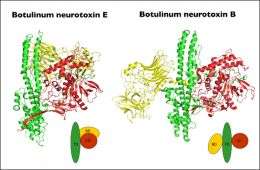
(PhysOrg.com) -- Scientists at the U.S. Department of Energy's (DOE) Brookhaven National Laboratory have determined the atomic-level structure of a third subtype of botulinum neurotoxin — a deadly toxin produced by certain bacteria that causes the disease botulism, and is also used in cosmetic and therapeutic applications such as reducing wrinkles and calming a hyperactive bladder. The detailed structure, published online December 22, 2008, by the Journal of Molecular Biology, reveals a unique arrangement of the active components that may help explain why botulinum neruotoxin subtype E (one of seven distinct subtypes) is faster-acting than other subtypes previously studied at Brookhaven Lab — and may have implications for improving vaccines and/or therapeutic agents.
"Understanding the differences among the seven botulinum neurotoxin subtypes is particularly imperative at a time of heightened concern about the potential use of these toxins as bioterror weapons," said Brookhaven biologist and lead author Subramanyam Swaminathan, who has conducted extensive research on botulinum neurotoxins supported by DOE, the U.S. Army, and the National Institutes of Health. Although experimental vaccines administered prior to exposure can inhibit the neurotoxin's destructive action, no effective pharmacological treatment exists.
All seven neurotoxin subtypes cause their deadly effects using a common mechanism, with each step being activated by a different portion, or domain, of the toxin protein. First the neurotoxin binds to a nerve cell; then it moves into the cell; and then it cleaves specific proteins that block the release of neurotransmitters, the chemicals nerve cells use to communicate with one another and with muscles. Without that communication, muscles, including those used to breathe, become paralyzed.
"Blocking any of these steps could thwart the toxins' deadly action," Swaminathan said. "But to do that, we need to understand the details of the proteins' structures."
Swaminathan and his team had previously analyzed the molecular-level structures of various fragments of botulinum neurotoxin subtypes A to F, and that of the whole neurotoxin B, using x-ray crystallography at the National Synchrotron Light Source (NSLS) at Brookhaven Lab. In this technique, scientists beam high-intensity x-rays at a crystalline sample of the protein and measure how the x-rays scatter off the sample to locate the positions of individual atoms.
These studies revealed that in subtypes A and B, the three domains were arranged in the same way: with the binding and protein-cleaving domains "flanking" a longer central region known as the translocation domain, essential for moving the toxin into the cell.
"Because the genes that code for these proteins have a large degree of similarity and all the subtypes incapacitate nerve cells in a very similar way, many biologists had assumed that all seven botulinum neurotoxins would have a similar structural arrangement," Swaminathan said.
The current study of botulinum subtype E, also conducted at the NSLS, disproved that assumption, taking the scientists by surprise. Instead of the flanking arrangement, the binding and protein-cleaving domains of subtype E are both on the same side of the translocation domain. In addition, while all other subtypes are made of two protein chains, subtype E is a single-chain molecule.
"This arrangement may have an effect on translocation, with the molecule strategically positioned for quick entry into the cell," Swaminathan said. Though he emphasizes that further confirming research is essential, this could be a plausible explanation for why botulism caused by subtype E sets in faster than that caused by other subtypes.
This finding may help scientists develop faster-acting vaccines and therapeutic agents.
For example, in the treatment of hyperactive bladder disorders, botulinum neurotoxin subtype A is currently used to inhibit neurotransmitter release and control bladder muscles. But it can take days or a week for the drug to be effective. A faster-acting neurotoxin might improve the response.
Additionally, patients sometimes develop resistance to botulinum treatments, developing antibodies that break down the toxin. So having an additional subtype for therapeutic use could be of benefit in situations where treatments must be repeated.
Finally, considering the threat of botulinum neurotoxin being used as a bioterror weapon, Swaminathan said, "The finding of a significant variation in the structural arrangement of subtype E also makes it clear that we must study the structures of the four remaining subtypes to gain a better understanding of their individual characteristics so that appropriate countermeasures can be developed for all seven forms."
Provided by Brookhaven National Laboratory


