Microscopic meteorites show early life on Earth faced rain of rocks
December 22, 2008 Microscopic meteorites show early life on Earth faced rain of rocks

Enlarge

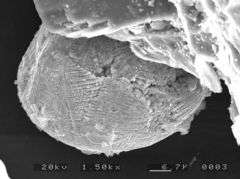
Micrometeorite, a hundredth the size of a grain of sand, dissolved out of limestone from Durness, NW Scotland. The micrometeorite landed nearly 500 million years ago during a period of intense meteorite bombardment - courtesy of Ian Dredge, University of Aberdeen and Royal Holloway University of London

(PhysOrg.com) -- Microscopic meteorites found in Scotland have unveiled major clues about a catastrophic event which dramatically altered the Earth’s surface nearly 500 million years ago.

The evidence shows that life at this time, which was restricted to the seas, faced the consequences of an event far out in space.

Recent studies in Sweden have revealed that a massive collision in the asteroid belt between Mars and Jupiter resulted in thousands of meteorites landing on the Earth.

Studies by experts from the University of Aberdeen have now uncovered tiny remnants of meteorites, smaller than a grain of sand, within rocks exposed along the shore near Durness, which they believe can be tied to this event.

The find has confirmed previous scientific speculation, that this meteorite shower was so vast in size that it affected locations across the globe including Scotland.

The study, led by Professor John Parnell from the School of Geosciences at the University of Aberdeen, has also shown that the meteorites falling to Earth may have been responsible for large earthquakes and tidal waves throughout the world.

The research, which has been published in Nature Geoscience this month, has revealed that in locations from China to the Yukon and Australia to Norway, large blocks of rock tumbled down slopes from shallow to deep water.

Pieces of rock the size of a football stadium also went sliding down hillsides in Korea, Argentina and the English Lake District.

These findings will now help scientists to investigate if there is any connection between the meteorites falling and the diversification of underwater species which took place around the same period.

Professor Parnell said: "We tested the piece of rock in Durness by dissolving the limestone in acid which allowed us to detect meteorites, smaller than can be seen by the naked eye. This confirmed that 470 million years ago these enormous meteorites fell in a wide span of locations across the globe – including Scotland. This is the first time we have been able to prove the mammoth scale of the event and just how many geographical locations felt its impact.

"Our research has also pinpointed that the meteorites falling caused earthquakes and tidal waves to take place at the edge of many continents. Records show that the underwater life which existed on Earth at this time became a lot more diverse directly after this major event. Any connection between these occurrences is not clear, but our findings will help us to investigate and potentially pinpoint how it happened."

Provided by University of Aberdeen


print this article email this article download pdf blog this article bookmark this article     Stumble it Digg this share on Facebook retweet share on Reddit add to delicious
Rate this story - 3.9 /5 (9 votes)

Rank Filter

Move the slider to adjust rank threshold, so that you can hide some of the comments.


Display comments: newest first

  • tkjtkj - Dec 23, 2008
    • Rank: not rated yet
    Re: "The find has confirmed previous scientific speculation, that this meteorite shower was so vast in size that it affected locations across the globe including Scotland.

    http://www.physor...713.html "

    There is a very large difference
    between the words "confirmed" and
    "supported" !!!! Where are our
    scientists being trained??
    Missing this critical point is
    tantamount to admitting to having
    a grossly distorted view of the
    methods of science. It creates
    confusion, misleads the public,
    and is to be condemned.

    tkjtkj@gmail.com


December 22, 2008 all stories

Comments: 1

3.9 /5 (9 votes)
  • Stumble this up

  • Digg this

  • share this

  • hide
  • Related Stories


  • hide
  • Relevant PhysicsForums posts

  • Random variability of wind patterns
    created 10 hours ago
  • Record precipitation in the UK
    created 14 hours ago
  • How to move cloud from one time to another..
    created 22 hours ago
  • Which countries around the world cause the most destruction to the rain forest
    created Nov 21, 2009
  • More from Physics Forums - Earth

Other News

Is global warming unstoppable?

Space & Earth / Environment

created 5 hours ago | popularity 3.4 / 5 (10) | comments 10

In a provocative new study, a University of Utah scientist argues that rising carbon dioxide emissions - the major cause of global warming - cannot be stabilized unless the world's economy collapses or society builds the ...


The shore of Deception Island in Antarctica, in 2008

Antarctic ice loss vaster, faster than thought: study

Space & Earth / Earth Sciences

created 20 hours ago | popularity 3 / 5 (18) | comments 26

The East Antarctic icesheet, once seen as largely unaffected by global warming, has lost billions of tonnes of ice since 2006 and could boost sea levels in the future, according to a new study.


Astronaut suit problem delays spacewalk No. 3 (AP)

Astronaut suit problem delays spacewalk No. 3

Space & Earth / Space Exploration

created 6 hours ago | popularity not rated yet | comments 0

(AP) -- The third and final spacewalk of space shuttle Atlantis' mission is being held up by a suit problem.


How green is your house? Recycling favorite activity among Brits says new survey

Space & Earth / Environment

created 4 hours ago | popularity not rated yet | comments 3

Seventy percent of households always separate their rubbish for recycling, but only 2 percent buy their energy on a green tariff, according to the early findings of a major new annual household survey, called "Understanding ...


Denmark: 65 world leaders for UN climate summit (AP)

Denmark: 65 world leaders for UN climate summit

Space & Earth / Environment

created 20 hours ago | popularity 2.3 / 5 (3) | comments 2

(AP) -- Sixty-five world leaders have said they will attend the Copenhagen climate summit in December, and several more have responded positively to invitations, Danish officials said Sunday.