Next NASA Moon Mission Completes Major Milestone
December 22, 2008 Next NASA Moon Mission Completes Major Milestone

Enlarge

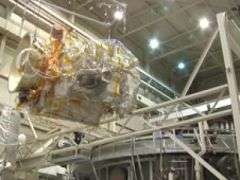
The Lunar Reconnaissance Orbiter entering the Thermal Vacuum Chamber at NASA's Goddard Space Flight Center in Greenbelt, Md. Credit: NASA's Goddard Space Flight Center

(PhysOrg.com) -- NASA's Lunar Reconnaissance Orbiter, or LRO, has successfully completed thermal vacuum testing, which simulates the extreme hot, cold and airless conditions of space LRO will experience after launch. This milestone concludes the orbiter's environmental test program at NASA's Goddard Space Flight Center in Greenbelt, Md.

The orbiter will carry seven instruments to provide scientists with detailed maps of the lunar surface and increase our understanding of the moon's topography, lighting conditions, mineralogical composition and natural resources.

Data returned to Earth from the Lunar Reconnaissance Orbiter will be used to select safe landing sites, determine locations for future outposts and help mitigate radiation dangers to astronauts. The spacecraft will spend at least a year in a low, polar orbit approximately 30 miles above the lunar surface while the instruments work together to collect detailed information about the moon's environment.

The thermal vacuum testing on the spacecraft took about two months. The orbiter, which was built at Goddard, was subjected to the extreme temperature cycles of the lunar environment as engineers conducted simulated flight operations.

"We have cooked LRO, frozen it, shaken it, and blasted it with electromagnetic waves, and still it operates," said Dave Everett, LRO mission system engineer at Goddard. "We have performed more than 2,500 hours of powered testing since January, more than 600 of that in vacuum."

The first two checks were the spin and vibration tests. The spin test determined the spacecraft's center of gravity and measured characteristics of its rotation. During vibration testing, engineers checked the structural integrity of the spacecraft aboard a large, shaking table that simulated the rigorous ride the orbiter will encounter during liftoff aboard an Atlas rocket.

Next, the orbiter was subjected to acoustics testing. The bagged spacecraft was placed near wall-sized speakers that simulate the noise-induced vibrations of launch. Following acoustics testing, LRO underwent tests that simulated the orbiter's separation from the rocket during launch. The spacecraft also underwent electromagnetic compatibility testing to ensure internal and external electrical signals do not interfere with its critical functions.

"It was less than one year ago that LRO was a myriad collection of parts not yet delivered to our clean room," said Craig Tooley, LRO project manager at Goddard. "This truly is a significant accomplishment -- a hard earned milestone. It is a humbling and awe-inspiring experience to work with the LRO team."

LRO will be shipped to NASA's Kennedy Space Center in Florida in early 2009 to be prepared for its April 24 launch aboard an Atlas V rocket. Accompanying the spacecraft will be the Lunar Crater Observation and Sensing Satellite, a mission that will impact the moon's surface in its search for water ice.

Provided by NASA


Rate this story - 2 /5 (1 vote)


December 22, 2008 all stories

Comments: 0

2 /5 (1 vote)

  • hide
  • Related Stories

  • A Second Look at Apollo 11
    created Oct 01, 2009 | popularity not rated yet | comments 0
  • NASA Lunar Satellite Begins Detailed Mapping of Moon's South Pole
    created Sep 17, 2009 | popularity not rated yet | comments 0
  • The Ultimate Long Distance Communication
    created Aug 19, 2009 | popularity not rated yet | comments 0
  • NASA's Next Moon Mission Begins Thermal Vacuum Test
    created Oct 23, 2008 | popularity not rated yet | comments 0
  • NASA Tests Moon Imaging Spacecraft at Goddard
    created Aug 01, 2008 | popularity not rated yet | comments 0


  • hide
  • Relevant PhysicsForums posts

  • Spreading Life in the Universe
    created 3 hours ago
  • Force of Gravity in terms of Density
    created Feb 08, 2010
  • what is the relation between gravity and light?
    created Feb 08, 2010
  • Does the Thermoelectric effect apply in sun?
    created Feb 07, 2010
  • More from Physics Forums - General Astronomy

Other News

A new 3-D map of the interstellar gas within 300 parsecs from the sun

A new 3D map of the interstellar gas within 300 parsecs from the Sun

Space & Earth / Astronomy

created 4 hours ago | popularity 5 / 5 (3) | comments 0 | with audio podcast

(PhysOrg.com) -- Astronomy & Astrophysics is publishing new 3D maps of the interstellar gas in the local area around our Sun. A French-American team of astronomers presents new absorption measurements toward ...


Climate 'Tipping Points' May Arrive Without Warning, Says Top Forecaster

Space & Earth / Environment

created 2 hours ago | popularity 5 / 5 (1) | comments 1 | with audio podcast

(PhysOrg.com) -- A new University of California, Davis, study by a top ecological forecaster says it is harder than experts thought to predict when sudden shifts in Earth's natural systems will occur -- a worrisome finding ...


Rho Ophiuchus cloud

Professor: We have a 'moral obligation' to seed universe with life

Space & Earth / Astronomy

created 13 hours ago | popularity 3.6 / 5 (20) | comments 40 | with audio podcast report

(PhysOrg.com) -- Eventually, the day will come when life on Earth ends. Whether that’s tomorrow or five billion years from now, whether by nuclear war, climate change, or the Sun burning up its fuel, the last ...


URI researcher calls for global effort to monitor marine pollutants

Space & Earth / Environment

created 3 hours ago | popularity 5 / 5 (1) | comments 1

A University of Rhode Island researcher who studies chemical pollutants in the marine environment has called on colleagues around the world to establish a global monitoring network to verify that the chemicals banned by the ...


New international satellite observations help assess future earthquake risk in Haiti

New international satellite observations help assess future earthquake risk in Haiti

Space & Earth / Earth Sciences

created 5 hours ago | popularity not rated yet | comments 0

Virginia Key, Florida--Scientists at the University of Miami have analyzed images based on Synthetic Aperture Radar (SAR) observations taken before and just after Haiti's earthquake, on January 12. The images ...