Saturn's Crazy Christmas Tilt
December 22, 2008 Saturn's Crazy Christmas Tilt

Enlarge

You look through the telescope. Blink. Shake your head and look again. The planet you expected to see in the eyepiece is not the one that's actually there. Too much eggnog? No, it's just Saturn's crazy Christmas tilt.

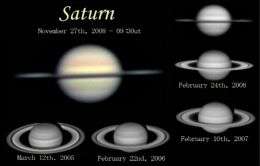
All year long, the rings of Saturn have been tilting toward Earth and now they are almost perfectly edge-on. The opening angle is a paper-thin 0.8o. Viewed from the side, the normally wide and bright rings have become a shadowy line bisecting Saturn's two hemispheres--a scene of rare beauty.

Amateur astronomer Efrain Morales Rivera of Aguadilla, Puerto Rico, has been monitoring Saturn and he created this composite image to show how the geometry has changed (see image above).

Astronomers call the phenomenon a "ring plane crossing." As Saturn goes around the sun, it periodically (once every 14 to 15 years) turns its rings edge-on to Earth. Because the rings are so thin, they can actually disappear when viewed through a backyard telescope. At the precise moment of crossing, Saturn undergoes a startling metamorphosis. The ringed planet becomes a lonely ball of gas, almost unrecognizable: Hubble photo.

(Historical note: Shortly after Galileo discovered Saturn's rings in 1610, they disappeared in precisely this fashion. Galileo didn't understand the nature of the rings and the vanishing act confused him mightily. Nevertheless, his physical intuition prevailed. "They'll be back," he predicted, and without ever knowing why, he was correct.)

We're not quite there yet. The opening angle won't be precisely 0o until Sept. 4, 2009. Don't bother marking your calendar, though. Saturn will be so close to the sun, no one will be able to see the rings wink out.

The best time to look is now.

The 0.8o opening angle of Christmas 2008 is the minimum for some time to come. In January 2009 the rings begin to open up again, a temporary reversal caused by the orbital motions of Earth and Saturn. By the time narrowing resumes in summer 2009, Saturn will be approaching the sun; looking through a telescope then could actually be dangerous. The next ring plane crossing that's easy to watch won't come until 2038.

So wake up before sunrise on Dec. 25th, point your telescope at the golden "star" in Leo, and behold Saturn's crazy Christmas tilt: sky map.

Provided by Science@NASA, by Dr. Tony Phillips


print this article email this article download pdf blog this article bookmark this article     Stumble it Digg this share on Facebook retweet share on Reddit add to delicious
Rate this story - 3.7 /5 (3 votes)


December 22, 2008 all stories

Comments: 0

3.7 /5 (3 votes)
  • Stumble this up

  • Digg this

  • share this

  • hide
  • Related Stories

  • Fantastic Voyage
    created Nov 02, 2009 | popularity not rated yet | comments 0
  • STAR TRAK for November: Mars is prominent again
    created Nov 02, 2009 | popularity not rated yet | comments 0
  • A long night falls over Saturn's rings
    created Oct 24, 2009 | popularity not rated yet | comments 0
  • Scientists Explore Galactic Frontier, Release First-Ever All-Sky Map (w/ Video)
    created Oct 15, 2009 | popularity not rated yet | comments 0
  • Largest Ring Around Saturn Discovered
    created Oct 07, 2009 | popularity not rated yet | comments 0


  • hide
  • Relevant PhysicsForums posts

  • The shape of our solar system's orbits.
    created Nov 07, 2009
  • Above or Below the Line of Nodes
    created Nov 07, 2009
  • Supernova vs. Nova?
    created Nov 07, 2009
  • Supernova's Gamma Rays and Comets
    created Nov 06, 2009
  • More from Physics Forums - General Astronomy

Other News

Planetary Society plans new 'solar sail'

Space & Earth / Space Exploration

created 30 minutes ago | popularity not rated yet | comments 0

(AP) -- Four years after its first solar sail ended up in the ocean instead of orbit, The Planetary Society announced Monday that by the end of 2010 it will try again to launch a spacecraft that will be propelled by the ...


Australian scientists call for urgent 'global cooling' to save coral reefs

Space & Earth / Environment

created 1hour ago | popularity not rated yet | comments 0

(PhysOrg.com) -- Australian marine scientists have issued an urgent call for massive and rapid worldwide cuts in carbon emissions, deep enough to prevent atmospheric CO2 levels rising to 450 parts per million (ppm).


L-R: Chiwetel Ejiofor, Amanda Peet and John Cusack at the premiere of "2012"

NASA on crusade to debunk 2012 apocalypse myths

Space & Earth / Space Exploration

created 6 hours ago | popularity not rated yet | comments 0

The world is not coming to an end on December 21, 2012, the US space agency insisted Monday in a rare campaign to dispel widespread rumors fueled by the Internet and a new Hollywood movie.


Antarctica glacier retreat creates new carbon dioxide store

Antarctica glacier retreat creates new carbon dioxide store

Space & Earth / Earth Sciences

created 10 hours ago | popularity 4.3 / 5 (3) | comments 0

Large blooms of tiny marine plants called phytoplankton are flourishing in areas of open water left exposed by the recent and rapid melting of ice shelves and glaciers around the Antarctic Peninsula. This ...


NASA satellites make a movie and get rainfall, wind info on Ida

NASA satellites make a movie and get rainfall, wind info on Ida (w/ Video)

Space & Earth / Earth Sciences

created 6 hours ago | popularity not rated yet | comments 0

NASA satellites are amazing examples of technology. The TRMM satellite peers into tropical cyclones and can tell how much rain is falling per hour and where. QuikScat uses microwave technology to measure Ida's ...