Feather scientists have Christmas all wrapped up
December 22, 2008
Feather scientists have Christmas all wrapped up

Enlarge

(PhysOrg.com) -- Material scientists at The University of Manchester are causing a festive flap after developing a way of making Christmas wrapping paper – from TURKEY FEATHERS.

A team led by Professor Chris Carr from The School of Materials has broken down and filtered large amounts of bird feathers.

Researchers then used special machinery – unique to The University of Manchester – to turn the feathery pulp into paper.

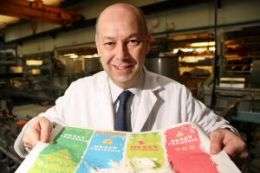
And to mark the festive season, Prof Carr has joined forces with Dr Nick Clarke from The University’s state-of-the-art Digital Print Centre to create colourful feather-based wrapping paper.

The new innovation from Manchester scientists – piloted using duck, goose and poultry feathers – opens up the possibility that in future years the paper used to wrap a family’s presents could be made from feathers plucked from the turkey they are eating for Christmas lunch.

According to the National Farmers’ Union (NFU), 10 million turkeys are consumed in the UK over the festive period – with around 6 million of them reared in the UK.

And according to DEFRA figures, in 2007 the UK produced 1,264,400 tonnes of chicken*.

The vast majority of feathers plucked from these birds are incinerated or end up in landfill. Each of these methods has implications for the environment.

It is estimated that around 120,000 tonnes of poultry feathers are produced every year in UK alone.

And there is a pressing demand for an alternative processing route for the feathers – especially as companies currently have to pay for unwanted feathers to be taken away.

As well as paper, scientists at the University have been able to make plant pots that are potentially flame retardant and more biodegradable than traditional plastic plant pots.

Researchers believe these feather-based pots may also offer enhanced fertilising properties as a result of the nitrogen supplied by the protein in the feathers.

Using The University of Manchester’s unique paper pilot plant, they have even made prototype EGG BOXES from unwanted feathers.

And in future years vegetable peelings may not go to waste, as researchers have even looked at making paper from these.

Professor Carr said: “Over recent years we have been working closely with industrial partners to characterise feathers, develop suitable cleaning technology and identify potential opportunities for new and novel products.

"Our progress in this field and the production of prototype products would have been impossible without the unique paper production pilot facility we have on campus. We are fortunate to be the only university in the UK to boast such advanced equipment.

“We are very excited and encouraged by our results and the prototypes we have produced, although there is still some way to go before products start to appear on the shelves.

“We see this as a real opportunity to take the large volume of poultry feathers, which are currently being incinerated or dumped into land fill sites, and put them to good use.”

The University of Manchester is currently working with industrial partners to develop the necessary processes and technology to produce commercially viable feather-based products.

Provided by University of Manchester


Rank not rated yet
Relevant PhysicsForums posts
  • Calling function with no input argument
    created10 hours ago
  • Force free body diagram problem on gym equipment
    created11 hours ago
  • Empirical data regarding shower heads and water
    created19 hours ago
  • feed hold button on CNC lathe
    createdFeb 09, 2012
  • RFAC in Fortran
    createdFeb 09, 2012
  • dynamics 2/32
    createdFeb 08, 2012
  • More from Physics Forums - General Engineering

More news stories

Google users warned of threat to smartphone wallets

Users of Google smartphone wallets were being warned on Friday that there is a way to crack pass codes intended to thwart thieves from going on illicit shopping sprees.

Technology / Internet

created 3 hours ago | popularity 5 / 5 (1) | comments 0

Anonymous knocks CIA website offline (Update)

The website of the Central Intelligence Agency was inaccessible on Friday after the hacker group Anonymous claimed to have knocked it offline.

Technology / Internet

created 4 hours ago | popularity 5 / 5 (6) | comments 10

New error-correcting codes guarantee the fastest possible rate of data transmission

Error-correcting codes are one of the triumphs of the digital age. They’re a way of encoding information so that it can be transmitted across a communication channel — such as an optical fiber o ...

Technology / Computer Sciences

created 13 hours ago | popularity 5 / 5 (4) | comments 5 | with audio podcast

New power source discovered

(PhysOrg.com) -- Researchers at the Massachusetts Institute of Technology (MIT) and RMIT University have made a breakthrough in energy storage and power generation.

Technology / Energy & Green Tech

created 12 hours ago | popularity 4.8 / 5 (19) | comments 7 | with audio podcast

Small modular reactor design could be a 'SUPERSTAR'

(PhysOrg.com) -- Though most of today's nuclear reactors are cooled by water, we've long known that there are alternatives; in fact, the world's first nuclear-powered electricity in 1951 came from a reactor ...

Technology / Energy & Green Tech

created 12 hours ago | popularity 4.3 / 5 (11) | comments 20 | with audio podcast


Complex wiring of the nervous system may rely on a just a handful of genes and proteins

Researchers at the Salk Institute have discovered a startling feature of early brain development that helps to explain how complex neuron wiring patterns are programmed using just a handful of critical genes. ...

Putting the squeeze on planets outside our solar system

(PhysOrg.com) -- Using high-powered lasers, scientists at Lawrence Livermore National Laboratory and collaborators discovered that molten magnesium silicate undergoes a phase change in the liquid state, abruptly ...

The power of estrogen -- male snakes attract other males

A new study has shown that boosting the estrogen levels of male garter snakes causes them to secrete the same pheromones that females use to attract suitors, and turned the males into just about the sexiest ...

NASA sees wide-eyed cyclone Jasmine

Cyclone Jasmine's eye has opened wider on NASA satellite imagery, as it moves through the Southern Pacific Ocean.

Humans may have helped the decline of African rainforests 3000 years ago

(PhysOrg.com) -- Large areas of rainforests in Central Africa mysteriously disappeared over three thousand years ago, to be replaced by savannas. The prevailing theory has been that the cause was a change ...

NASA sees Giovanna reach cyclone strength, threaten Madagascar

Tropical Storm 12S built up steam and became a cyclone on February 10, 2012 as NASA's Terra satellite passed overhead. Residents of east-central Madagascar should prepare for this cyclone to make landfall ...