Cell phones using lens-free imaging promise to improve health monitoring
(PhysOrg.com) -- Cell phones have already revolutionized the way people around the world communicate and do business. Thanks to advances being made at UCLA, they are about to do the same thing for medicine.
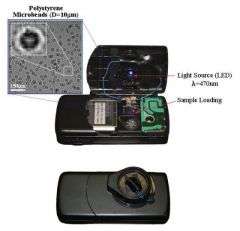
In the lab of UCLA electrical engineering professor Aydogan Ozcan, a prototype cell phone has been constructed that is capable of monitoring the condition of HIV and malaria patients, as well as testing water quality in undeveloped areas or disaster sites. The innovative imaging technology was invented by Ozcan, a member of the California NanoSystems Institute at UCLA, and has been miniaturized by researchers in his lab to the point that it can fit in standard cell phones.
The imaging platform, known as LUCAS (Lensless Ultra-wide-field Cell monitoring Array platform based on Shadow imaging), has now been successfully installed in both a cell phone and a webcam. Both devices acquire an image in the same way, using a short wavelength blue light to illuminate a blood, saliva or other fluid sample. LUCAS captures an image of the microparticles in the solution using a sensor array.
Because red blood cells and other microparticles have a distinct diffraction pattern, or shadow image, they can be identified and counted virtually instantaneously by LUCAS using a custom-developed "decision algorithm" that compares the captured shadow images to a library of training images. Data collected by LUCAS can then be sent to a hospital for analysis and diagnosis using the cell phone, or transferred via USB to a computer for transmission to a hospital.
LUCAS is not a substitute for a microscope but rather a complement. While microscopes can produce detailed images, images produced by LUCAS are grainy and pixelated. The LUCAS platform's advantage lies in its ability to nearly instantaneously identify and count microparticles, something that is time consuming and difficult to do with a microscope in resource-limited settings. Also, because LUCAS does not use a lens, the only constraint on size is the size of the chip it is built on.
"This technology will not only have great impact in health care applications, it also has the potential to replace cytometers in research labs at a fraction of the cost," said Ozcan. "A conventional flow-cytometer identifies cells serially, one at a time, whereas tabletop versions of LUCAS can identify thousands of cells in a second, all in parallel, with the same accuracy."
In research published online Dec. 5 in the journal Lab on a Chip, Ozcan described an improvement in the LUCAS system which he calls holographic LUCAS. This improvement allows for identification of smaller particles such as E. coli that were not previously possible. By controlling the spatial properties of the light source, a two-dimensional holographic shadow image of the microparticles can be captured that contains much more information than the classic shadow image.
Now that Ozcan has successfully created prototypes with a cell phone and webcam, his next step is to build from scratch a handheld device incorporating the LUCAS imaging system. Using this device, people in remote areas of the world would be able to monitor the spread of disease, allowing doctors to focus limited resources in the areas of greatest need.
The system also can be used to monitor water quality by detecting hazardous microparticles. In addition to undeveloped areas, LUCAS would be useful for water testing in the event of a disaster which compromises water quality. After making a presentation on LUCAS in Japan, Ozcan was approached by researchers from the University of Tokyo and Kyushu University interested in earthquake preparedness.
For more on the work of Ozcan's lab, visit innovate.ee.ucla.edu/ .
Provided by University of California - Los Angeles


