Electromagnetic Phantom Exorcises Specters of Metal Detector Tests
December 23, 2008
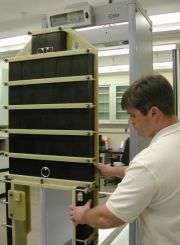
Guest researcher John Jendzurski prepares the NIST electromagnetic phantom for passage through the walk-through metal detector behind it. The carbon-polymer blocks of the phantom are arranged in a form that simulates the mass and height of the average American adult male. Metal objects such as the mock eyeglasses and belt buckle (top and center of the phantom) test the detector's function. Credit: Newman, NIST
In the comics, the Phantom is a masked crimefighter who protected the innocent from pirates, hijackers and other evildoers. While not as dashing or exciting as its costumed namesake, this electromagnetic phantom -- a carbon and polymer mixture that simulates the human body -- is being readied by the National Institute of Standards and Technology for its upcoming role as a different kind of protector. The NIST phantom serves as a mannequin in a standardized performance test for walk-through metal detectors or WTMDs such as those used at airports.
Metal detectors currently are evaluated by using “clean testers” (human subjects) who walk through the detector adorned with different types of innocuous metal objects, such as eyeglasses, belt buckles, watches, jewelry and coins, or by a piece of plywood pushed through the metal detector with the same items mounted on it. The disadvantage of using human subjects is that person-to-person variability in physical makeup and walking style and changes in a particular person’s gait or position at each pass makes standardization impossible. The second method is reproducible, but it can’t tell evaluators how a human body may impact the WTMD’s ability to discriminate between weapons and innocuous objects.
The solution for both problems came from the lab. With funding from the U.S. Department of Justice’s National Institute of Justice (NIJ), researchers in NIST’s Electromagnetics Division mixed a polymer with carbon black—a fine powder made almost entirely of elemental carbon—to yield a low-cost, easily molded compound that can mimic the average electrical conductivity of the human body (which includes blood, bone, fat, organs, muscle and skin). The material is shaped into brick-like blocks and then arranged on a non-conductive fiberglass frame in a form that simulates the mass and height of the average American adult male.
Once assembled, the NIST phantom is placed atop a low-friction nonmetallic cart and passed through a WTMD at a speed of 0.5 meters per second by a computer-controlled actuator. This speed was selected because it is a common walking pace for an adult male. Engineers in NIST’s Office of Law Enforcement Standards used the data from recent trials to design and support a reproducible process incorporating the phantom that will evaluate a walk-through metal detector’s ability to discriminate between threatening and non-threatening objects, such as the simulated eyeglasses or belt buckle. Plans call for the testing protocol to be considered in a future revision of the NIJ standard on metal detector performance.
Source: National Institute of Standards and Technology
-
Researchers Develop Breast Biopsy Robot
Feb 10, 2009 |
not rated yet |
0
-
Study adds timing capability to living cell sensors
18 hours ago |
not rated yet |
0
-
New study links high levels of cadmium, lead in blood to pregnancy delay
16 hours ago |
not rated yet |
0
-
Diamond light, brighter than the sun
Feb 07, 2012 |
4.3 / 5 (7) |
15
-
Copper + love chemical = big sulfur stink
Feb 06, 2012 |
4.3 / 5 (6) |
1
-
Engineers build first sub-10-nm carbon nanotube transistor
Feb 01, 2012 |
4.9 / 5 (33) |
30
-
Something old, something new: Evolution and the structural divergence of duplicate genes
Jan 31, 2012 |
4.6 / 5 (7) |
1
-
The hidden nanoworld of ice crystals: Revealing the dynamic behavior of quasi-liquid layers
Jan 30, 2012 |
5 / 5 (5) |
1
-
Stock market network reveals investor clustering
Jan 27, 2012 |
3.9 / 5 (23) |
8
-
Of microchemistry and molecules: Electronic microfluidic device synthesizes biocompatible probes
Jan 26, 2012 |
5 / 5 (2) |
0
-
Help with snow Crystals
8 hours ago
-
Doubts about surface plasmons
Feb 11, 2012
-
excited U-236 decay time in the U235 fission chain
Feb 09, 2012
-
Polar catastrophe?
Feb 09, 2012
-
Large scale field sonication
Feb 09, 2012
-
states and energy of paired electrons in BCS
Feb 08, 2012
- More from Physics Forums - Atomic, Solid State, Comp. Physics
More news stories
Rapunzel, Leonardo and the physics of the ponytail
(PhysOrg.com) -- New research provides the first mathematical understanding of the shape of a ponytail and could have implications for the textile industry, computer animation and personal care products.
2 hours ago |
4 / 5 (1) |
0
|
Explained: Sigma
It's a question that arises with virtually every major new finding in science or medicine: What makes a result reliable enough to be taken seriously? The answer has to do with statistical significance -- but ...
Feb 09, 2012 |
5 / 5 (21) |
87
Quantum physicist explains $100K offer for proof scaled-up quantum computing is impossible
(PhysOrg.com) -- MIT researcher Scott Aaronson has certainly riled the physics community with his offer this past Friday, of $100,000 to anyone who can prove that scaled-up quantum computing is impossible. ...
Hovering not hard if you're top-heavy, researchers find
Top-heavy structures are more likely to maintain their balance while hovering in the air than are those that bear a lower center of gravity, researchers at New York University's Courant Institute of Mathematical Sciences ...
Feb 10, 2012 |
5 / 5 (4) |
5
|
Physicists build highly efficient 'no-waste' laser
A team of University of California, San Diego researchers has built the smallest room-temperature nanolaser to date, as well as an even more startling device: a highly efficient, "thresholdless" laser that ...
Feb 08, 2012 |
4.9 / 5 (21) |
5
|
New molecule has potential to help treat genetic diseases and HIV
(PhysOrg.com) -- Chemists at The University of Texas at Austin have created a molecule that's so good at tangling itself inside the double helix of a DNA sequence that it can stay there for up to 16 days before ...
Social psychologist: Lust makes you smarter and evidence that seven deadly sins are good for you
(Medical Xpress) -- Good news for lovers on Valentine’s Day - the seven deadly sins, including Lust, are good for you. University of Melbourne social psychologist Dr Simon Laham uses modern research to make a compelling ...
The joy of cheques
An electronic cheque which eliminates the need for costly processing by banks but preserves the simplicity and ease of a traditional cheque book has been designed by a team of academics in the UK.
Research shows promise in converting camelina oil into jet fuel
(PhysOrg.com) -- Researchers at Montana State University-Northern have developed a process to convert camelina oil to jet fuel and other high-value chemicals. MSU has applied for a U.S. patent and research is ongoing.
Researchers make breakthrough in stem cell research
(Medical Xpress) -- University of Queensland scientists have developed a world-first method for producing adult stem cells that will substantially impact patients who have a range of serious diseases.
Georgia Tech develops software for the rapid analysis of foodborne pathogens
2011 brought two of the deadliest bacterial outbreaks the world has seen during the last 25 years. The two epidemics accounted for more than 4,200 cases of infectious disease and 80 deaths. Software developed at Georgia Tech ...
Apr 16, 2009
Rank: not rated yet