Biologists learn structure, mechanism of powerful 'molecular motor' in virus
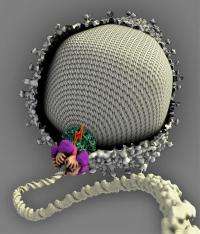
(PhysOrg.com) -- Researchers have discovered the atomic structure of a powerful "molecular motor" that packages DNA into the head segment of some viruses during their assembly, an essential step in their ability to multiply and infect new host organisms.
The researchers, from Purdue University and The Catholic University of America, also have proposed a mechanism for how the motor works. Parts of the motor move in sequence like the pistons in a car's engine, progressively drawing the genetic material into the virus's head, or capsid, said Michael Rossmann, Purdue's Hanley Distinguished Professor of Biological Sciences.
The motor is needed to insert DNA into the capsid of the T4 virus, which is called a bacteriophage because it infects bacteria. The same kind of motor, however, also is likely present in other viruses, including the human herpes virus.
"Molecular motors in double-stranded DNA viruses have never been shown in such detail before," said Siyang Sun, a postdoctoral research associate working in Rossmann's lab.
Findings are detailed in a paper appearing online on Dec. 24 in the journal Cell. The lead authors are Sun and Kiran Kondabagil, a research assistant professor at Catholic University of America working with biology professor Venigalla B. Rao.
"This research is allowing us to examine the inner workings of a virus packaging motor at the atomic level," Rao said. "This particular motor is very fast and powerful."
Other researchers have determined that the T4 molecular motor is the strongest yet discovered in viruses and proportionately twice as powerful as an automotive engine. The motors generate 20 times the force produced by the protein myosin, one of the two proteins responsible for the contraction and strength of muscles.
The virus consists of a head and tail portion. The DNA-packaging motor is located in the same place where the tail eventually connects to the head. Most of the motor falls off after the packaging step is completed, allowing the tail to attach to the capsid. The DNA is a complete record of a virus's properties, and the capsid protects this record from damage and ensures that the virus can reproduce by infecting a host organism.
Sun determined that the packaging motor is made of two ringlike structures, and both of these discs contain five segments made of a protein called gp17, for gene product 17. The researchers determined the atomic structure of these protein segments using a procedure called X-ray crystallography. They also used another technique called cryo-electron microscopy, which enabled them to see a more distant, overall design of the motor's ringlike structure.
One disc sits on top of the other, and each of the five segments of the top disc shares a gp17 protein with a corresponding segment in the bottom disc. The gp17 proteins have two segments, or domains, one segment in the lower disc and the other segment in the upper disc.
The lower disc first attaches to the DNA and is then drawn upward by the upper disc, pushing the DNA into the virus's capsid in the process. The top disc of the motor pulls the lower disc upward using electrostatic forces generated between oppositely charged objects, Rossmann said.
"These findings determined the relationship between the motor and DNA," Rossmann said.
The research data also showed that the motor is dynamic and apparently exists in two states: relaxed and tensed, the latter likely occurring when the top disk has attracted the lower disc.
Researchers at Catholic University of America supplied the gp17 and other materials, and the Purdue researchers studied the structure of the materials.
"By combining the structural data and the biochemical data of our colleagues at the Catholic University of America, we were jointly able to come up with a hypothesis of how this motor works," Rossmann said.
Because herpes and other viruses contain similar DNA packaging motors, such findings could someday help scientists design drugs that would interfere with the function of these motors and mitigate the result of some viral infections. The findings also could have other future applications, such as developing alternatives to current antibiotics, creating methods to deliver genetic material to patients for gene therapy or creating tiny "nanomotors" in future machines.
"But this is very basic research, and it's far too soon to talk more about possible practical applications of this knowledge," Rossmann said.
Provided by Purdue University


