Study: Facial expressions of emotion are innate, not learned
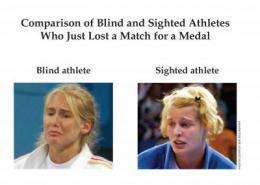
December 29, 2008 Comparison of Blind and Sighted Athletes

Enlarge

Photos show comparison of facial expressions by blind and sighted athletes who just lost a match for a medal. Image: Bob Willingham

Facial expressions of emotion are hardwired into our genes, according to a study published today in the Journal of Personality and Social Psychology. The research suggests that facial expressions of emotion are innate rather than a product of cultural learning. The study is the first of its kind to demonstrate that sighted and blind individuals use the same facial expressions, producing the same facial muscle movements in response to specific emotional stimuli.

The study also provides new insight into how humans manage emotional displays according to social context, suggesting that the ability to regulate emotional expressions is not learned through observation.

San Francisco State University Psychology Professor David Matsumoto compared the facial expressions of sighted and blind judo athletes at the 2004 Summer Olympics and Paralympic Games. More than 4,800 photographs were captured and analyzed, including images of athletes from 23 countries.

"The statistical correlation between the facial expressions of sighted and blind individuals was almost perfect," Matsumoto said. "This suggests something genetically resident within us is the source of facial expressions of emotion."

Matsumoto found that sighted and blind individuals manage their expressions of emotion in the same way according to social context. For example, because of the social nature of the Olympic medal ceremonies, 85 percent of silver medalists who lost their medal matches produced "social smiles" during the ceremony. Social smiles use only the mouth muscles whereas true smiles, known as Duchenne smiles, cause the eyes to twinkle and narrow and the cheeks to rise.

"Losers pushed their lower lip up as if to control the emotion on their face and many produced social smiles," Matsumoto said. "Individuals blind from birth could not have learned to control their emotions in this way through visual learning so there must be another mechanism. It could be that our emotions, and the systems to regulate them, are vestiges of our evolutionary ancestry. It's possible that in response to negative emotions, humans have developed a system that closes the mouth so that they are prevented from yelling, biting or throwing insults."

Paper: "Spontaneous Facial Expressions of Emotion in Congenitally and Non-Congenitally Blind Individuals" will be published in the January issue of The Journal of Personality and Social Psychology, Vol. 96, No.1.

Source: San Francisco State University


print this article email this article download pdf blog this article bookmark this article     Stumble it Digg this share on Facebook retweet share on Reddit add to delicious
Rate this story - 4 /5 (1 vote)

Rank Filter

Move the slider to adjust rank threshold, so that you can hide some of the comments.


Display comments: newest first

  • Bob_Kob - Dec 29, 2008
    • Rank: 5 / 5 (3)
    Next obvious study: Pain hurts!
  • Egnite - Dec 29, 2008
    • Rank: not rated yet
    http://www.naturalnews.com/

    Any other interesting non-political sites out there?
  • gmurphy - Dec 29, 2008
    • Rank: 5 / 5 (1)
    dum de dum de dum. ok, this is the first study to show this (obvious) finding with respect to blind people. This have been known for a long time previously though and the article suffers from not mentioning this.
  • x646d63 - Dec 29, 2008
    • Rank: not rated yet
    Another one for the "duh" file.

December 29, 2008 all stories

Comments: 4

4 /5 (1 vote)
  • Stumble this up

  • Digg this

  • share this

  • hide
  • Related Stories

  • The upside of feeling down
    created 5 hours ago | popularity not rated yet | comments 0
  • Pain automatically activates facial muscle groups
    created Oct 27, 2008 | popularity not rated yet | comments 0
  • Study finds facial expressions are inherited
    created Nov 07, 2006 | popularity not rated yet | comments 0
  • Brain responds to human voice in one fifth of a second
    created Oct 28, 2009 | popularity not rated yet | comments 0
  • Research Investigates Rebuilding Identity When Communication Is Impaired
    created Sep 08, 2009 | popularity not rated yet | comments 0


  • hide
  • Relevant PhysicsForums posts

  • Improving the brain through chemistry
    created Nov 07, 2009
  • Sleep / REM Sleep and homeostasis
    created Nov 07, 2009
  • The Biceps Reflex
    created Nov 05, 2009
  • Consequenses of striking a Vein and an artery?
    created Nov 05, 2009
  • More from Physics Forums - Medical Sciences

Other News

The upside of feeling down

The upside of feeling down

Medicine & Health / Psychology & Psychiatry

created 5 hours ago | popularity 4 / 5 (4) | comments 2

A chill wind chases you into the door of your local newsagent. Rain is drumming down outside. As you pay for your newspaper, you briefly notice a number of strange items on the checkout counter - a matchbox ...


Words, gestures are translated by same brain regions, says new research

Medicine & Health / Neuroscience

created 10 hours ago | popularity 5 / 5 (3) | comments 0

Your ability to make sense of Groucho's words and Harpo's pantomimes in an old Marx Brothers movie takes place in the same regions of your brain, says new research funded by the National Institute on Deafness and Other Communication ...


Implantable Glucose Sensor Could Spell Relief for Millions of Diabetics (w/ Video)

Implantable Glucose Sensor Could Spell Relief for Millions of Diabetics (w/ Video)

Medicine & Health / Research

created 6 hours ago | popularity not rated yet | comments 0

(PhysOrg.com) -- UConn researchers have developed a tiny wireless device that can be inserted under a patient?s skin to monitor blood glucose levels over a period of several months.


Diet switching can activate brain's stress system, lead to 'withdrawal' symptoms

Medicine & Health / Research

created 7 hours ago | popularity not rated yet | comments 0

In research that sheds light on the perils of yo-yo dieting and repeated bouts of sugar-bingeing, researchers from The Scripps Research Institute have shown in animal models that cycling between periods of eating sweet and ...


Mood improves on low-fat, but not low-carb, diet plan

Medicine & Health / Health

created 8 hours ago | popularity 5 / 5 (1) | comments 0

After one year, a low-calorie, low-fat diet appears more beneficial to dieters' mood than a low-carbohydrate plan with the same number of calories, according to a report in the November 9 issue of Archives of Internal Me ...