4 years after tsunami: Corals stage comeback
December 29, 2008
Aceh Coral Transplant Site

Enlarge

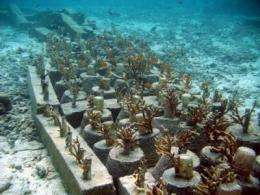
Four years after the tsunami, corals are thriving in this transplant site on Achech, Indonesia. Credit: Rizya Legawa

A team of scientists from the New York-based Wildlife Conservation Society (WCS) has reported a rapid recovery of coral reefs in areas of Indonesia, following the tsunami that devastated coastal regions throughout the Indian Ocean four years ago today.

The WCS team, working in conjunction with the Australian Research Council Centre of Excellence for Coral Reef Studies (ARCCoERS) along with government, community and non-government partners, has documented high densities of "baby corals" in areas that were severely impacted by the tsunami.

The team, which has surveyed the region's coral reefs since the December 26, 2004 tsunami, looked at 60 sites along 800 kilometers (497 miles) of coastline in Aceh, Indonesia. The researchers attribute the recovery to natural colonization by resilient coral species, along with the reduction of destructive fishing practices by local communities.

"On the 4th anniversary of the tsunami, this is a great story of ecosystem resilience and recovery," said Dr, Stuart Campbell, coordinator of the Wildlife Conservation Society's Indonesia Marine Program. "Our scientific monitoring is showing rapid growth of young corals in areas where the tsunami caused damage, and also the return of new generations of corals in areas previously damaged by destructive fishing. These findings provide new insights into coral recovery processes that can help us manage coral reefs in the face of climate change."

While initial surveys immediately following the tsunami showed patchy (albeit devastating) damage to coral reefs in the region, surveys in 2005 indicated that many of the dead reefs in the study area had actually succumbed long ago to destructive fishing practices such as the use of dynamite and cyanide to catch fish. It is also possible that the crown of thorns starfish—a marine predator—had caused widespread coral mortality.

Since then, some communities have moved away from destructive fishing and have even begun transplanting corals to recover damaged areas.

For example, Dodent Mahyiddin, a dive operator on Weh Island, leads an effort to transplant corals onto hand-laid underwater structures to restore a badly damaged reef in front of the remains of his dive shop, which was also destroyed by the tsunami. Already he is seeing widespread colonization of young corals.

On a larger scale, the WCS team is working to establish community-based coral reef protected areas based on customary marine laws that were first established in the 1600's and maintained throughout Dutch colonial rule. The laws empower local communities to manage their own local marine resources rather than adhere to nationalized protected areas.

Healthy coral reefs are economic engines for Acehnese communities, according to WCS, supplying commercially valuable food fish as well as tourism dollars from recreational diving.

"The recovery, which is in part due to improved management and the direct assistance of local people, gives enormous hope that coral reefs in this remote region can return to their previous condition and provide local communities with the resources they need to prosper," said Dr. Campbell. "The recovery process will be enhanced by management that encourages sustainable uses of these ecosystems and the protection of critical habitats and species to help this process."

The study area is adjacent to the "Coral Triangle," a massive region containing 75 percent of the world's coral species shared by Indonesia, Malaysia, Papua New Guinea, Philippines, Solomon Islands, and Timor-Leste.

The region is estimated to generate more than $2 billion per year in revenues and supports more than 120 million people dependent on its resources for food security and employment. The "Coral Triangle Initiative," an effort to save the region's reefs and contribute to sustainable livelihoods, has received global support. The U.S. State Department and the U.S. Agency for International Development (USAID) have together pledged over $32 million over a five-year period towards this initiative alongside contributions from other major donors, including the Global Environment Facility and twenty-one other Heads of State totaling over $400 million in pledges. WCS conducts conservation projects in this globally important region, and also works on coral conservation in Belize, Papua New Guinea, Fiji, and Madagascar. The U.S. Department of State along with the International Coral Reef Initiative (ICRI) through recent commemorations of 2008 as the International Year of the Reef (IYOR) has engaged other leading nations by continuing to strengthen political will and commitment to conserving the resource-rich reefs of the world.

Source: Wildlife Conservation Society

4.2 /5 (9 votes)  

Filter


Move the slider to adjust rank threshold, so that you can hide some of the comments.


Display comments: newest first

MikeB
Dec 29, 2008

Rank: 3.7 / 5 (9)
This is simply unbelievable. There is no way that baby corals could thrive in this age of Global Warming, coral bleaching and ocean acidification!!

Do you guys at Physorg think we are stupid? Please report the truth that these poor baby corals do not have a chance!!
Roach
Dec 29, 2008

Rank: 4.3 / 5 (6)
Absolutly Mike, I just read on here that all the worlds coral are dying off. Clearly these particular corals did not get the post last week. Could someone please resend the memo?
vanderMerwe
Dec 29, 2008

Rank: 3.5 / 5 (8)
Be good baby corals now! Play dead while the nice environutjob takes your picture. :-D
GrayMouser
Dec 29, 2008

Rank: 3.7 / 5 (6)
You know, you try to clean out the lowlifes and they just polyp back...
Velanarris
Dec 30, 2008

Rank: 3 / 5 (4)
You know, you try to clean out the lowlifes and they just polyp back...

Winner.
MikeB
Jan 01, 2009

Rank: 2 / 5 (4)
Those poor baby corals are dying just like the teddy polar bears... Why is this world so cruel??? WAHHHHH!!!
BucketfootAl
Jan 04, 2009

Rank: 3.2 / 5 (6)
The amazement of 'the world is ending lemmings' at the (well-documented) ability of earth's ecosystems to recover from catastrophic events is a cliche by now.

Rank 4.2 /5 (9 votes)
Relevant PhysicsForums posts
  • Do some geologists actually act a lot like Randy Marsh?
    createdFeb 11, 2012
  • Discrepancy between oxygen and carbon-dioxide levels
    createdFeb 09, 2012
  • where gems are found in the world
    createdFeb 09, 2012
  • Wind Waves in Reservoir ~ Wind run-up and Wind set-up
    createdFeb 08, 2012
  • Balance of oxygen in the atmosphere
    createdFeb 01, 2012
  • The case for a methanol-based economy
    createdJan 30, 2012
  • More from Physics Forums - Earth

More news stories

Salvage workers begin pumping fuel from Italian shipwreck

Salvage workers Sunday began pumping fuel from the shipwrecked Italian cruise liner Costa Concordia, a day ahead of schedule, officials said.

Space & Earth / Environment

created 5 hours ago | popularity not rated yet | comments 0

Latin America mining boom clashes with conservation

Latin America is experiencing a mining boom as prices rise fuelled by a hike in global demand, but the region is also being hit by a wave of violent protests, strikes and rallies by environmentalists.

Space & Earth / Environment

created 13 hours ago | popularity 5 / 5 (1) | comments 1

Political leaders play key role in how worried Americans are by climate change: study

More than extreme weather events and the work of scientists, it is national political leaders who influence how much Americans worry about the threat of climate change, new research finds.

Space & Earth / Environment

created Feb 06, 2012 | popularity 5 / 5 (6) | comments 73

NASA budget will axe Mars deal with Europe: scientists

US President Barack Obama's budget proposal to be submitted next week for 2013 will cut NASA's budget by 20 percent and eliminate a major partnership with Europe on Mars exploration, scientists said Thursday.

Space & Earth / Space Exploration

created Feb 10, 2012 | popularity 5 / 5 (3) | comments 58

Humans may have helped the decline of African rainforests 3000 years ago

(PhysOrg.com) -- Large areas of rainforests in Central Africa mysteriously disappeared over three thousand years ago, to be replaced by savannas. The prevailing theory has been that the cause was a change ...

Space & Earth / Environment

created Feb 10, 2012 | popularity 4.1 / 5 (14) | comments 21 | with audio podcast report


Scientists discover molecular secrets of 2,000-year-old Chinese herbal remedy

For roughly two thousand years, Chinese herbalists have treated Malaria using a root extract, commonly known as Chang Shan, from a type of hydrangea that grows in Tibet and Nepal. More recent studies suggest that halofuginone, ...

Overeating may double risk of memory loss

New research suggests that consuming between 2,100 and 6,000 calories per day may double the risk of memory loss, or mild cognitive impairment (MCI), among people age 70 and older. The study was released today and will be ...

New method to examine batteries -- MRI from the inside

There is an ever-increasing need for advanced batteries for portable electronics, such as phones, cameras, and music players, but also to power electric vehicles and to facilitate the distribution and storage of energy derived ...

A mitosis mystery solved: How chromosomes align perfectly in a dividing cell

Although the process of mitotic cell division has been studied intensely for more than 50 years, Whitehead Institute researchers have only now solved the mystery of how cells correctly align their chromosomes during symmetric ...

Lab study raises questions over nano-particle impact

Tests involving chickens have raised questions about the impact on health from engineered nano-particles, the ultra-fine grains commonly used in drugs and processed foods, scientists said on Sunday.

Starve a virus, feed a cure? Findings show how some cells protect themselves against HIV

A protein that protects some of our immune cells from the most common and virulent form of HIV works by starving the virus of the molecular building blocks that it needs to replicate, according to research published online ...