Matrix fragments trigger fatal excitement
December 29, 2008 Extracellular Matrix

Enlarge

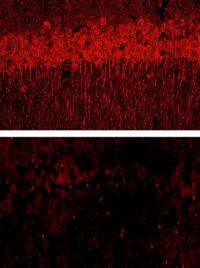
The extracellular matrix thins in mice lacking laminin in the hippocampus (bottom). Credit: Chen, Z.-L., et al. 2008. J. Cell Biol.

Shredded extracellular matrix (ECM) is toxic to neurons. Chen et al. reveal a new mechanism for how ECM demolition causes brain damage. The study will appear in the December 29, 2008 issue of The Journal of Cell Biology.

A stroke or head injury kills large numbers of neurons through a process called excitotoxicity. A surge of the neurotransmitter glutamate jolts receptors such as the kainate receptor and stimulates cell death. Enzymes add to the death toll by chopping up ECM near the injury site. How ECM breakdown takes out neurons was mysterious. The standard view was that neurons perished because they got separated from the ECM as it dissolved.

Chen et al. found otherwise when they engineered mice to lack the ECM component laminin in the hippocampus, a brain region often damaged by stroke or injury. If cells languished after parting from the ECM, the researchers reasoned that mice missing laminin would suffer more damage from excitotoxicity. But when excitotoxicity was spurred with an injection of kainate—a molecule that, like glutamate, activates the kainate receptor—the laminin-lacking mice showed less brain damage. After a dose of diced laminin, however, the mutant mice were vulnerable to kainate, indicating that the fragments are the culprit in cell death.

The researchers discovered that chopped-up ECM kills cells by ramping up production of one subunit of the kainate receptor, known as KA1. They speculate that hiking the amount of KA1 subunits might make the receptor more sensitive and thus more likely to trigger an overreaction by the cell.

Although drugs that obstruct the glutamate receptor slow brain cell death, they can lead to serious cognitive impairment and even coma. The study suggests that drugs that block KA1 might provide an alternative way to save brain cells after stroke or head trauma.

Paper: Chen, Z.-L., et al. 2008. J. Cell Biol. doi:10.1083/jcb.200803107, www.jcb.org" target="_blank">http://www.jcb.org">www.jcb.org

Source: Rockefeller University


Rate this story - 5 /5 (3 votes)


December 29, 2008 all stories

Comments: 0

5 /5 (3 votes)

  • hide
  • Related Stories

  • Communication breakdown: What happens to nerve cells in Parkinson's disease
    created 5 hours ago | popularity not rated yet | comments 0
  • Researchers discover new way to kill pediatric brain tumors
    created 16 hours ago | popularity not rated yet | comments 0
  • Research could lead to way to halt deadly immune response
    created 16 hours ago | popularity not rated yet | comments 0
  • Scientists find ideal target for malaria therapy
    created Feb 03, 2010 | popularity not rated yet | comments 0
  • 3 brain diseases linked by toxic form of same neural protein
    created Feb 02, 2010 | popularity not rated yet | comments 0


Other News

bee

Are bees also addicted to caffeine and nicotine?

Biology / Plants & Animals

created 13 minutes ago | popularity 5 / 5 (1) | comments 0 | with audio podcast

A study carried out at the University of Haifa has found that bees prefer nectar with a small concentration of caffeine and nicotine over nectar that does not comprise these substances at all. "This could ...


giant oarfish

Bizarre giant oarfish filmed (w/ Video)

Biology / Plants & Animals

created 3 hours ago | popularity 4.3 / 5 (4) | comments 0 | with audio podcast report

(PhysOrg.com) -- A rare giant oarfish, probably the largest bony fish in the ocean, has been filmed off the Gulf of Mexico. This is possibly the first time the fish has been observed in its natural environment.


Scientists crash test DNA's replication machinery

Biology / Cell & Microbiology

created 2 hours ago | popularity 5 / 5 (2) | comments 0 | with audio podcast

(PhysOrg.com) -- Important molecular machines routinely crash into one another while plying their trades on DNA. New research shows that the enzymes that copy DNA before cell division, called replisomes, are the kings of ...


Benefits of badger culling not long lasting for reducing cattle TB, says study

Benefits of badger culling not long lasting for reducing cattle TB, says study

Biology / Ecology

created 2 hours ago | popularity not rated yet | comments 0

(PhysOrg.com) -- Badger culling is unlikely to be a cost-effective way of helping control cattle TB in Britain, according to research published today in PLoS ONE.


Great tits: birds with character

Great tits: birds with character

Biology / Plants & Animals

created 16 hours ago | popularity 5 / 5 (3) | comments 3 | with audio podcast

(PhysOrg.com) -- In humans and animals alike, individuals differ in sets of traits that we usually refer to as personality. An important part of the individual difference in personality is due to variation ...