New 'Nanowelding' Technique for Building Electronic Nanostructures
December 29, 2008 By Laura Mgrdichian feature
New 'Nanowelding' Technique for Building Electronic Nanostructures

Enlarge

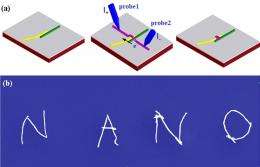
Nanoconstruction using nanoscale solder. (a) Touching nanowires can be joined using a nanoscale volume of solder melted from a sacrificial nanowire. (b) The word "NANO" written at the nanoscale by individual 55-nm-diameter gold nanowires. Adapted with permission from Nano Letters, ASAP Article, DOI:10.1021/nl8025339. Copyright 2008 American Chemical Society.

(PhysOrg.com) -- Scientists have discovered a way to link nanowires and other nanoobjects into complex nanostructures and circuits by fusing them together with tiny amounts of solder. The researchers, from Sheffield University in the UK, expect that their method could be used to fabricate nanoelectronic test structures for research or to repair interconnects or other defects in circuits.

The process is a new form of nanowelding, which is similar to large-scale welding in that hot metal, or solder, is used to fuse the components together. The new technique may address an ongoing problem in nanotechnology research, namely the lack of successful ways to form bonds that are not only mechanically strong but can be easily tweaked to adjust the overall structure's electrical and chemical properties.

The experiment, performed by researchers Beverley Inkson, Tony Cullis, and Yong Peng, is published in the December 10, 2008, online version of Nano Letters.

In the paper, the researchers describe the nanowelding method in detail. For example, to fuse together two gold nanowires, the group positioned the wires such that their ends were touching but not their full lengths. Using a scanning electron microscope to view their work, they moved the wires with a nanomanipulator, a tiny specialized tool used in nanotechnology research to move nanostructures around, both mechanically and, by applying a current, electrically.

They laid a "sacrificial" gold nanowire across the adjacent ends and electrically severed the sacrificial wire at two points, leaving a small bridge connecting the two nanowire ends. The bridge was welded into place by applying short voltage pulses with the nanomanipulator, inducing enough heat to fuse it to the nanowires.

"The ability to weld nanowires and individual functional components is vitally important for future nanotechnology," said Inkson to PhysOrg.com. "The new nanowelding technique can be used to join nanoobjects with a wide range of shapes and chemistries, and so could be used as part of a future 3D nanoscale fabrication line.”

Inkson and her group also welded nanowires using another solder, a tin-gold alloy. This alloy is widely used in macroscopic welding because it has excellent conductivity, a low melting point, and large corrosion resistance.

The group created more complex structures and networks with the gold nanowires, including the Chinese character for "human being" and the letters "N," "A," "N," and "O." Each structure was built on a silicon wafer.

This nanowelding approach produces much better results than simply fusing together two nanowires without the use of solder, such as can be done by heating via an electric current, or "Joule heating." Currently direct Joule heating has only been successful in welding relatively large platinum nanowires as the method tends to cause significant changes in the nanowire shape, or even complete break-up of the nanowire, due to severe local over-heating.

"Using Joule heating to melt the sacrificial nanowire at the weld point, instead of fusing the nanowires directly, results in a weld that is controllable, secure, and conductive," says Inkson. “The use of nanosolder is also exciting because the chemistry and performance of the join can be engineered at the nanoscale.”

This research is published in the December 10, 2008, online edition of Nano Letters.

Citation: Nano Letters, ASAP Article, DOI:10.1021/nl8025339

Copyright 2008 PhysOrg.com.
All rights reserved. This material may not be published, broadcast, rewritten or redistributed in whole or part without the express written permission of PhysOrg.com.


Rank 5 /5 (9 votes)
Related Stories
Relevant PhysicsForums posts
  • Pure energy
    created4 hours ago
  • How to remove the magnetic property for screw driver?
    created7 hours ago
  • How to magnetize a concrete wall?
    created11 hours ago
  • Upward speed of an object in water
    created12 hours ago
  • flipping quarks
    created12 hours ago
  • partial derivation question
    created12 hours ago
  • More from Physics Forums - General Physics

More news stories

Australians risking skin cancer to avoid nanoparticles

More than three in five Australians are concerned enough about the health implications of nanoparticles in sunscreens to want to know more about their impact. And while the initial scientific information released suggests ...

Nanotechnology / Bio & Medicine

created 39 minutes ago | popularity not rated yet | comments 0

Inspired by steel, nanomanufacturing gets wear-resistant carbide tip

(PhysOrg.com) -- Scientists at the University of Pennsylvania, the University of Wisconsin-Madison and IBM Research - Zurich have fabricated an ultrasharp silicon carbide tip possessing such high strength ...

Nanotechnology / Nanophysics

created 2 hours ago | popularity not rated yet | comments 1 | with audio podcast

New kind of solar cell could capture significantly more energy than current cells

New solar cells could increase the maximum efficiency of solar panels by over 25%, according to scientists from the University of Cambridge.

Nanotechnology / Nanophysics

created 23 hours ago | popularity 4.3 / 5 (8) | comments 14 | with audio podcast

'Shish kebab' structure provides improved form of 'buckypaper'

Scientists are reporting development of a new form of buckypaper, which eliminates a major drawback of these sheets of carbon nanotubes -- 50,000 times thinner than a human hair, 10 times lighter than steel, ...

Nanotechnology / Nanomaterials

created 21 hours ago | popularity 1 / 5 (1) | comments 0 | with audio podcast

Will bubble-powered microrockets zoom through the human stomach?

Scientists have developed a new kind of tiny motor — which they term a "microrocket" — that can propel itself through acidic environments, such as the human stomach, without any external energy source, ...

Nanotechnology / Nanomaterials

created 22 hours ago | popularity 5 / 5 (1) | comments 0


New Zealand team finds early plant arrivers dominated landscape

(PhysOrg.com) -- It seems intuitive that not all plant species could have taken a foothold on land at the same time all those millions of years ago as conditions on Earth evolved to the point where they could survive; some ...

Black holes and star formation

(PhysOrg.com) -- It has long been recognized that galaxy mergers or even close interactions can play a vital role in shaping the morphology of galaxies. One way they can do so, it is thought, is by triggering ...

Deciding to go left or right: Researchers use device to determine that lower animals can navigate too

For decades, scientists have associated binary decision making — opting to go left or right — with higher-ranking animals, including humans. A team of Harvard researchers, however, is rewriting that ...

Chemists harvest light to create 'green' tool for pharmaceuticals

(PhysOrg.com) -- A team of University of Arkansas researchers, including an Honors College undergraduate student, has created a new, "green" method for developing medicines. The researchers used energy from ...

Researchers develop gene therapy to boost brain repair for demyelinating diseases

(Medical Xpress) -- Our bodies are full of tiny superheroes—antibodies that fight foreign invaders, cells that regenerate, and structures that ensure our systems run smoothly. One such structure is myelin—a ...

Google launches Chrome browser for Android smartphones

With more and more people connecting to the Internet through a phone or a tablet instead of a PC, Google Inc. is bringing its fast-growing browser, Chrome, to the newest Android-powered mobile devices.