Gold nanoparticles for controlled drug delivery
December 30th, 2008 Gold nanoparticles for controlled drug delivery

Enlarge

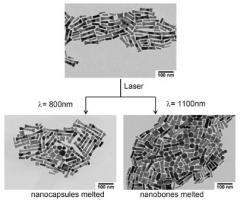
The top image shows a mixture of gold nanoparticles. The longer particles are called nanobones, and the smaller are nanocapsules. Bottom left: After the nanoparticles are hit with 800 nanometer wavelength infrared light, the nanocapsules melt and release their payload. Nanobones remain intact. Right: After the nanoparticles are hit with 1100 nanometer wavelength infrared light, the nanobones melt and release their payload. Nanocapsules remain intact. Image: Andy Wijaya

(PhysOrg.com) -- Using tiny gold particles and infrared light, MIT researchers have developed a drug-delivery system that allows multiple drugs to be released in a controlled fashion.

Such a system could one day be used to provide more control when battling diseases commonly treated with more than one drug, according to the researchers.

"With a lot of diseases, especially cancer and AIDS, you get a synergistic effect with more than one drug," said Kimberly Hamad-Schifferli, assistant professor of biological and mechanical engineering and senior author of a paper on the work that recently appeared in the journal ACS Nano.

Delivery devices already exist that can release two drugs, but the timing of the release must be built into the device — it cannot be controlled from outside the body. The new system is controlled externally and theoretically could deliver up to three or four drugs.

The new technique takes advantage of the fact that when gold nanoparticles are exposed to infrared light, they melt and release drug payloads attached to their surfaces.

Nanoparticles of different shapes respond to different infrared wavelengths, so "just by controlling the infrared wavelength, we can choose the release time" for each drug, said Andy Wijaya, graduate student in chemical engineering and lead author of the paper.

The team built two different shapes of nanoparticles, which they call "nanobones" and "nanocapsules." Nanobones melt at light wavelengths of 1,100 nanometers, and nanocapsules at 800 nanometers.

In the ACS Nano study, the researchers tested the particles with a payload of DNA. Each nanoparticle can carry hundreds of strands of DNA, and could also be engineered to transport other types of drugs.

In theory, up to four different-shaped particles could be developed, each releasing its payload at different wavelengths.

Provided by Massachusetts Institute of Technology


print this article email this article download pdf blog this article bookmark this article     Digg this Stumble it share on Facebook share on Reddit add to delicious save to Yahoo! bookmarks
5/5 after 2 votes


December 30th, 2008 all stories
Nanotechnology / Bio & Medicine

Comments: 0
Rank: 5/5 after 2 votes

  • Stumble this up

  • Digg this

  • Share it:
  • share on Facebook
  • share on MySpace
  • share on Slashdot
  • rss-newsfeed
  • share on Google
  • share on Reddit
  • add to delicious
  • save to Yahoo! bookmarks
  • share on Windows Live
  • Add to Mixx!
Rating: 5/5 after 2 votes


  • Physicists Demonstrate Quantum Memory with Matter Qubits
    Physicists Demonstrate Quantum Memory with Matter Qubits
    Physics / General Physics
    created Jul 03, 2009 | popularity 4.4 / 5 (17) | comments 1
  • 'Holey' Nanosheets for Wastewater Dye Removal
    Nanotechnology / Nanomaterials
    created Jul 01, 2009 | popularity 5 / 5 (5) | comments 1
  • Jellyfish Robot Swims Like its Biological Counterpart
    Jellyfish Robot Swims Like its Biological Counterpart
    Electronics / Robotics
    created Jun 26, 2009 | popularity 4.4 / 5 (8) | comments 1
  • Could Maxwell's Demon Exist in Nanoscale Systems?
    Could Maxwell's Demon Exist in Nanoscale Systems?
    Physics / General Physics
    created Jun 24, 2009 | popularity 4.4 / 5 (18) | comments 29
  • Living Safely with Robots, Beyond Asimov's Laws
    Living Safely with Robots, Beyond Asimov's Laws
    Electronics / Robotics
    created Jun 22, 2009 | popularity 4.6 / 5 (52) | comments 40
  • Other News

    A 'quantum of sol' -- how nanotechnology could hold the key to a solar-powered future

    A 'quantum of sol' -- how nanotechnology could hold the key to a solar-powered future

    Nanotechnology / Nanomaterials

    created Jun 30, 2009 | popularity 3.9 / 5 (14) | comments 16

    (PhysOrg.com) -- A new generation of 'nano-structured' millimetre-sized solar cells that could convert the sun's energy to electricity more than twice as efficiently as current technology, is the subject of ...


    Australian researchers are set to begin human trials of a tiny nano-cell that acts as a "Trojan horse" against cancer

    Hi-tech 'Trojan horse' can kill cancer cells: researchers

    Nanotechnology / Bio & Medicine

    created Jun 29, 2009 | popularity 4.6 / 5 (11) | comments 7

    Australian researchers are set to begin human trials of a tiny nano-cell that acts as a "Trojan horse" against cancer cells, a breakthrough they say may curb the need for debilitating chemotherapy.


    'Holey' Nanosheets for Wastewater Dye Removal

    Nanotechnology / Nanomaterials

    created Jul 01, 2009 | popularity 5 / 5 (5) | comments 1

    (PhysOrg.com) -- Researchers have discovered that extremely thin sheets of nickel oxide with hexagonally shaped holes can absorb hazardous dyes from wastewater nearly as well as the best traditional methods, but are recyclable. ...


    Harnessing Nanoparticles To Track Cancer Cell Changes

    Nanotechnology / Bio & Medicine

    created Jul 03, 2009 | popularity not rated yet | comments 1

    The more dots there are, the more accurate a picture you get when you connect them. Cancer researchers adopting that philosophy have developed a new imaging technology that could give scientists the ability to simultaneously ...


    Computer-Guided Nanoparticle Therapy Destroys Tumors

    Nanotechnology / Bio & Medicine

    created Jun 29, 2009 | popularity 5 / 5 (11) | comments 0

    Gold nanoshells are among the most promising new nanoscale therapeutics being developed to kill tumors, acting as antennas that turn light energy into heat that cooks cancer to death. Now, a multi-institutional research team ...