Mars Rovers Near Five Years of Science and Discovery
December 30, 2008
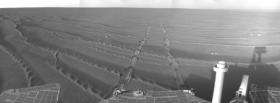
This mosaic of frames from the navigation camera on NASA's Mars Exploration Rover Opportunity gives a view to the northeast from the rover's position on its 1,687th Martian day, or sol (Oct. 22, 2008). By that date, Opportunity had driven southwestward from Victoria Crater, beginning a long trek toward a larger crater, Endeavour. Image: NASA/JPL-Caltech
(PhysOrg.com) -- NASA rovers Spirit and Opportunity may still have big achievements ahead as they approach the fifth anniversaries of their memorable landings on Mars.
Of the hundreds of engineers and scientists who cheered at NASA's Jet Propulsion Laboratory in Pasadena, Calif., on Jan. 3, 2004, when Spirit landed safely, and 21 days later when Opportunity followed suit, none predicted the team would still be operating both rovers in 2009.
"The American taxpayer was told three months for each rover was the prime mission plan," said Ed Weiler, associate administrator for NASA's Science Mission Directorate at NASA Headquarters in Washington. "The twins have worked almost 20 times that long. That's an extraordinary return of investment in these challenging budgetary times."
The rovers have made important discoveries about wet and violent environments on ancient Mars. They also have returned a quarter-million images, driven more than 21 kilometers (13 miles), climbed a mountain, descended into craters, struggled with sand traps and aging hardware, survived dust storms, and relayed more than 36 gigabytes of data via NASA's Mars Odyssey orbiter. To date, the rovers remain operational for new campaigns the team has planned for them.
"These rovers are incredibly resilient considering the extreme environment the hardware experiences every day," said John Callas, JPL project manager for Spirit and Opportunity. "We realize that a major rover component on either vehicle could fail at any time and end a mission with no advance notice, but on the other hand, we could accomplish the equivalent duration of four more prime missions on each rover in the year ahead."
Occasional cleaning of dust from the rovers' solar panels by Martian wind has provided unanticipated aid to the vehicles' longevity. However, it is unreliable aid. Spirit has not had a good cleaning for more than 18 months. Dust-coated solar panels barely provided enough power for Spirit to survive its third southern-hemisphere winter, which ended in December.
"This last winter was a squeaker for Spirit," Callas said. "We just made it through."
With Spirit's energy rising for spring and summer, the team plans to drive the rover to a pair of destinations about 183 meters (200 yards) south of the site where Spirit spent most of 2008. One is a mound that might yield support for an interpretation that a plateau Spirit has studied since 2006, called Home Plate, is a remnant of a once more-extensive sheet of explosive volcanic material. The other destination is a house-size pit called Goddard.
"Goddard doesn't look like an impact crater," said Steve Squyres of Cornell University, in Ithaca, N.Y. Squyres is principal investigator for the rover science instruments. "We suspect it might be a volcanic explosion crater, and that's something we haven't seen before."
A light-toned ring around the inside of the pit might add information about a nearby patch of bright, silica-rich soil that Squyres counts as Spirit's most important discovery so far. Spirit churned up the silica in mid-2007 with an immobile wheel that the rover has dragged like an anchor since it quit working in 2006. The silica was likely produced in an environment of hot springs or steam vents.
For Opportunity, the next major destination is Endeavour Crater. It is approximately 22 kilometers (14 miles) in diameter, more than 20 times larger than another impact crater, Victoria, where Opportunity spent most of the past two years. Although Endeavour is about 12 kilometers (7 miles) from Victoria, it is considerably farther as the rover drives on a route evading major obstacles.
Since climbing out of Victoria four months ago, Opportunity has driven more than a mile of its route toward Endeavour and stopped to inspect the first of several loose rocks the team plans to examine along the way. High-resolution images from NASA's Mars Reconnaissance Orbiter, which reached Mars in 2006, are helping the team plot routes around potential sand traps that were not previously discernable from orbit.
"We keep setting the bar higher for what these rovers can do," said Frank Hartman, a JPL rover driver. "Once it seemed like a crazy idea to go to Endeavour, but now we're doing it."
Squyres said, "The journeys have been motivated by science, but have led to something else important. This has turned into humanity's first overland expedition on another planet. When people look back on this period of Mars exploration decades from now, Spirit and Opportunity may be considered most significant not for the science they accomplished, but for the first time we truly went exploring across the surface of Mars."
Provided by NASA
-
Mars-bound NASA rover carries coin for camera checkup
Feb 07, 2012 |
4.2 / 5 (6) |
10
-
Durable NASA rover beginning ninth year of Mars work
Jan 25, 2012 |
4.8 / 5 (4) |
1
-
Three generations of rovers with crouching engineers
Jan 20, 2012 |
4.3 / 5 (3) |
0
-
Curiosity rover will serve as terramechanics instrument in explortation of Martian soils
Jan 20, 2012 |
5 / 5 (2) |
0
-
'Greeley Haven' is winter workplace for Mars rover
Jan 06, 2012 |
5 / 5 (2) |
1
-
Engineers build first sub-10-nm carbon nanotube transistor
Feb 01, 2012 |
4.9 / 5 (33) |
30
-
Something old, something new: Evolution and the structural divergence of duplicate genes
Jan 31, 2012 |
4.6 / 5 (7) |
1
-
The hidden nanoworld of ice crystals: Revealing the dynamic behavior of quasi-liquid layers
Jan 30, 2012 |
5 / 5 (5) |
1
-
Stock market network reveals investor clustering
Jan 27, 2012 |
3.9 / 5 (23) |
8
-
Of microchemistry and molecules: Electronic microfluidic device synthesizes biocompatible probes
Jan 26, 2012 |
5 / 5 (2) |
0
-
Never ending outer space.....
Feb 11, 2012
-
Neutron Star fragments?
Feb 11, 2012
-
stationary or not?
Feb 11, 2012
-
Scale of the Universe
Feb 10, 2012
-
Titan's lack of impact craters
Feb 09, 2012
-
Real pictures of black hole eating a star?
Feb 08, 2012
- More from Physics Forums - General Astronomy
More news stories
Climate change causes harmful algal blooms in North Atlantic: study
Warming oceans and increases in windiness could be causing of an abundance of harmful algal blooms in the North Atlantic Ocean and North Sea, according to new research.
2 hours ago |
not rated yet |
0
New European rocket lifts off on maiden flight
A new lightweight rocket, Vega, lifted off from Europe's space base Monday carrying nine satellites on its inaugural flight, mission control said.
Space & Earth / Space Exploration
55 minutes ago |
5 / 5 (2) |
1
Salvage workers begin pumping fuel from Italian shipwreck
Salvage workers Sunday began pumping fuel from the shipwrecked Italian cruise liner Costa Concordia, a day ahead of schedule, officials said.
17 hours ago |
5 / 5 (2) |
0
NASA budget will axe Mars deal with Europe: scientists
US President Barack Obama's budget proposal to be submitted next week for 2013 will cut NASA's budget by 20 percent and eliminate a major partnership with Europe on Mars exploration, scientists said Thursday.
Space & Earth / Space Exploration
Feb 10, 2012 |
5 / 5 (4) |
59
Humans may have helped the decline of African rainforests 3000 years ago
(PhysOrg.com) -- Large areas of rainforests in Central Africa mysteriously disappeared over three thousand years ago, to be replaced by savannas. The prevailing theory has been that the cause was a change ...
New molecule has potential to help treat genetic diseases and HIV
(PhysOrg.com) -- Chemists at The University of Texas at Austin have created a molecule that's so good at tangling itself inside the double helix of a DNA sequence that it can stay there for up to 16 days before ...
Social psychologist: Lust makes you smarter and evidence that seven deadly sins are good for you
(Medical Xpress) -- Good news for lovers on Valentine’s Day - the seven deadly sins, including Lust, are good for you. University of Melbourne social psychologist Dr Simon Laham uses modern research to make a compelling ...
The joy of cheques
An electronic cheque which eliminates the need for costly processing by banks but preserves the simplicity and ease of a traditional cheque book has been designed by a team of academics in the UK.
Research finds injuries to professional athletes from routine play or practice often reported as 'freak accidents' in me
(Medical Xpress) -- A new report from the Johns Hopkins Center for Injury Research and Policy finds injuries to professional athletes from routine play or practice are often characterized as freak accidents in ...
Researchers' paper wins Best Paper Award for 2011
A paper written by Dr. Paul Gratz and his graduate student, Reena Panda, from the Department of Electrical and Computer Engineering at Texas A&M University was selected as one of the best papers from IEEE Computer Architecture ...
Low levels of amplitude-modulated electromagnetic fields elicit therapeutic responses cancer patients
Ryne Ramaker, a senior UALR Donaghey Scholar and University Science Scholar with a double major in biology and chemistry, is a co-author of a cancer research paper creating excitement among other researchers. The article ...
Dec 30, 2008
Rank: not rated yet
5 YEARS ON MARS: MARS EXPLORATION ROVERS
http://www.youtub...UcTGXIjM