A happy new year for penguins
The Bronx Zoo-based Wildlife Conservation Society announced today that its efforts to protect a wildlife-rich coastal region in South America have paid off in the form of a new coastal marine park recently signed into law by the Government of Argentina.
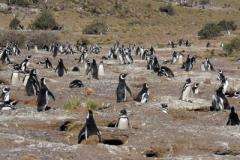
The park, which became official earlier this month, protects half a million penguins along with several species of rare seabirds and the region's only population of South American fur seals. It is the first protected area in Argentina specifically designed to safeguard not only onshore breeding colonies but also areas of ocean where wildlife feed at sea.
The park's creation represents a joint effort by the National Parks Service of Argentina, Government of Chubut, Wildlife Conservation Society and its local partner Fundación Patagonia Natural with support from the United Nations Development Programme and the Global Environment Facility.
WCS researchers, working with Fundación Patagonia Natural, provided critical data of key wildlife to ensure that the park's boundaries would include both onshore areas and adjacent waters. Researchers found that the area was in need of protection from increasing pressures by commercial fishing and the oil industry.
"The park protects one of the most productive and extraordinary marine ecosystems on the planet," said Dr. Guillermo Harris, director of the Wildlife Conservation Society's Argentina Program. "The creation of this park comes in the nick of time for many species that are threatened by the region's fishing and energy industries."
Located in Golfo San Jorge in Chubut Province, some 1056 miles (1700 kilometers) south of Buenos Aires, the new protected area covers approximately 250 square miles (647 square kilometers) of coastal waters and nearby islands strung along almost 100 miles (160 kilometers) of shoreline.
The region serves as a nesting and feeding ground for some quarter million pairs of Magellanic penguin, estimated to represent 25 percent of the entire population in Patagonia. Its 50 small islands also support two nesting colonies of southern giant petrels that represent over 80 percent of its population on the entire Patagonian coast. Other denizens of this coastal oasis include the endangered Olrog's gull, the white-headed steamer duck, and almost one third of all imperial and rock cormorants of Argentina.
While the coastline is largely undeveloped, its wildlife has been increasingly threatened by commercial fishing nets, which can entangle birds as they feed. Oil pollution from tankers transporting petroleum from southern Patagonia to Buenos Aires, coupled with expanding offshore oil drilling, have also loomed as growing threats in recent years.
Mitsubishi Corporation Foundation for the Americas has provided funding for the creation of this unique coastal protected area and for WCS's multi-faceted efforts to safeguard coastal Patagonia, including the Sea & Sky program, which is committed to achieving long-term viability of the Patagonian Sea by integrating the best available science, building capacity and providing inspiration to promote local interest in ocean conservation.
WCS has been active in Patagonia since the 1960s, conducting studies for the conservation of southern right whales, Magellanic penguins, southern elephant seals, and other unique wildlife. WCS manages some 740,000 acres of wilderness on the Chilean side of Tierra del Fuego, part of a major donation of land made by Goldman Sachs in 2004.
Source: Wildlife Conservation Society


