Researchers prove food safety to help commercialize irradiation technology
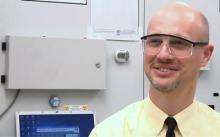
Michigan State University researchers are helping a technology startup company improve the safety of leafy greens and other foods as more consumers seek to eat fresh and healthy.
Bradley Marks and Sanghyup Jeong are proving that X-rays can kill bacterial pathogens such as E. coli 0157:H7 and salmonella on the most delicate vegetables, extending shelf life in the bargain. Irradiation from other sources has been used for years to protect ground meat and other products, essentially pasteurizing food without cooking it.
"Our work to date has shown that X-ray technology is very effective in killing the bacterial pathogens without causing undesirable changes in product quality," Marks said.
They do it by applying a higher dose than is used for medical X-ray imaging, yet less than is used by competing irradiation methods. That means less protective shielding is necessary, so the equipment is more compact and food companies can install it at their processing plants. Currently, food must be transported to specialty facilities, which eliminates irradiation as an option for much fresh produce.
Marks and Jeong work in the MSU Department of Biosystems and Agricultural Engineering and collaborate with Elliot Ryser, a microbiologist in the Department of Food Science and Human Nutrition. They are using MSU's unique biosafety level-2 pilot processing facility to validate technology being commercialized by Rayfresh Foods Inc. of Ann Arbor.
"The problem the leafy green industry faces is there is absolutely no kill step in the process of cleaning, rinsing and bagging the product. There is nothing they can do," explained Peter Schoch, Rayfresh's CEO. The potential for widespread contamination is compounded by the mingling of greens from different sources in processing plants, he said.
Food irradiation - which does not in any way render food radioactive - today uses gamma rays from radioactive material or machine-generated electron beams, Schoch said, both of which tend to cause cellular damage and visually degrade food. X-rays promise a gentler, more scalable solution. Rayfresh recently landed its first contract to build an X-ray machine to treat ground beef for Omaha Steaks, which inspected the prototype at MSU. The university's validation work was pivotal in winning that first order, Schoch said.
"We also have very significant interest from people who produce and use food service lettuce," he added, a product connected to a recent E. coli illness outbreak in Michigan and other states.
Before regulators and the market will accept such devices, however, their use for each food and target bacteria must be scientifically validated. That ensures a continuing role for the MSU testing facility and staff, who also are working on validating the technology to kill salmonella on almonds. Earlier this year the U.S. Food and Drug Administration published a final rule allowing the use of irradiation for iceberg lettuce and fresh spinach, a move expected to open the doors to greater use of the technology for leafy greens. Click to www.fda.gov/consumer/updates/i … radiation082208.html for more information.
Regulators have studied irradiation of food for 40 years and approved its use for red meat in 1997. Irradiation also now may be applied to other foods such as spices, poultry and shellfish including oysters, clams and scallops.
The world food irradiation market is predicted to exceed $2.3 billion by 2012, according to Global Industry Analysts Inc.
Source: Michigan State University


