Hubble telescope to get last tuneup during International Year of Astronomy
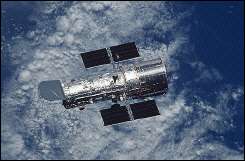
From troubled beginnings nearly 18 years ago, the Hubble Space Telescope has revolutionized astronomy and its stunning images have stirred the imaginations of people around the globe.
But as the International Year of Astronomy dawns, the renowned telescope is preparing for its final chapter, starting with the scheduled May 12 launch of the space shuttle Atlantis for NASA's fifth and final service mission to the telescope.
The repairs will provide Hubble with a future as bright, though perhaps not nearly as long, as its past, said Julianne Dalcanton, a University of Washington associate professor of astronomy who for nearly a decade has used the telescope for a major part of her research.
Dalcanton is the author of a review article in the Jan. 1 edition of Nature that recounts the storied history of Hubble and its many contributions to astronomy, most of which could not have been achieved by ground-based telescopes.
She attributes Hubble's success to the fact that it orbits nearly 350 miles above the Earth, far removed from the atmosphere and ambient light that limit the effectiveness of ground-based telescopes, and says the upcoming servicing mission will likely allow Hubble to add to its already rich legacy of scientific discovery.
That legacy includes helping to revolutionize astronomers' understanding of phenomena called black holes and their role in forming galaxies; more detailed observations of pulsating stars called Cepheids that enhanced the ability to judge the huge distances involved in stellar astronomy; and, most recently, producing an image, the first direct evidence, of a planet orbiting a star outside our solar system.
"One of the things Hubble has done is enhance the precision with which we can carry out research," Dalcanton said. "And the images produced have really spurred public interest. Those pictures are on screen savers throughout the world."
Hubble was launched on April 24, 1990, as a joint venture of NASA, the European Space Agency and the Space Telescope Science Institute. But the mission got off to a rocky start when it was discovered that an error had been made in fabricating the main mirror and its images were often fuzzy at best. The problem was corrected on NASA's first service mission in 1993 and the telescope has been wildly successful ever since.
One of the biggest successes, Dalcanton believes, is the democratization of Hubble's data. Astronomers place requests for the telescope to make specific observations, and if their project is accepted the data is returned to them to continue their work. But after one year, the data becomes available for anyone to use for any type of study.
"You don't have to be at Harvard or CalTech. You can be at a small Midwestern liberal arts teaching college and still have the opportunity to work with Hubble data," she said.
Asked what Hubble's greatest contribution is, Dalcanton was hard pressed to single one out from among the telescope's many accomplishments. She suspects the answers might vary greatly among astronomers who have different research goals.
The upcoming service mission, among other things, will replace gyroscopes and heat shields, upgrade instruments and add "some spiffy new capabilities that will allow us to make much deeper observations."
Dalcanton is pleased that she and others will have at least another five years or so to work with Hubble. The telescope eventually will be replaced by the James Webb Space Telescope, though the Webb telescope will focus more on the infrared part of the spectrum and won't produce the same type of images that Hubble has.
"It's a great telescope and I'm happy to be part of it," she said. "Like any tool, the more you use it the more you are able to get the best out of it."
Source: University of Washington


