The gold standard: researchers use nanoparticles to make 3-D DNA nanotubes
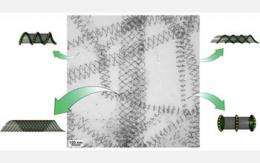
Arizona State University researchers Hao Yan and Yan Liu imagine and assemble intricate structures on a scale almost unfathomably small. Their medium is the double-helical DNA molecule, a versatile building material offering near limitless construction potential.
In the January 2, 2009 issue of Science, Yan and Liu, researchers at ASU's Biodesign Institute and faculty in the Department of Chemistry and Biochemistry, reveal for the first time the three-dimensional character of DNA nanotubules, rings and spirals, each a few hundred thousandths the diameter of a human hair. These DNA nanotubes and other synthetic nanostructures may soon find their way into a new generation of ultra-tiny electronic and biomedical innovations.
Yan and Liu are working in the rapidly proliferating field of structural DNA nanotechnology. By copying a page from nature's guidebook, they capitalize on the DNA molecule's remarkable properties of self-assembly. When ribbonlike strands of the molecule are brought together, they fasten to each other like strips of Velcro, according to simple rules governing the pairing of their four chemical bases, (labeled A, C, T and G). From this meager alphabet, nature has wrung a mind-bending multiplicity of forms. DNA accomplishes this through the cellular synthesis of structural proteins, coded for by specific sequences of the bases. Such proteins are fundamental constituents of living matter, forming cell walls, vessels, tissues and organs. But DNA itself can also form stable architectural structures, and may be artificially cajoled into doing so.
In his research, Yan has been much inspired by nanoscale ingenuity in the natural world: "Unicellular creatures like oceanic diatoms," he points out, "contain self-assembled protein architectures." These diverse forms of enormous delicacy and organismic practicality are frequently the result of the orchestrated self-assembly of both organic and inorganic material.
Scientists in the field of structural DNA nanotechnology, including Dr. Yan's team, have previously demonstrated that pre-fab DNA elements could be induced to self-assemble, forming useful nanostructural platforms or "tiles." Such tiles are able to snap together—with jigsaw puzzle-piece specificity—through base pairing, forming larger arrays.
Yan and Liu's work in Science responds to one of the fundamental challenges in nanotechnology and materials science, the construction of molecular-level forms in three dimensions. To do so, the team uses gold nanoparticles, which can be placed on single-stranded DNA, compelling these flexible molecular tile arrays to bend away from the nanoparticles, curling into closed loops or forming spring-like spirals or nested rings, roughly 30 to 180 nanometers in diameter.
The gold nanoparticles, which coerce DNA strands to arc back on themselves, produce a force known as "steric hindrance," whose magnitude depends on the size of particle used. Using this steric hindrance, Yan and Liu have shown for the first time that DNA nanotubules can be specifically directed to curl into closed rings with high yield.
When 5 nanometer gold particles were used, a milder steric hindrance directed the DNA tiles to curl up and join complementary neighboring segments, often forming spirals of varying diameter in addition to closed rings. A 10 nanometer gold particle however, exerted greater steric hindrance, directing a more tightly constrained curling which, produced mostly closed tubules. Yan stresses that the particle not only participates in the self-assembly process as the directed material, but also as an active agent, inducing and guiding formation of the nanotube.
With the assistance of Anchi Cheng and Jonanthan Brownell at the Scripps Research Institute, they have used an imaging technique known as electron cryotomography to provide the first glimpses of the elusive 3-D architecture of DNA nanotubules. "You quickly freeze the sample in vitreous ice," he explains, describing the process. "This will preserve the native conformation of the structure." Subsequent imaging at various tilted angles allows the reconstruction of the three-dimensional nanostructure, with the gold particles providing enough electron density for crisp visualization. (see movies)
DNA nanotubules will soon be ready to join their carbon nanotube cousins, providing flexible, resilient and manipulatable structures at the molecular level. Extending control over 3-D architectures will lay the foundation for future applications in photometry, photovoltaics, touch screen and flexible displays, as well as for far-reaching biomedical advancements.
"The ability to build three-dimensional structures through self-assembly is really exciting, " Yan says. "It's massively parallel. You can simultaneously produce millions or trillions of copies."
Yan and Liu believe that controlled tubular nanostructures bearing nanoparticles may be applied to the design of electrical channels for cell-cell communication or used in the construction of various nanoelectrical devices.
Source: Arizona State University


