Scientists say comet killed off mammoths, saber-toothed tigers
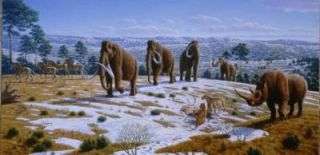
January 2nd, 2009 By Robert Mitchum Woolly Mammoths

Woolly Mammoths. Credit: Mauricio Anton

First an explosion as powerful as thousands of megatons of TNT rained meteorites down on North America. Then forest fires broke out across the continent, sending up a thick layer of soot and dust that blocked out the sun. A sudden ice age ensued, and some of the Earth's largest animals went extinct in a blink of geological time.

It's well known that a meteorite colliding with Earth is considered the most likely reason dinosaurs died off 65 million years ago. Now a team of scientists says it has found new evidence that a comet triggered a similar extinction much more recently: just 13,000 years ago, when humans were around to witness the event and suffer its terrible consequences.

The researchers also think that when the comet exploded above the planet's surface - ultimately killing off mammoths, saber-toothed tigers and other large mammals that roamed North America - Chicago wasn't too far from ground zero.

"If you'd been in Chicago back in that time, it would've been one very bad day," said Allen West, an Arizona geophysicist and one of the authors of a paper appearing Friday in the journal Science.

The scientists, led by University of Oregon anthropologist Douglas Kennett, say their report offers up a "smoking bullet" - proof it was a comet that set off the sudden, thousand-year freeze and wiped out the big animals of the era.

Working at multiple sites across the continent, researchers found nanodiamonds - microscopic particles thought to be found on comets - in a 13,000-year-old layer of rich sedimentary soil called a "black mat." Beneath the layer with the nanodiamonds, fossils of the animals are abundant. After that layer, they disappear, West said.

"It's extraordinary that tens of millions of animals disappeared synchronously at exactly the time when the diamonds and carbon layer are laid down across the continent," said West, whose co-authors include DePaul University chemist Wendy Wolbach.

Arrowheads and other artifacts from the Clovis culture of humans - an early hunter-gatherer society - also vanish after the black mat was laid down 13,000 years ago.

In 2007, West and a team of scientists published an analysis of black mats from several regions that found heavy metals, soot and charcoal suggestive of meteorite impacts and subsequent fires. The new report says the discovery of nanodiamonds in the same material is more evidence of a cosmic strike.

Archeologists have long speculated about whether climate change or over-hunting drove the mammoths, tigers and other "megafauna" to extinction and led to the decline of the Clovis culture.

Many remain skeptical of the comet theory and think there may be better explanations for what happened, said Daniel Amick, an associate professor of anthropology at Loyola University who studies the Clovis culture.

"When most archeologists heard about it they were somewhat dismissive," Amick said. "We would think, 'How in the world could we have missed this? How could this spectacular kind of event have occurred and never even dawned on us?'"

The authors have much to prove before their theory is accepted, Amick said, like pinpointing the date of the event and ruling out other potential causes of extinction and climate change.

In response to one common criticism of the comet theory - that no craters have been found from an impact - West said the comet may not have actually reached Earth, but exploded into fragments somewhere above the surface.

Where exactly that might have happened is a mystery, but high concentrations of nanodiamonds at a site in Eastern Michigan suggest the Great Lakes as a possibility.

"We think that Chicago might well have been very near ground zero," West said.

The idea that a comet may have caused catastrophic climate change and extinction relatively recently in Earth's long history suggests scientists shouldn't dismiss the possibility of it happening again, Wolbach said.

"Should we be doing more to try to deflect future asteroids, or is that too sci-fi?" she said. "If this is true and there was an impact 12.9 thousand years ago, obviously this is not something that's just a theoretical idea, it's a real thing."

___

© 2009, Chicago Tribune.
Visit the Chicago Tribune on the Internet at http://www.chicagotribune.com/
Distributed by McClatchy-Tribune Information Services.


print this article email this article download pdf blog this article bookmark this article     Digg this Stumble it share on Facebook share on Reddit add to delicious save to Yahoo! bookmarks
4.6/5 after 22 votes

Rank Filter

Move the slider to adjust rank threshold, so that you can hide some of the comments.


Display comments: newest first

  • neurogalactus - Jan 02, 2009
    • Rank: 2 / 5 (4)
    That's kind of funny because every some time we see victorious headlines in sort of "X mystery finally solved!", where some scientists reveal a "breakthrough" theory or explanation of why dinosaurs or mammoths or other monsters don't roam the Earth any more. Then, after a few months, another team gets enlightened and abolishes the latest theory with their own "finally accurate" explanation. In fact, however, none of them has a clue. Explain this, wise people: how come ALL mammoths on the entire planet died off, while your theory speaks only of those on the American continent? A comet exploding OVER THE SURFACE? Destroys ALL mammoths and sabre-tooth tigers? ALL of them?? You really sure about that? If so, please explain then. Exactly, I mean. What was the process of the mammoth extinction, with regard to their distribution over a very wide geographic area? Even more: What is the statistical chance that a single semi-impact event destroys ALL species over the entire continent? Could you please show us the relevant calculations/estimates? Thanx in advance.
  • chibiabo - Jan 02, 2009
    • Rank: not rated yet
    Perhaps it would advance some scientists understanding to review the works of Immanuel Velikovsky, "World's In Collision" and "Earth In Upheaval" published some sixty years ago. Amazing that i6t takes these geniuses that long to repeat a theory they laughed at back then.
  • googleplex - Jan 02, 2009
    • Rank: not rated yet
    If the continent burned as they said then the soot and ash would cause a nuclear Winter. Whereby the smog blocks out the sunlight and causes temperatures to drop significantly. The scale of the event would have to be big enough to affect the entire planet.
    Global nulcear war/super volcanoes/massive meteor strikes are all supposed to create a severe Winter that last for over a year. During this time pastures and plants die off and impact the food chain. During a normal Winter most animals survive from fat reserves. However they cannot survive 1 year without food.
    My own view is that large meteor strikes are common and need to be planned for. The earth is unique in that the its craters are hidden under water (75% of earth surface), or eroded away by water, covered by vegetation.
    Take a look at the moon and mars. The most striking features are the craters. The earths atmosphere only protects us from small meteorites.
    Planets are effectively giant meteorite magnets.
  • Hodgepodge - Jan 02, 2009
    • Rank: 5 / 5 (3)
    Neurogalactus, I imagine the reason why the scientists limited their hypothesis to North America is because, well, that is from where all the data were obtained. I can't imagine "Nature" would have allowed the authors of this study to state that megafauna from around the world died out as a result of this when their research only focused on North American sites. I'm sure the authors suggested it in the paper (with the caveat that they would need to look at sites all over the world to truly come to that conclusion), but any scientist that's worth a damn should know that expanding your hypothesis beyond the parameters under which your data were measured is pretty irresponsible and not the sort of thing that journal editors are going to greenlight.
  • theophys - Jan 02, 2009
    • Rank: not rated yet
    So, basically. a collision caused an ice age that supposedly wiped out the mammoth's and the saber tooth's. Correct me if I'm wrong, but weren't the mammoths built for very cold climates? I would think that the reduction of food would merely reduce the mammoth population. Seeing as we still have a lot of plants in North America, the entire vegitation population wasn't wiped out, so there was still food around. Since this theory gives the mammoth a comfortable climate to live in and leaves some food to graze on, I don't think it can be labeled as the number one reason for the mammoth extinction. they may be right about the commet, but I really don't think you could wipe out that particular species in that particular scenario.
  • neurogalactus - Jan 02, 2009
    • Rank: 1 / 5 (1)
    googleplex,
    Hodgepodge,

    I am fully aware of the nuclear winter scenario, but I somehow cannot imagine that an OVER-THE-SURFACE impact (so, in fact, not quite an impact) would be capable of raising so much ash that it affects the entire planet, especially if no crater has been found. I am more inclined to accept the impact scenario in case of the dinosaurs' extinction, as there is a huge crater on the Yucatan peninsula. Another question I would have is: how come only select species died out, while other survived (humans, crocodiles, tigers, lions, birds, etc.)? After all, they all depended on the food supply, particularly the predators that, I imagine, would have been much more sensitive to nuclear winter conditions than, say, rodents, or even some larger herbivores. But somehow they made it through. I'm not saying the impact theory IS wrong, but that there has been NO proof that it is RIGHT. And then, if we're speaking of unjustified extensions of scientific theses, for me what those guys presented is just that: they ASSUME that a certain impact that might have happened (or not) resulted in the extinction of a few species on the entire continent. So, again, I'm asking: what makes them so sure that the impact was indeed so strong as to inflict destruction on such a vast area? Maybe it just wiped out some species locally?
    But still, if you can convince me with proofs, I'll stay corrected. Until then, I remain doubtful. Peace! \m/
  • neurogalactus - Jan 02, 2009
    • Rank: not rated yet
    theophys,

    That's very close to my point!
    Have there ever been any simulations about the relationship between a species population growth and prolonged shortage of food supply? How much of flora would need to be lost in order to trigger the ultimate extinction of a herbivorous species?
  • bugmenot23 - Jan 02, 2009
    • Rank: not rated yet
    Wasn't Chicago under an icesheet 13K years ago? I heard a theory about a meteor impact on that icesheet that of course left no crater. How would meltback change the distribution of these nanodiamonds/black mat?
  • nkalanaga - Jan 02, 2009
    • Rank: 3 / 5 (1)
    An airburst could easily produce that much ash, as the thermal radiation would ignite anything burnable. The first atomic bomb set fire to much of a city, even though it exploded in the air. Since hot air rises, the resulting winds would have carried the ash far beyond the explosion site.
  • A_Paradox - Jan 03, 2009
    • Rank: 3 / 5 (1)
    neurogalactus makes some good points.

    One _possible_ explanation/solution to the main question might be that the comet had previously passed Earth in a very near miss such that the tidal effect had disrupted it into a "smear" of snow and dust. Then next time/later its impact was like a sheet of water coming out of a bucket rather than a single lump.

    I have seen this 'near miss with tidal disruption' idea used to explain _pairs_ of impact craters found in various parts of the world. In those cases the idea seems to be that the time between near-miss and impact was quite long so that the cometary material re-combined due to self-gravity but the near-miss had added angular momentum which stabilised the products into two mutually orbiting collections.

    Perhaps the comet discussed in the article did not have time to recombine.
  • Fazer - Jan 03, 2009
    • Rank: 4 / 5 (1)
    I am definitely no expert on the subject, but the scenario makes sense to me: Meteors explode above North America, killing many plants and animals outright. Plant life is scarce, so the remaining animals begin to starve. Human (Clovis) survivors prey on the mammoths, further decimating their population, eventually driving them to extinction. Since the Clovis people depended upon hunting for sustinance, their population dwindled and disappeared. This could all happen within a few generations, appearing as a near instantaneous event in geologic timescales.

    Other Mammoth populations around the world may have been nice and comfy in the suddenly cooler conditions resulting from the dust and soot in the atmosphere, but with so many possible side effects from the disaster, the overall changing conditions would be hard for a large, long-lived species to cope with whilst competing for food against humans and smaller, more adaptable species, so the Mammoth populations dwindled, perhaps at a slower rate than in N. America. Overall, the Mammoths were doomed to extinction anyway with global temperatures rising toward the interglacial period, so even those least affected by the meteor event eventually died off as the warming continued.
  • brant - Jan 03, 2009
    • Rank: not rated yet
    "explosion as powerful as thousands of megatons of TNT"

    That would be me after beans and rice......

    How about a huge lightning bolt that made some (flat bottomed)craters and killed the dinos....
  • Nartoon - Jan 03, 2009
    • Rank: 5 / 5 (1)
    Perhaps all the Woolly Mammoths and saber-toothed tigers were having a giant convention in Chicago?
  • theophys - Jan 03, 2009
    • Rank: not rated yet
    This could all happen within a few generations, appearing as a near instantaneous event in geologic timescales.

    Considering the relatively small population of Clovis, and the number of people a signle mamoth could feed, I don't think that a comet strike without the power to devestate life globaly could do that much damage.
  • aufever - Jan 04, 2009
    • Rank: not rated yet
    I have often wondered if the Glaciers that occured after the event moved the evidence. Hudson Bay sure looks like an Impact Crater from a Satellite
  • Pointedly - Jan 04, 2009
    • Rank: not rated yet
    Why do findings in "Eastern" Michigan point to Chicago?
  • BucketfootAl - Jan 04, 2009
    • Rank: 5 / 5 (3)
    A few points in addition to some good comments above re: lack of an obvious impact crater. It is interesting that many major extinction events seem to be related to some type of extra-terrestrial impact.

    Personally this made sense to me since the mystery of the dinosaurs' sudden disappearance was solved. You need a major event to have many species vanish in a blink of geological time. The width of the loss of mega-fauna in N. America certainly puzzled me for years.

    Yes, man's hunting was a factor, but perhaps not THE factor. Regarding a global winter, small animals and reptiles can survive by staying in burrows or simply (as in the case of larger reptiles) by going into hibernation underground. There are crocodiles in small pockets within the Sahara Desert that do just that for much of the year until water returns. (Sounds crazy but its true. Saw it on Discovery.) Plus reptiles do not have to eat nearly as often. A large Croc or Gator can go for a year without eating if the conditions require it. Ever wonder how turtles, snakes and frogs make it through the Northern Winters? That's right. They hibernate underground.

    Larger warm-blooded animals are impacted much more quickly by a severe climate change because they have no time to adapt, and require large amounts of food daily. (Same reason why the warm-blooded dinosaurs could not make it, though the severity of the Chixculub catastrophe was so great that none might have made it beyond a week in that event). So, when you start hacking down that food chain, its the biggest timbers that go down first. Remove the vegetation and you soon remove the herbivores, remove them and the large carnivores follow suit.

    Because this strike was in the Northern Hemisphere, it is likely that the 'unscheduled winter' also had an impact on Siberia and Northern Europe - hence the extinction of the Mammoths there as well (with an assist from hungry humans).

    You will note that the larger species related to the extinct megafauna tend to have survived in sub-tropical and tropical climates that would not have been as badly affected by the impact. Simply put, life in a cold climate is closer to the razor's edge than life in the Tropics. A few degrees' drop in the former may not be survivable, while in the latter the impact of that temperature drop might be negligible.

    This isn't exactly rocket science, but it does require some basic knowledge of the mechanics of the food chain. I am just an educated layman when it comes to science, have to say a bit surprised by some of the ignorant comments posted so cavalierly upthread. Expected a couple of posters to bring up 'the Great Flood' as the extinction's cause, but apparently they pulled up just before doing so.

    I don't mean to sound snippy here, but as a historian and former prosecutor trained in amassing and sifting through evidence logically and methodically before arriving at a conclusion, the unwillingness or otherwise intelligent people to do likewise always rubs me the wrong way.
  • StoneMan - Mar 22, 2009
    • Rank: not rated yet
    Well, here's the facts:

    1) Soot layer, nanodiamonds, and other oddities are clear evidence of a large comet impact at that time.

    2) Megafauna are completely missing above this layer.

    Whether it was the initial impact, ensuing fires, lack of food, and/or nuclear winter, there seems little doubt a comet impact resulted in the extinction.

January 2nd, 2009 all stories
Space & Earth / Earth Sciences

Comments: 18
Rank: 4.6/5 after 22 votes

  • Stumble this up

  • Digg this

  • Share it:
  • share on Facebook
  • share on MySpace
  • share on Slashdot
  • rss-newsfeed
  • share on Google
  • share on Reddit
  • add to delicious
  • save to Yahoo! bookmarks
  • share on Windows Live
  • Add to Mixx!
Rating: 4.6/5 after 22 votes


  • Physicists Demonstrate Quantum Memory with Matter Qubits
    Physicists Demonstrate Quantum Memory with Matter Qubits
    Physics / General Physics
    created Jul 03, 2009 | popularity 4.4 / 5 (17) | comments 1
  • 'Holey' Nanosheets for Wastewater Dye Removal
    Nanotechnology / Nanomaterials
    created Jul 01, 2009 | popularity 5 / 5 (5) | comments 1
  • Jellyfish Robot Swims Like its Biological Counterpart
    Jellyfish Robot Swims Like its Biological Counterpart
    Electronics / Robotics
    created Jun 26, 2009 | popularity 4.4 / 5 (8) | comments 1
  • Could Maxwell's Demon Exist in Nanoscale Systems?
    Could Maxwell's Demon Exist in Nanoscale Systems?
    Physics / General Physics
    created Jun 24, 2009 | popularity 4.4 / 5 (18) | comments 29
  • Living Safely with Robots, Beyond Asimov's Laws
    Living Safely with Robots, Beyond Asimov's Laws
    Electronics / Robotics
    created Jun 22, 2009 | popularity 4.6 / 5 (54) | comments 40
  • Other News

    Researchers test new 'space Internet' system on International Space Station

    Researchers test new 'space Internet' system on International Space Station

    Space & Earth / Space Exploration

    created 2 hours ago | popularity not rated yet | comments 0

    The University of Colorado at Boulder is working with NASA to develop a new communications technology now being tested on the International Space Station, which will extend Earth's Internet into outer space ...


    Space Station Marathon

    Space Station Marathon

    Space & Earth / Space Exploration

    created 1hour ago | popularity not rated yet | comments 0

    The International Space Station (ISS) is about to make a remarkable series of flybys over the United States. Beginning this 4th of July weekend, the station will appear once, twice, and sometimes three times ...


    China environmental phenomena monitored from space

    Space & Earth / Earth Sciences

    created 5 hours ago | popularity not rated yet | comments 0

    China is in a very seismically active area and has had many catastrophic earthquakes during its history. A joint European-Chinese team is using satellite radar data to monitor ground deformation across major continental faults ...


    California to require sun-blocking car windows

    Space & Earth / Environment

    created 7 hours ago | popularity 2 / 5 (4) | comments 10

    New cars sold in California must include windshields that block or absorb the sun's rays beginning in 2012, the state's Air Resources Board recently ruled.


    Proba-2's journey to Russia marks its first step towards space

    Proba-2's journey to Russia marks its first step towards space

    Space & Earth / Space Exploration

    created 1hour ago | popularity not rated yet | comments 0

    (PhysOrg.com) -- Proba-2, one of the smallest satellites ESA has ever built for space, is about to leave its Belgian homeland. Its development and testing complete, the satellite is being packed up for the ...