Researchers Show Why Peer Discussion Improves Student Performance on 'Clicker' Questions
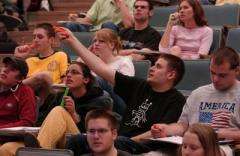
(PhysOrg.com) -- Across the University of Colorado at Boulder campus students are sharing answers, checking their responses to questions against those of their neighbors and making adjustments to those answers in hopes of earning a better grade.
Not surprisingly, the students are getting more answers right. But what may be startling is that professors are encouraging the whole thing.
The students aren't cheating, they are learning from each other in a meaningful way, according to Tin Tin Su, an associate professor in the molecular, cellular and developmental biology department. Su is one of a group of CU-Boulder researchers that also includes Michelle Smith, William Wood, Wendy Adams, Carl Wieman (also of the University of British Columbia), Jennifer Knight and Nancy Guild, who authored a paper in the Jan. 2 issue of the journal Science showing how peer discussion during "clicker" questions helps students learn in a way that simple lecturing does not.
Clickers are simple audience response devices, similar to a TV remote control, that allow students to record their answers to thought-provoking, multiple-choice questions in class. After students answer a question individually, the instructor often asks them to discuss the question and then vote again before revealing the answer. After discussion, they usually do better on the question - but why?
"I was skeptical about whether in-class discussion really led to students' learning," said Su. "The clickers are a good way to get instant feedback, but do the students really learn from discussion or are they just changing their answers because of peer pressure?" Since no study had ever been done to determine which of these possibilities was true, Su and a number of other researchers decided to find out.
"We came up with a method for testing whether the students are actually learning or just being influenced by other students who they think know the right answer," said Michelle Smith, a science teaching fellow with CU's Science Education Initiative and a research associate in MCD biology.
The researchers used pairs of similar clicker questions in lectures during the semester and evaluated student responses. Each time, the students answered the first question of the pair individually, then talked to their neighbors about their answers.
Then they were asked to answer a second, similar question individually. About 50 percent got the question right on the first try. After talking to neighbors, the number jumped to 68 percent. And when they individually answered a follow-up question about the same concept, the number jumped again to over 70 percent, much better than the 50 percent of individual correct answers on the first question.
"There was no influence from the instructor during the clicker question series," said Smith. "We were just giving students the opportunity to talk to each other."
Su said the improvement on the first question after discussion didn't surprise her. She said it's possible the students were not learning but just copying answers. But by adding the element of a follow-up question, the truth became clear.
"The important point is that none of the students were told what the right answer was," said Su. "Even when students in a discussion group all got the initial answer wrong, after talking to each other they were able to figure out the correct response, to learn. That was unexpected, and I think that's dramatic."
Instructors at CU-Boulder began using a simple colored card system for student voting -- a precursor to clickers -- during lectures in 1996. Mike Dubson, senior instructor and associate chair in the physics department, got the first wave of clickers in 2000 when a system known as H-ITT became cheap enough for students to afford. At the height of their popularity, H-ITT clickers were used by about 6,000 CU-Boulder students in astronomy, atmospheric sciences, geology, engineering and MCD biology, according to Dubson.
But Dubson said the H-ITT clickers had their drawbacks. They required a lot of maintenance, infrastructure and training of instructors and students. By spring of 2006 the problems were solved by the introduction of the current generation of iClickers, a cheaper, simpler design than the H-ITT clicker that requires no wiring. The iClicker has only one small base receiver that attaches to an instructor's laptop.
Dubson said the most important advance in clicker usage at CU-Boulder came in the spring of 2007 when the university's Information Technology Services began supporting the iClicker and maintaining a clicker registration site. "The centralized clicker registration system really lowered the barrier for a lot of students and made the logistics of using clickers in your classroom easier," said Dubson.
The iClicker costs $40 and requires a one-time registration. The best part, said Dubson, is that a freshman can use his or her clicker for the entire four years at CU-Boulder.
"A physics major is going to use the iClicker in 15 courses in their career," said Dubson. "That's not much of a financial burden."
Today 17,000 CU-Boulder students own a clicker and 135 classes require them, according to Dubson. Clickers also are used by professors in the social sciences and humanities.
Provided by University of Colorado at Boulder


