High numbers of right whales seen in Gulf of Maine
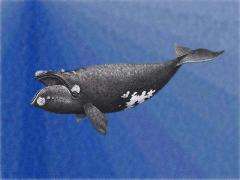
A large number of North Atlantic right whales have been seen in the Gulf of Maine in recent days, leading right whale researchers at NOAA's Northeast Fisheries Science Center (NEFSC) to believe they have identified a wintering ground and potentially a breeding ground for this endangered species.
The NEFSC's aerial survey team saw 44 individual right whales on December 3 in the Jordan Basin area, located about 70 miles south of Bar Harbor, Maine. Weather permitting, the team regularly surveys the waters from Maine to Long Island and offshore 150 miles to the Hague Line (the U.S.-Canadian border), an area about 25,000 nautical square miles.
"We're excited because seeing 44 right whales together in the Gulf of Maine is a record for the winter months, when daily observations of 3 or 5 animals are much more common," said Tim Cole, who heads the team. "Right whales are baleen whales, and in the winter spend a lot of time diving for food deep in the water column. Seeing so many of them at the surface when we are flying over an area is a bit of luck."
Just a few days later, on December 6, the team observed only three right whales on Cashes Ledge, about 80 miles east of Gloucester, Mass. Cole says the whales are known to be in the region, but actually seeing any of them on any given aerial survey is unpredictable. On December 14, the team saw 41 right whales just west of Jordan Basin.
Many female North Atlantic right whales head south in winter to give birth in the waters off Florida and Georgia, the only known calving ground for this population. Little is known about where other individual right whales go in winter, largely due to surveying conditions. Bad weather, the challenges of finding whales in such a large area, and the resources required to assess their distribution make sightings in winter especially difficult. The aerial surveys, conducted year-round, began in the 1990s.
"Sometimes we will see a whale we haven't seen in years, while other individuals are sighted fairly often," team member Pete Duley said, noting the existing library of photographs of individual right whales that observers have come to know by name based on the patterns of callosities, like barnacles, on the animal's heads. "Because only about 100 right whales, mostly females and their calves, are sighted each year in aerial surveys off the southeast coast, we know the remainder of the population must be somewhere else. We don't know much about where these other whales spend the winter or breed, but we have recently started to look in the Gulf of Maine in winter."
With a population estimated to be about 325 whales, knowing where the whales are at any time is critical to protect them. Finding an aggregation of whales can trigger a management action affording protection, such as slowing ship speeds in the vicinity of the whales. On December 9, new federal speed rules for large ships went into effect to reduce ship strikes of whales, to which North Atlantic right whales are particularly vulnerable.
Since the National Marine Fisheries Service, also known as NOAA Fisheries Service, has federal responsibilities for right whales and other marine mammals under the Marine Mammal Protection Act and Endangered Species Act, the NEFSC is a primary source of information about North Atlantic right whales in the northeast region. The Center conducts scientific research, while the agency's regional office in Gloucester handles policy and regulatory issues. NOAA Fisheries Service also funds research and conservation efforts of many other organizations, including support for stranding networks.
The aerial survey team is part of the NEFSC's Protected Species Branch based at the Center's Woods Hole Laboratory, which conducts research needed to manage protected species off the northeast coast of the U.S. from Maine to North Carolina. The Southeast Fisheries Science Center in Florida, which also deploys aerial survey teams, has similar responsibilities for the southeastern U.S. region, which includes the Gulf of Mexico.
"We regularly exchange information with our colleagues in the southeast, who are currently doing aerial surveys of the right whales now in that region, so we know which whales are there over the winter based on their sightings and can track births," said Allison Glass, another member of the NEFSC survey team. Glass and other team members, who are marine biologists, have flown surveys and worked in the southeast region as well, so they know the individual animals. "It is a very small community, both of whales and of those who study them."
Team members carry a pager to keep up to date on right whale sightings. When a sighting is reported, the maritime community is immediately notified via email, the sighting web site and other automated means. Some days, especially in the summer when many people are out on the water, they receive more than a dozen sighting reports.
Given the large geographical area over which North Atlantic right whales can occur, Cole and NEFSC colleagues developed an aerial grid system a few years ago for the Gulf of Maine and waters around Cape Cod to ensure complete coverage of the region. The grid resulted in consistent surveys of areas infrequently surveyed in the past, like Jordan Basin and the Great South Channel. Those surveys have shown that whales congregate in certain areas at certain times, so the most effort is placed on surveying these areas, with the entire grid still surveyed but on a less frequent basis.
"The whales appear to follow the circulation system of the Gulf of Maine and Georges Bank and pursue their food," said Cole, who has been flying surveys for more than 15 years. "In the winter many of the right whales seem to be in the middle of the Gulf of Maine and off Portsmouth, New Hampshire, and by early spring move into Cape Cod Bay, then the Great South Channel and then eastward toward Georges Basin. By mid-summer they head north into the Bay of Fundy."
The survey team has used a variety of aircraft through the years, from helicopters to seaplanes to the current Twin Otter based at the nearby U.S. Coast Guard Air Station Cape Cod. On each flight, which generally lasts five to six hours, there are two pilots for safety, two observers and a data recorder. Special domed or "bubble" windows on each side of the aircraft permit each observer to scan a wide range of ocean surface. A removable window in the back of the plane allows them to take clear photographs of any right whales they see. Other species of whales and marine mammals sighted are recorded into the data logging system but are not individually photographed. Only right whales are uniquely suited for individual identification from the air.
The pilots are also NOAA employees, part of the agency's Office of Aviation and Marine Operations. Coast Guard Air Station Cape Cod supports the mission, providing their air field and even hangar space as needed for the NOAA plane. "This is a very resource intensive operation," Cole said. "The Coast Guard provides not only financial support but access to their facilities when we are on the Air Station. Like us, they have a responsibility to protect marine resources, so we share this mission with them."
In early January, several colleagues from the Woods Hole Laboratory will head south to continue genetic sampling and tagging studies of right whales off of Florida. During the last three calving seasons, marine mammal scientists have collected small samples of skin and blubber from newborns and adults who have not been previously sampled to track the population through genetic "fingerprinting".
The right whales sampled in Florida are expected to head north to Cape Cod in March, when the NEFSC aerial team will be on the lookout for them.
Source: NOAA National Marine Fisheries Service


