Reality gets hyperlinked
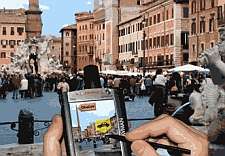
(PhysOrg.com) -- European researchers can now attach hyperlinks to pictures you take using your mobile phone. It offers the prospect of new ways to discover, engage and navigate your surroundings. You wake up in a strange city with no recollection of how you got there and no information about where you are. Demonstrating nerves of steel, you calmly pick up your mobile phone and take a picture of the streetscape.
Quickly, the picture comes alive with hyperlinks, offering the names of the buildings, monuments and streetscape features that appear in the photograph. The hyperlinks lead to information about the history, services and context of all the features in the photograph. You have just hyperlinked your reality.
That scenario might be a little far-fetched, but the technology exists and is no figment of some fevered imagination. This is not a gee-whiz gadget invented by Q for the next James Bond movie; this is a working technology just developed by European researchers. It could be coming to a phone near you, and soon.
This, as the marketing types say, is a game changer. It develops a completely new interface paradigm that meshes web-technology with the real world. It is big and fresh like Apple’s game-changing multi-touch interface for the iPhone. But it goes much further and has implications that are much more profound.
The MOBVIS platform completely rewrites the rules for navigation, exploration and interaction with your physical environment. It identifies the buildings from a photograph you take in an urban environment and then places icons on points of interest.
Technology that pays attention
Then you simply click on the icon, using a cursor or, more frequently, a touch-screen phone, and the MOBVIS system will provide information on the history, art, architecture or even the menu, if it is a restaurant, of the building in question.
MOBVIS stands for mobile attentive interfaces in urban scenarios and it is the brainchild of the EU-funded MOBVIS project, a team of engineers and scientists who have successfully demonstrated the technology working in a real environment, with real users unconnected to the project.
The project’s work is all the more remarkable because image recognition technology has long been pregnant with promise, but seemed to suffer from an unending labour.
Now MOBVIS has not only developed image recognition; it has also developed compelling applications for the technology; and it has done so in the most striking and visible manner by adapting it to the world’s most ubiquitous technology: the mobile phone.
How to hyperlink reality
The system begins with geo-referenced panoramas, photographs that populate a database to establish points of reference in the streetscape. These panoramas form the basis of a city database. It can match buildings, monuments, banners and even logos that appear in the panoramas. Information relating to individual buildings or monuments is then added to the database manually.
Once annotation is complete, it is ready to take queries from mobile users. A user simply takes a picture of the streetscape, MOBVIS compares the user’s photograph to the reference panoramas and the relevant links are returned.
It is as if your picture becomes desktop background, with icons attached to each feature that you can click to navigate the history and culture of the location, or shopping opportunities in front of the user.
This is a lot trickier than it might first seem, because photos are taken in all kinds of light and weather, often at odd angles, and many buildings in Europe’s most beautiful cities, like Graz, Austria, actually look quite similar. How can the system tell them apart, and how can it be sure it is the right building?
This is where the MOBVIS demonstrates its greatest strength and most impressive advance over previous image-recognition technologies. The matching system is cloaked in impressive, intimidating technical concepts, like local invariant feature detection, epipolar geometry and planarity constraints.
Never wrong
But the genius of the system boils down to a higher-dimension, feature-matching algorithm developed by the University of Ljubljana in Slovenia, one of the partners of the project. It can very accurately detect minute but telling differences between similar objects, such as buildings or monuments, both by the appearance of the buildings themselves and their context in the streetscape.
For example, if a building with a particular geometry is beside a bridge, but not neighbouring a department store, then it must be building X. That marks the spot for the relevant information stored in the database, which is rendered as an icon.
It sounds perhaps a little improbable. How could such a system produce reliable results?
In fact, it is remarkable just how accurate this technology turned out to be in real-life tests. Users were given a five-minute instruction by an outside contractor, and then sent around to explore the city of Graz with their mobile phones.
The system reliably detected the right building 80 percent of the time, a figure that Aleš Leonardis, head of the Ljubljana team is convinced can be improved.
“But that’s not the most remarkable result of the prototype test,” stresses Leonardis. “It was remarkable that there were no false positives. Sometimes the system couldn’t identify a building, but it never put the incorrect link on a building.”
The system wasn’t always right, but it was never wrong, sometimes - about 20 percent of the time - it just did not know. This was its first live test. It is a notable achievement, and promises rapid deployment in commercial applications.
MOBVIS project: www.mobvis.org/
Provided by ICT Results


