Physicists are first to 'squeeze' light to quantum limit
January 2nd, 2009 By Kim Luke Physicists are first to 'squeeze' light to quantum limit

Enlarge

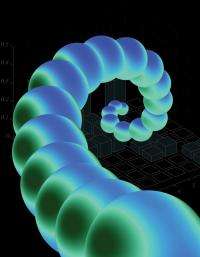
A progression of squeezed triphoton states spiraling outwards. The quantum uncertainty in the triphotons can be represented as a blob on a sphere that becomes progressively "squeezed". Image: Victoria Feistner

(PhysOrg.com) -- A team of University of Toronto physicists have demonstrated a new technique to squeeze light to the fundamental quantum limit, a finding that has potential applications for high-precision measurement, next-generation atomic clocks, novel quantum computing and our most fundamental understanding of the universe.

Krister Shalm, Rob Adamson and Professor Aephraim Steinberg of U of T's Department of Physics and Centre for Quantum Information and Quantum Control published their findings in the January 1 issue of the prestigious international journal Nature.

"Precise measurement lies at the heart of all experimental science: the more accurately we can measure something the more information we can obtain. In the quantum world, where things get ever-smaller, accuracy of measurement becomes more and more elusive," explained PhD graduate student Shalm.

Light is one of the most precise measuring tools in physics and has been used to probe fundamental questions in science ranging from special relativity to questions concerning quantum gravity. But light has its limits in the world of modern quantum technology.

The smallest particle of light is a photon and it is so small that an ordinary light bulb emits billions of photons in a trillionth of a second.. "Despite the unimaginably effervescent nature of these tiny particles, modern quantum technologies rely on single photons to store and manipulate information. But uncertainty, also known as quantum noise, gets in the way of the information," explained Steinberg.

Squeezing is a way to increase certainty in one quantity such as position or speed but it does so at a cost. "If you squeeze the certainty of one property that is of particular interest, the uncertainty of another complementary property inevitably grows," he said.

In the U of T experiment, the physicists combined three separate photons of light together inside an optical fibre, to create a triphoton. "A strange feature of quantum physics is that when several identical photons are combined, as they are in optical fibres such as those used to carry the Internet to our homes, they undergo an 'identity crisis' and one can no longer tell what an individual photon is doing," Steinberg said.

The authors then squeezed the triphotonic state to glean the quantum information that was encoded in the triphoton´s polarization. (Polarization is a property of light which is at the basis of 3D movies, glare-reducing sunglasses and a coming wave of advanced technologies such as quantum cryptography.)

In all previous work, it was assumed that one could squeeze indefinitely, simply tolerating the growth of uncertainty in the uninteresting direction. "But the world of polarization, like the Earth, is not flat," said Steinberg.

"A state of polarization can be thought of as a small continent floating on a sphere. When we squeezed our triphoton continent, at first all proceeded as in earlier experiments. But when we squeezed sufficiently hard, the continent lengthened so much that it began to "wrap around" the surface of the sphere," he added.

"To take the metaphor further, all previous experiments were confined to such small areas that the sphere, like your home town, looked as though it was flat. This work needed to map the triphoton on a globe, which we represented on a sphere providing an intuitive and easily applicable visualization. In so doing, we showed for the first time that the spherical nature of polarization creates qualitatively different states and places a limit on how much squeezing is possible."

"Creating this special combined state allows the limits to squeezing to be properly studied," said Adamson. "For the first time, we have demonstrated a technique for generating any desired triphoton state and shown that the spherical nature of polarization states of light has unavoidable consequences. Simply put: to properly visualize quantum states of light, one should draw them on a sphere."

Provided by University of Toronto


print this article email this article download pdf blog this article bookmark this article     Digg this Stumble it share on Facebook share on Reddit add to delicious save to Yahoo! bookmarks
4.9/5 after 20 votes

Rank Filter

Move the slider to adjust rank threshold, so that you can hide some of the comments.


Display comments: newest first

  • s0cratus - Jan 09, 2009
    • Rank: not rated yet
    More about Light Quanta.
    ==================================
    Photons drive nanomachines.

    Photonic circuit in which optical force is harnessed to drive nanomechanics. (c) H. Tang, Yale University
    Science fiction writers have long envisioned sailing a spacecraft by the optical force of the sun's light. But, the forces of sunlight are too weak to fill even the oversized sails that have been tried. Now a team led by researchers at the Yale School of Engineering and Applied Science has shown that the force of light indeed can be harnessed to drive machines - when the process is scaled to nano-proportions.
    Their work opens the door to a new class of semiconductor devices that are operated by the force of light. They envision a future where this process powers quantum information processing and sensing devices, as well as telecommunications that run at ultra-high speed and consume little power.
    The research, appearing in the 27 November issue of Nature, demonstrates a marriage of two emerging fields of research - nanophotonics and nanomechanics. - which makes possible the extreme miniaturisation of optics and mechanics on a silicon chip.
    The energy of light has been harnessed and used in many ways. The 'force' of light is different - it is a push or a pull action that causes something to move.
    'While the force of light is far too weak for us to feel in everyday life, we have found that it can be harnessed and used at the nanoscale,' said team leader Hong Tang, assistant professor at Yale. 'Our work demonstrates the advantage of using nano-objects as 'targets' for the force of light - using devices that are a billion-billion times smaller than a space sail, and that match the size of today's typical transistors.'
    Until now light has only been used to manoeuvre single tiny objects with a focused laser beam - a technique called 'optical tweezers.' Postdoctoral scientist and lead author, Mo Li noted, 'Instead of moving particles with light, now we integrate everything on a chip and move a semiconductor device.'
    'When researchers talk about optical forces, they are generally referring to the radiation pressure light applies in the direction of the flow of light,' said Tang. 'The new force we have investigated actually kicks out to the side of that light flow.'
    While this new optical force was predicted by several theories, the proof required state-of-the-art nanophotonics to confine light with ultra-high intensity within nanoscale photonic wires. The researchers showed that when the concentrated light was guided through a nanoscale mechanical device, significant light force could be generated - enough, in fact, to operate nanoscale machinery on a silicon chip.
    The light force was routed in much the same way electronic wires are laid out on today's large scale integrated circuits. Because light intensity is much higher when it is guided at the nanoscale, they were able to exploit the force. 'We calculate that the illumination we harness is a million times stronger than direct sunlight,' adds Wolfram Pernice, a Humboldt postdoctoral fellow with Tang.
    'We create hundreds of devices on a single chip, and all of them work,' says Tang, who attributes this success to a great optical I/O device design provided by their collaborators at the University of Washington.
    It took more than 60 years to progress from the first transistors to the speed and power of today's computers. Creating devices that run solely on light rather than electronics will now begin a similar process of development, according to the authors.
    'While this development has brought us a new device concept and a giant step forward in speed, the next developments will be in improving the mechanical aspects of the system. But,' says Tang, 'the photon force is with us.'
    Tang's team at Yale also included graduate student Chi Xiong. Collaborators at University of Washington were T. Baehr-Jones and M. Hochberg. Funding in support of the project came from the National Science Foundation, the Air Force Office of Scientific Research and the Alexander von Humboldt post-doctoral fellowship program.

    Source: Yale University

    Source: http://www.scienc...machines]http://www.scienc...machines[/url]
    =============== . .
    Physics and Consciousness
    Physics and Brain/Information/

    P.S.
    But,' says Tang, 'the photon force is with us.'
    http://www.scienc...machines]http://www.scienc...machines[/url]

    #
    Our brain works like a nanomachine- computer.
    #
    The secret of words 'God', 'soul ', 'religion', %u2018 Existence%u2019,
    'dualism of consciousness', 'human being' is hiding
    in the %u201CTheory of Light quanta%u201D.
    ============ . .
    Best wishes.
    Israel Sadovnik. / Socratus.
    ============= . .
    http://www.socratus.com
    http://www.wbabin.net
    http://www.wbabin.net/comments/sadovnik.htm
    http://www.wbabin.net/physics/sadovnik.pdf

    ================ .
  • Whitey - Mar 27, 2009
    • Rank: not rated yet
    See what happens when you draw quantum states of light on a torus

January 2nd, 2009 all stories
Physics / General Physics

Comments: 2
Rank: 4.9/5 after 20 votes

  • Stumble this up

  • Digg this

  • Share it:
  • share on Facebook
  • share on MySpace
  • share on Slashdot
  • rss-newsfeed
  • share on Google
  • share on Reddit
  • add to delicious
  • save to Yahoo! bookmarks
  • share on Windows Live
  • Add to Mixx!
Rating: 4.9/5 after 20 votes


  • Physicists Demonstrate Quantum Memory with Matter Qubits
    Physicists Demonstrate Quantum Memory with Matter Qubits
    Physics / General Physics
    created Jul 03, 2009 | popularity 4.4 / 5 (17) | comments 1
  • 'Holey' Nanosheets for Wastewater Dye Removal
    Nanotechnology / Nanomaterials
    created Jul 01, 2009 | popularity 5 / 5 (5) | comments 1
  • Jellyfish Robot Swims Like its Biological Counterpart
    Jellyfish Robot Swims Like its Biological Counterpart
    Electronics / Robotics
    created Jun 26, 2009 | popularity 4.4 / 5 (8) | comments 1
  • Could Maxwell's Demon Exist in Nanoscale Systems?
    Could Maxwell's Demon Exist in Nanoscale Systems?
    Physics / General Physics
    created Jun 24, 2009 | popularity 4.4 / 5 (18) | comments 29
  • Living Safely with Robots, Beyond Asimov's Laws
    Living Safely with Robots, Beyond Asimov's Laws
    Electronics / Robotics
    created Jun 22, 2009 | popularity 4.6 / 5 (52) | comments 40
  • Other News

    UQ researchers break the law -- of physics

    Physics / General Physics

    created 2 hours ago | popularity 4.5 / 5 (6) | comments 0

    (PhysOrg.com) -- Two UQ Science researchers have proved two famous physical laws that have been widely used for the past 25 years do not always work.


    Scientists create first electronic quantum processor

    Scientists create first electronic quantum processor

    Physics / General Physics

    created Jun 28, 2009 | popularity 4.8 / 5 (54) | comments 41

    A team led by Yale University researchers has created the first rudimentary solid-state quantum processor, taking another step toward the ultimate dream of building a quantum computer.


    Science journals

    How to Spot an Influential Paper Based on its Citations

    Physics / General Physics

    created Jul 04, 2009 | popularity 4 / 5 (9) | comments 6

    (PhysOrg.com) -- At first it may seem that the number of citations received by a published scientific paper is directly related to that paper's quality of content. The higher the quality, the more people read ...


    Fermilab's CDF observes Omega-sub-b baryon

    Fermilab's CDF observes Omega-sub-b baryon

    Physics / General Physics

    created Jun 29, 2009 | popularity 4.7 / 5 (17) | comments 7

    (PhysOrg.com) -- At a recent physics seminar at the Department of Energy’s Fermi National Accelerator Laboratory, Fermilab physicist Pat Lukens of the CDF experiment announced the observation of a new particle, ...


    New insights, and a new angle, on high-temperature superconductivity

    New insights, and a new angle, on high-temperature superconductivity

    Physics / Superconductivity

    created Jun 29, 2009 | popularity 4.8 / 5 (13) | comments 6

    (PhysOrg.com) -- A Princeton-led research team has revealed surprising information about how electron behavior influences the conduction of electricity in a class of high-temperature superconductors. An increased ...