Using light to move and trap DNA molecules
January 2nd, 2009 By Bill Steele Using light to move and trap DNA molecules

Enlarge

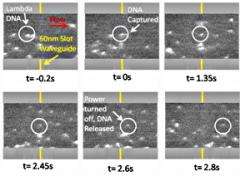
Microphotos show DNA tagged with a fluorescent dye, flowing through a channel 100 microns (millionths of a meter) wide. Laser light in a slot waveguide laid across the channel traps some of the DNA, which is released when the light is turned off.

(PhysOrg.com) -- A major goal of nanotechnology research is to create a "lab on a chip," in which a tiny biological sample would be carried through microscopic channels for processing. This could make possible portable, fast-acting detectors for disease organisms or food-borne pathogens, rapid DNA sequencing and other tests that now take hours or days.

One obstacle has been the difficulty of moving stuff at the nanoscale. Mechanical pumps don't scale down well. So David Erickson, Cornell assistant professor of mechanical and aerospace engineering, and colleague Michal Lipson, Cornell associate professor of electrical and computer engineering, have turned to "optofluidics," using the pressure of light to move and manipulate biological molecules.

Now they have shown that a beam of light can trap and move particles as small as 75 nanometers (nm -- a billionth of a meter) in diameter, including DNA molecules -- some of the smallest material ever manipulated by such a system, the researchers said. Their experiments are described in the Jan. 1, 2009 issue of the journal Nature.

This is possible because of the paradoxical dual nature of light. Light can be thought of as a stream of particles called photons that can exert a force, or as waves of expanding and contracting electric and magnetic fields. If light is confined to a waveguide narrower than its wavelength, the wave overflows and can exert a force beyond the guide. Imagine a nanoscale Indiana Jones chased down a nanotunnel by a photon instead of a granite sphere. if Indy climbs into a tunnel above the one in which the photon is moving, he is still being chased because the photon is bigger than its own tunnel.

Erickson and Lipson first cut microfluidic channels in a chip and placed waveguides directly under the channels. In earlier research published in Optics Express (Oct. 15, 2007), the researchers showed that light in the waveguide could move polystyrene spheres about 3 microns (millionths of a meter) in diameter through the fluid-filled channels. But the "evanescent field" of a light wave that extends beyond the waveguide did not extend far enough or carry enough energy to capture and manipulate smaller biological molecules, they found.

So they turned to a new device created by Lipson: a "slot waveguide" -- two parallel silicon bars 60 nm apart, serving as two parallel wave guides. Light waves traveling along each guide expand beyond its boundaries, but because the parallel guides are so close together, the waves overlap and most of the energy is concentrated in the slot. In addition to creating a more intense beam, this structure allows a beam of light to be channeled through air or water.

As a demonstration, graduate students Allen Yang, Sean Moore, Bradley Schmidt and colleagues in Erickson's and Lipson's research groups laid a slot waveguide across a microscopic fluid channel and showed that light from an infrared laser channeled through the wave guide could trap 75-nm diameter polystyrene spheres and comparably-sized DNA molecules out of a stream of water flowing across it. The light in the slot waveguide extends above the slot and exerts a downward force on a particle entering it, pulling the particle down into the slot. Since light pressure then moves the trapped particles along the slot, such a device could be used to separate biological molecules out of a stream and send them somewhere else for processing, the researchers said. Further development, they added, could make it possible to separate DNA molecules by length for rapid DNA sequencing.

The research was funded by the National Science Foundation, which also supports the Cornell Nanoscale Facility where the devices were manufactured.

Provided by Cornell University


print this article email this article download pdf blog this article bookmark this article     Digg this Stumble it share on Facebook share on Reddit add to delicious save to Yahoo! bookmarks
5/5 after 6 votes

Rank Filter

Move the slider to adjust rank threshold, so that you can hide some of the comments.


Display comments: newest first

  • gmurphy - Jan 03, 2009
    • Rank: 5 / 5 (1)
    honestly, the Indiana Jones description was totally unnecessary, like using frogs to describe the structure of dna, totally f**king perplexing.
  • thales - Jan 05, 2009
    • Rank: not rated yet
    No, you know, it's like he uses his photonic "whip" to "grab" the DNA and "swing" it over to where it needs to be so he can... analyze it with... his, um, hat? No, wait, it's like that one with the invisible bridge and the holy grail. I think?
  • eliecerjorfoas - Jan 11, 2009
    • Rank: not rated yet
    I think is fair to put the example of Indiana Jones in the article simply because those are the words employed by the PI. Whether the example is appropriate or not may be a matter of debate. But the role of the journalist is to present the study as it comes, without affecting it.

January 2nd, 2009 all stories
Nanotechnology / Bio & Medicine

Comments: 3
Rank: 5/5 after 6 votes

  • Stumble this up

  • Digg this

  • Share it:
  • share on Facebook
  • share on MySpace
  • share on Slashdot
  • rss-newsfeed
  • share on Google
  • share on Reddit
  • add to delicious
  • save to Yahoo! bookmarks
  • share on Windows Live
  • Add to Mixx!
Rating: 5/5 after 6 votes

  • Related Stories

  • Integrated optical trap holds particles for on-chip analysis
    created Jun 30, 2009 | popularity not rated yet | comments 0
  • New organic material may speed Internet access
    created Mar 15, 2009 | popularity not rated yet | comments 0
  • Making nanoparticles in artificial cells
    created Jun 26, 2009 | popularity not rated yet | comments 0
  • Backtracking on DNA
    created Jun 23, 2009 | popularity not rated yet | comments 0
  • Carb synthesis sheds light on promising tuberculosis drug target
    created Jun 22, 2009 | popularity not rated yet | comments 0


  • Physicists Demonstrate Quantum Memory with Matter Qubits
    Physicists Demonstrate Quantum Memory with Matter Qubits
    Physics / General Physics
    created Jul 03, 2009 | popularity 4.4 / 5 (17) | comments 1
  • 'Holey' Nanosheets for Wastewater Dye Removal
    Nanotechnology / Nanomaterials
    created Jul 01, 2009 | popularity 5 / 5 (5) | comments 1
  • Jellyfish Robot Swims Like its Biological Counterpart
    Jellyfish Robot Swims Like its Biological Counterpart
    Electronics / Robotics
    created Jun 26, 2009 | popularity 4.4 / 5 (8) | comments 1
  • Could Maxwell's Demon Exist in Nanoscale Systems?
    Could Maxwell's Demon Exist in Nanoscale Systems?
    Physics / General Physics
    created Jun 24, 2009 | popularity 4.4 / 5 (18) | comments 29
  • Living Safely with Robots, Beyond Asimov's Laws
    Living Safely with Robots, Beyond Asimov's Laws
    Electronics / Robotics
    created Jun 22, 2009 | popularity 4.6 / 5 (52) | comments 40
  • Other News

    A 'quantum of sol' -- how nanotechnology could hold the key to a solar-powered future

    A 'quantum of sol' -- how nanotechnology could hold the key to a solar-powered future

    Nanotechnology / Nanomaterials

    created Jun 30, 2009 | popularity 3.9 / 5 (14) | comments 16

    (PhysOrg.com) -- A new generation of 'nano-structured' millimetre-sized solar cells that could convert the sun's energy to electricity more than twice as efficiently as current technology, is the subject of ...


    Australian researchers are set to begin human trials of a tiny nano-cell that acts as a "Trojan horse" against cancer

    Hi-tech 'Trojan horse' can kill cancer cells: researchers

    Nanotechnology / Bio & Medicine

    created Jun 29, 2009 | popularity 4.6 / 5 (11) | comments 7

    Australian researchers are set to begin human trials of a tiny nano-cell that acts as a "Trojan horse" against cancer cells, a breakthrough they say may curb the need for debilitating chemotherapy.


    'Holey' Nanosheets for Wastewater Dye Removal

    Nanotechnology / Nanomaterials

    created Jul 01, 2009 | popularity 5 / 5 (5) | comments 1

    (PhysOrg.com) -- Researchers have discovered that extremely thin sheets of nickel oxide with hexagonally shaped holes can absorb hazardous dyes from wastewater nearly as well as the best traditional methods, but are recyclable. ...


    Harnessing Nanoparticles To Track Cancer Cell Changes

    Nanotechnology / Bio & Medicine

    created Jul 03, 2009 | popularity not rated yet | comments 1

    The more dots there are, the more accurate a picture you get when you connect them. Cancer researchers adopting that philosophy have developed a new imaging technology that could give scientists the ability to simultaneously ...


    Computer-Guided Nanoparticle Therapy Destroys Tumors

    Nanotechnology / Bio & Medicine

    created Jun 29, 2009 | popularity 5 / 5 (11) | comments 0

    Gold nanoshells are among the most promising new nanoscale therapeutics being developed to kill tumors, acting as antennas that turn light energy into heat that cooks cancer to death. Now, a multi-institutional research team ...