Engineers develop new way to fuse cells
January 4, 2009 by Anne Trafton Engineers develop new way to fuse cells

Enlarge

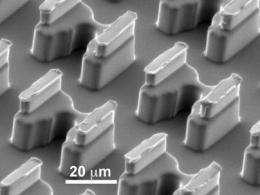
These cups on a microchip trap cells so they can be paired up and fused together. Image / Alison Skelley

MIT engineers have developed a new, highly efficient way to pair up cells so they can be fused together into a hybrid cell. The new technique should make it much easier for scientists to study what happens when two cells are combined. For example, fusing an adult cell and an embryonic stem cell allows researchers to study the genetic reprogramming that occurs in such hybrids.

The researchers, led by a collaboration between Joel Voldman, associate professor of electrical engineering and computer science, and Rudolf Jaenisch, professor of biology and a member of the Whitehead Institute, report the new technique in the Jan. 4 online edition of Nature Methods.


Above: In this video, pairs of cells that have been trapped together are fused into single hybrid cells.

The work was spearheaded by two postdoctoral associates, Alison Skelley, who worked in Voldman's lab, and Oktay Kirak, who works with Jaenisch. Skelley and Kirak are lead authors of the Nature Methods paper. Heikyung Suh, a technical associate in the Whitehead Institute, is also an author of the paper.

The team's simple but ingenious sorting method increases the rate of successful cell fusion from around 10 percent to about 50 percent, and allows thousands of cell pairings at once.

Though cell fusion techniques have been around for a long time, there are many technical limitations, said Voldman.

Getting the right cells to pair up before fusing them is one major obstacle. If scientists are working with a mixture of two cell types, for example A and B, they end up with many AA and BB pairings, as well as the desired AB match.

Researchers had previously trapped cells in tiny cups as they flow across a chip. Each cup can hold only two cells, but there is no way to control whether the cups capture an A and a B, two As or two Bs.

In contrast, the cell-trapping cups on Voldman and Jaenisch's new sorting device are arranged strategically to capture and pair up cells of different types.

First, type A cells are flowed across the chip in one direction and caught in traps that are large enough to hold only one cell. Once the cells are trapped, liquid is flowed across the chip in the opposite direction, pushing the cells out of the small cups and into larger cups across from the small ones.

Once one A cell is in each large cup, type B cells are flowed into the large cups. Each cup can only hold two cells, so each ends up with one A and one B. After the cells are paired in the traps, they can be joined together by an electric pulse that fuses the cell membranes.

In addition to helping with studies of stem cell reprogramming, this technique could be used to study interactions between any types of cells. "It's a very general type of device," said Voldman.

Source: Massachusetts Institute of Technology


print this article email this article download pdf blog this article bookmark this article     Stumble it Digg this share on Facebook retweet share on Reddit add to delicious
Rate this story - 3.5 /5 (4 votes)

Rank Filter

Move the slider to adjust rank threshold, so that you can hide some of the comments.


Display comments: newest first

  • NOM - Jan 04, 2009
    • Rank: not rated yet
    Vulvox has a general method of excreting several smelly types of molecule.

    Stop spamming neil
  • Dating - Jan 04, 2009
    • Rank: not rated yet
    great study, Nice article to read. With these study a lot research for sure related to stem cell and other cell related work will come up.

    http://www.univer...tion.com

January 4, 2009 all stories

Comments: 2

3.5 /5 (4 votes)
  • Stumble this up

  • Digg this

  • share this

  • hide
  • Related Stories


Other News

The Monarchs' annual migration ritual has yet to be scientifically explained

Tree-eating bugs threaten Monarch butterfly in Mexico

Biology / Ecology

created 11 hours ago | popularity 4 / 5 (1) | comments 0

The mysterious Monarch butterfly, which migrates en masse annually between Canada and Mexico, is now facing a new peril: another insect thriving in Western Mexican forests.


Bigger not necessarily better, when it comes to brains

Bigger not necessarily better, when it comes to brains

Biology / Plants & Animals

created Nov 17, 2009 | popularity 4.5 / 5 (17) | comments 11

(PhysOrg.com) -- Tiny insects could be as intelligent as much bigger animals, despite only having a brain the size of a pinhead, say scientists at Queen Mary, University of London.


Extinct goat Myotragus balearicus

Extinct goat was cold-blooded

Biology / Plants & Animals

created Nov 18, 2009 | popularity 4.9 / 5 (33) | comments 10

(PhysOrg.com) -- An extinct goat that lived on a barren Mediterranean island survived for millions of years by reducing in size and by becoming cold-blooded, which has never before been discovered in mammals.


Right-handed chimpanzees provide clues to the origin of human language

Biology / Plants & Animals

created Nov 16, 2009 | popularity 3 / 5 (1) | comments 7

Most of the linguistic functions in humans are controlled by the left cerebral hemisphere. A study of captive chimpanzees at the Yerkes National Primate Research Center (Atlanta, Georgia), reported in the January 2010 issue ...


The creature was found at a depth of 161 metres

Japanese researchers film rare baby fish 'fossil'

Biology / Plants & Animals

created Nov 17, 2009 | popularity 4.7 / 5 (7) | comments 4

Japanese marine researchers said Tuesday they had found and successfully filmed a young coelacanth -- a rare type of fish known as "a living fossil" -- in deep water off Indonesia.