Discovery helps solve mystery of South American trophy heads
January 5th, 2009 Discovery helps solve mystery of South American trophy heads

Enlarge

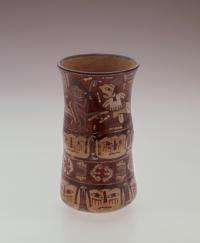
Nasca ceramic vessel featuring a warfare scene and disembodied heads on display in the Ancient Americas exhibition at The Field Museum.

The mystery of why ancient South American peoples who created the mysterious Nazca Lines also collected human heads as trophies has long puzzled scholars who theorize the heads may have been used in fertility rites, taken from enemies in battle or associated with ancestor veneration.

A recent study using specimens from Chicago's Field Museum throws new light on the matter by establishing that trophy heads came from people who lived in the same place and were part of the same culture as those who collected them. These people lived 2,000 to 1,500 years ago.

Archaeologists determined that the severed heads were trophies because holes were made in the skulls allowing the heads to be suspended from woven cords. A debate has been raging for the past 100 years over their meaning.

Trophy heads in the Field collection were gathered from the Nazca Drainage of the arid southern Peruvian coast 80 years ago by noted American anthropologist Alfred Louis Kroeber (1876-1960). He also collected remains of some people buried normally. In some cases, the trophy heads were buried with their collectors.

Because Nazca is among the driest places on Earth, said Ryan Williams, a Field Museum curator, the specimens Kroeber collected were very well preserved. The dead bodies were naturally mummified and some trophy heads still had their hair as well as the display cords attached to the skull. The museum also has several examples of Nazca pottery illustrated with trophy heads; some of the pots are on display in the museum's Ancient Americas exhibition.

"Illustrations on some pots depict warriors and trophy heads," said Williams. "But there are also scenes that link trophy heads to agricultural fertility. Mythical creatures depicted on some pots carry trophy heads as well."

Researchers speculated that if trophy heads were spoils of war, they likely would have come from people who lived somewhere beyond the Nazca area. To test this notion, scientists took samples of tooth enamel from 16 trophy heads in the Field collection and 13 mummified bodies buried in the Nazca region. The results clearly show that donors of the trophy heads were from the same place as the people who kept the trophies, Williams said. This conclusion was based on research using modern technology to look for subtle differences in three elements found in the samples. Those elements - strontium, oxygen and carbon - each display a slightly different atomic structure that varies by geographic location.

"You are what you eat," said Williams, "and the elements you consume become a part of your bones' chemical signature."

People ingesting food produced in different regions will have different strontium isotope ratios in their bones that mirror the age of the bedrock where the food was grown, he said. Carbon also displays different isotopic patterns that vary with the plants that process it. Carbon from corn looks different than carbon from wheat. Oxygen absorbed from water has an isotope signature that varies with climate, altitude and other factors.

"We used the latest technology to study samples that were gathered 80 years ago," said Williams. "This demonstrates the value of maintaining the vast collections that museums keep."

Scientists from Arizona State University, the University of Illinois at Chicago and Indiana University collaborated with Williams to do the study, which appears in the Journal of Anthropological Archaeology. The lead author is ASU professor Kelly Knudson.

There is still more to learn. Determining why the Nazca people collected trophy heads could be important in understanding how civilization progressed in South America, Williams said. "The vast majority of trophy skulls came from the same populations as the people they were buried with. They still could be the trophies of war; maybe warfare was oriented against related communities, or maybe this was ritual." New data on the changes in trophy head taking by the Nazca through time could be important in understanding how politics developed in early societies.

"This small scale agrarian society was succeeded by an empire with regional authority," Williams said. "For the first time people were governed by others who lived hundreds of miles distant. Understanding how this came about may help us better understand how these forms of government first emerged."

Source: Field Museum


print this article email this article download pdf blog this article bookmark this article     Digg this Stumble it share on Facebook share on Reddit add to delicious save to Yahoo! bookmarks
4.3/5 after 4 votes

Rank Filter

Move the slider to adjust rank threshold, so that you can hide some of the comments.


Display comments: newest first

  • mysticfree - Jan 06, 2009
    • Rank: not rated yet
    This is proof that today's business model existed in ancient times as tribes worked to get a head of their competitors...

January 5th, 2009 all stories
Other Sciences / Archaeology & Fossils

Comments: 1
Rank: 4.3/5 after 4 votes

  • Stumble this up

  • Digg this

  • Share it:
  • share on Facebook
  • share on MySpace
  • share on Slashdot
  • rss-newsfeed
  • share on Google
  • share on Reddit
  • add to delicious
  • save to Yahoo! bookmarks
  • share on Windows Live
  • Add to Mixx!
Rating: 4.3/5 after 4 votes

  • Related Stories

  • Trophy heads reveal secrets about ancient South American civilization
    created Jan 08, 2009 | popularity not rated yet | comments 0
  • Energy-Efficient Intelligent House that Can Learn our Routines
    created Jul 03, 2009 | popularity not rated yet | comments 0
  • Did modern humans eat Neanderthals?
    created May 18, 2009 | popularity not rated yet | comments 0
  • Best Visual Illusion of the Year: How a Curveball Works
    created May 13, 2009 | popularity not rated yet | comments 0
  • Tough times, complex systems -- a modernisation story
    created May 04, 2009 | popularity not rated yet | comments 0


  • Transform a ball into a rock -- or make it invisible -- using transformation optics
    Transform a ball into a rock -- or make it invisible -- using transformation optics
    Physics / General Physics
    created 8 hours ago | popularity 3 / 5 (2) | comments 0
  • Could a quantum motor do work?
    Physics / General Physics
    created Jul 07, 2009 | popularity 4 / 5 (12) | comments 0
  • Physicists Demonstrate Quantum Memory with Matter Qubits
    Physicists Demonstrate Quantum Memory with Matter Qubits
    Physics / General Physics
    created Jul 03, 2009 | popularity 4.5 / 5 (20) | comments 1
  • 'Holey' Nanosheets for Wastewater Dye Removal
    Nanotechnology / Nanomaterials
    created Jul 01, 2009 | popularity 5 / 5 (5) | comments 1
  • Jellyfish Robot Swims Like its Biological Counterpart
    Jellyfish Robot Swims Like its Biological Counterpart
    Electronics / Robotics
    created Jun 26, 2009 | popularity 4.4 / 5 (9) | comments 1
  • Other News

    A woman works on an exhibit at a mammoth show

    Steppe change: Mammoths roamed southern Spain

    Other Sciences / Archaeology & Fossils

    created 2 hours ago | popularity 4 / 5 (1) | comments 0

    Remains of woolly mammoths have been found in southern Spain, proving that the chilly grip of the last Ice Age extended farther south than thought, palaeontologists said on Thursday.


    Experts call for local and regional control of sites for radioactive waste

    Other Sciences / Other

    created 4 hours ago | popularity not rated yet | comments 0

    The withdrawal of Nevada's Yucca Mountain as a potential nuclear waste repository has reopened the debate over how and where to dispose of spent nuclear fuel and high-level nuclear waste.


    Study: Restoring lost privileges an overlooked key to discipline

    Other Sciences / Social Sciences

    created 7 hours ago | popularity not rated yet | comments 0

    Managers who dole out discipline by taking away privileges - without considering the implications of restoring them - are missing a key in their bid to improve performance and behavior, a new University of Illinois study ...


    Scientific achievements less prominent than a decade ago

    Other Sciences / Other

    created 5 hours ago | popularity not rated yet | comments 1

    A new report by the Pew Research Center for the People & the Press finds that overwhelming majorities of Americans believe that science has had a positive effect on society and that science has made life easier for most people. ...


    What On Earth Is Driving the Melodramatic, Histrionic Michael Jackson Coverage?

    Other Sciences / Social Sciences

    created Jul 07, 2009 | popularity 3.9 / 5 (8) | comments 8

    The 24-7, wall-to-wall press coverage of the life, death, music, clothing, vitiligo, sex life, "dearest friends" and plastic surgeries of musician Michael Jackson raises the question, "What the heck is going on?"