Scientists determine Viking trade routes by the metal in their swords
January 5, 2009
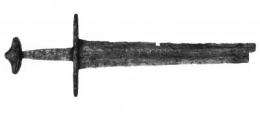
The sword from the Wurttemberg Landesmuseum, Stuttgart has the inscription of its maker's name spelt +VLFBERH+T (this was made of a high-carbon steel and would have been a very hard sword). Credit: Alan Williams
Scientists at the National Physical Laboratory (NPL) in Teddington have worked with the Wallace Collection to analyse the contents of Viking swords - and the results shed new light on trade routes in the middle ages.
Curators at the collection were researching the steel structure of ancient swords to find out more about where they had come from. To achieve this, they needed to analyse examples of ancient weapons to determine their carbon contents - those with very high carbon were likely made with crucible steel, which was only available in India and Central Asia.
Standard metallographic techniques that compare samples with published atlases of alloy microstructures were unable to determine the carbon contents of Viking-age swords. Instead the Wallace Collection relied on the experts at NPL to come up with another way of assessing the samples.
NPL used a highly calibrated Scanning Electron Microscope to determine the carbon contents of the steel samples provided. It analysed very small specimens (1mm in diameter) from Viking-age swords obtained from various museums in Norway and Finland.
The results showed that the swords were made of imperfectly melted steel - consisting of a mixture of iron and carbonaceous materials heated together to give high-carbon steel. NPL's results match descriptions of ancient sword making in Herat (now in Afghanistan) described by ninth century Arab philosopher and writer Al-Kindi. This links to a known Viking trade route down the Volga and across the Caspian Sea to Iran but until now it was not known that Vikings had brought crucible steel back to Scandinavia and integrated ancient Arab steelmaking methods with their own swordsmithing.
The National Physical Laboratory's Tony Fry said:
"Our role at NPL was to use our measurement expertise to analyse tiny fragments of Viking swords and determine the source of the steel used by the Vikings to make them. Standard methods using atlases of microstructures to compare optical images with an image in a book, is a difficult method to use, it is subjective and prone to generalisations. By mixing scientific expertise with a top of the range Electron Microscope we were able to provide a quantifiable value, rather than the standard qualitative approach of using an atlas, and enlighten our understanding of trade in the middle ages."
Dr Alan Williams, Consultant Archaeometallurgist at the Wallace Collection, said:
"Sword making in Viking times was important work, to the point that the best smiths had their work imitated and copied. On their travels, the Vikings were keen to pick up any innovative new means of improving their sword-making, but until now we haven't known where they have sourced some of their materials. The results from NPL confirm for the first time that the material analysed was brought by the Vikings from the Middle East to the Baltic area - and thrown new light on an important trade route that was in use until the 11th Century."
Source: National Physical Laboratory
-
Choreographing dance of electrons offers promise in pursuit of quantum computers
Jan 12, 2012 |
5 / 5 (3) |
1
-
Engineers discover graphene's weakness
Dec 09, 2010 |
4.9 / 5 (12) |
4
-
Diamond is one tough cookie
Jan 26, 2010 |
4.2 / 5 (17) |
1
-
Glittering and glinting, the world's biggest diamond structure heads to the West End, UK
Jul 20, 2009 |
2.5 / 5 (2) |
0
-
A new approach to engineering for extreme environments (w/ Video)
Jun 24, 2009 |
4.7 / 5 (3) |
3
-
Engineers build first sub-10-nm carbon nanotube transistor
Feb 01, 2012 |
4.9 / 5 (31) |
30
-
Something old, something new: Evolution and the structural divergence of duplicate genes
Jan 31, 2012 |
4.6 / 5 (7) |
1
-
The hidden nanoworld of ice crystals: Revealing the dynamic behavior of quasi-liquid layers
Jan 30, 2012 |
5 / 5 (3) |
1
-
Stock market network reveals investor clustering
Jan 27, 2012 |
3.9 / 5 (23) |
8
-
Of microchemistry and molecules: Electronic microfluidic device synthesizes biocompatible probes
Jan 26, 2012 |
5 / 5 (1) |
0
-
Does light travel for ever?
1 hour ago
-
Infinity by Particles
2 hours ago
-
what does negative resistivity mean
2 hours ago
-
Calculating Electrostatic force between parallel plates
4 hours ago
-
Strength of induced magnetic field inside an inductor
7 hours ago
-
increasing time of daylight
8 hours ago
- More from Physics Forums - General Physics
More news stories
Putting the squeeze on planets outside our solar system
(PhysOrg.com) -- Using high-powered lasers, scientists at Lawrence Livermore National Laboratory and collaborators discovered that molten magnesium silicate undergoes a phase change in the liquid state, abruptly ...
7 hours ago |
4.8 / 5 (4) |
0
|
Hovering not hard if you're top-heavy, researchers find
Top-heavy structures are more likely to maintain their balance while hovering in the air than are those that bear a lower center of gravity, researchers at New York University's Courant Institute of Mathematical Sciences ...
8 hours ago |
5 / 5 (1) |
1
|
SLAC, Stanford team focuses on high-energy electrons to treat cancer
Accelerator physicists at SLAC and cancer specialists from Stanford are working on a new technology that could dramatically reduce the time needed for cancer radiation treatments. The team ran an initial experiment ...
11 hours ago |
5 / 5 (1) |
0
Measurements from high-energy collisions lead to better understanding of why meson particles disappear
For several years, physicists at the Relativistic Heavy Ion Collider (RHIC) at Brookhaven National Laboratory (BNL), USA, have studied an unusual state of matter called the quarkgluon plasma, which they ...
11 hours ago |
5 / 5 (1) |
0
Explained: Sigma
It's a question that arises with virtually every major new finding in science or medicine: What makes a result reliable enough to be taken seriously? The answer has to do with statistical significance -- but ...
Feb 09, 2012 |
5 / 5 (16) |
48
Google users warned of threat to smartphone wallets
Users of Google smartphone wallets were being warned on Friday that there is a way to crack pass codes intended to thwart thieves from going on illicit shopping sprees.
Anonymous knocks CIA website offline (Update)
The website of the Central Intelligence Agency was inaccessible on Friday after the hacker group Anonymous claimed to have knocked it offline.
Complex wiring of the nervous system may rely on a just a handful of genes and proteins
Researchers at the Salk Institute have discovered a startling feature of early brain development that helps to explain how complex neuron wiring patterns are programmed using just a handful of critical genes. ...
New error-correcting codes guarantee the fastest possible rate of data transmission
Error-correcting codes are one of the triumphs of the digital age. Theyre a way of encoding information so that it can be transmitted across a communication channel such as an optical fiber o ...
The power of estrogen -- male snakes attract other males
A new study has shown that boosting the estrogen levels of male garter snakes causes them to secrete the same pheromones that females use to attract suitors, and turned the males into just about the sexiest ...
NASA sees wide-eyed cyclone Jasmine
Cyclone Jasmine's eye has opened wider on NASA satellite imagery, as it moves through the Southern Pacific Ocean.