Cell death from cytomegalovirus may bring new life to treatment of retinal disease
January 5th, 2009 Cell death from cytomegalovirus may bring new life to treatment of retinal disease

Enlarge

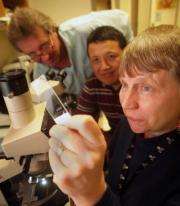
Dr. Sally Atherton (right to left) and MCG assistant research scientists, Drs. Ming Zhang and Brendan Marshall. Credit: Medical College of Georgia

Just days after the first retinal cell gets infected with the common cytomegalovirus, contiguous cells start committing suicide and researchers believe their death may provide clues to better treatment of this potentially blinding infection.

Understanding the cell death may also provide new insight into the larger issue of how the retina responds to assault, whether by infection or a disease process such as diabetes, said Dr. Sally Atherton, virologist and immunologist who chairs the Department of Cellular Biology and Anatomy in the Medical College of Georgia School of Medicine. "We are trying to get to the bottom of the mechanisms of that cell death."

A recent $1.3 million grant from the National Eye Institute is enabling studies of what's likely the body's well-intended effort to stop cytomegalovirus retinitis. "We can try to infect certain cells and see what happens. We can try to inhibit the virus and see what that does. The immediate goal is to look at the apoptosis (cell death) trigger but the bigger picture is really looking at mechanisms of retinal damage during cytomegalovirus infection," Dr. Atherton said. Tools include a mouse model of human disease as well as a retinal cell culture system developed by MCG Assistant Research Scientist Ming Zhang.

Their perusing may identify new treatment targets; a modulator made by infected cells that prompts adjacent cell death could be one such target. And certainly there is plenty to study: "Lots of signaling pathways are activated. There are a whole host of genes that are up-regulated and down-regulated," Dr. Atherton said. Infected cells as well as cells that come in to cart off dead cells may secrete tumor necrosis factor, for example, an immune cell regulator that causes inflammation and also may trigger cell death. "There are various mechanisms by which apoptosis, or cell death, can be induced," Dr. Atherton said.

As activity and damage increase, patients may experience blurred vision and floaters, eye pain and redness. Treatments include antivirals that may need to be injected or implanted directly into the eye or even surgery.

"Normally the retina is neatly stratified. What happens is you get an infection in the most external part of the retina - in humans the virus may actually have been latent in the retina - and it triggers cell death of the next layer and eventually virus spreads deeper into the retina and spreads out more," Dr. Atherton said. "Unchecked it can ruin your vision," especially if it affects the macula, or central part of the retina responsible for highest visual acuity.

Fortunately, despite the fact that most people are infected with this herpesvirus family member that can be found in saliva, blood and semen, it's most typically latent.

Cytomegalovirus retinitis' last big resurrection came with the AIDS epidemic of the 1980s, when nearly half of patients who were dying were going blind as well, Dr. Atherton said. The advent of antiretrovirals to keep HIV in check helped silence cytomegalovirus retinitis as well but today the incidence is again increasing, she said. A suppressed immune system is the primary reason cytomegalovirus becomes active, which means neonates and patients with organ or bone marrow transplants or taking therapy also are increased risk. Scientists aren't certain about the recent, albeit less severe, increase in disease incidence, but HIV patients who have become resistant to their therapy or just tired of taking it, likely are a factor.

Source: Medical College of Georgia


print this article email this article download pdf blog this article bookmark this article     Digg this Stumble it share on Facebook share on Reddit add to delicious save to Yahoo! bookmarks
not rated yet


January 5th, 2009 all stories
Medicine & Health / Diseases

Comments: 0
Rank: not rated yet

  • Stumble this up

  • Digg this

  • Share it:
  • share on Facebook
  • share on MySpace
  • share on Slashdot
  • rss-newsfeed
  • share on Google
  • share on Reddit
  • add to delicious
  • save to Yahoo! bookmarks
  • share on Windows Live
  • Add to Mixx!
Rating: not rated yet


  • Physicists Demonstrate Quantum Memory with Matter Qubits
    Physicists Demonstrate Quantum Memory with Matter Qubits
    Physics / General Physics
    created Jul 03, 2009 | popularity 4.4 / 5 (17) | comments 1
  • 'Holey' Nanosheets for Wastewater Dye Removal
    Nanotechnology / Nanomaterials
    created Jul 01, 2009 | popularity 5 / 5 (5) | comments 1
  • Jellyfish Robot Swims Like its Biological Counterpart
    Jellyfish Robot Swims Like its Biological Counterpart
    Electronics / Robotics
    created Jun 26, 2009 | popularity 4.4 / 5 (8) | comments 1
  • Could Maxwell's Demon Exist in Nanoscale Systems?
    Could Maxwell's Demon Exist in Nanoscale Systems?
    Physics / General Physics
    created Jun 24, 2009 | popularity 4.4 / 5 (18) | comments 29
  • Living Safely with Robots, Beyond Asimov's Laws
    Living Safely with Robots, Beyond Asimov's Laws
    Electronics / Robotics
    created Jun 22, 2009 | popularity 4.6 / 5 (52) | comments 40
  • Other News

    Caffeine reverses memory impairment in Alzheimer's mice

    Caffeine reverses memory impairment in Alzheimer's mice

    Medicine & Health / Research

    created 21 minutes ago | popularity not rated yet | comments 0

    Coffee drinkers may have another reason to pour that extra cup. When aged mice bred to develop symptoms of Alzheimer's disease were given caffeine - the equivalent of five cups of coffee a day - their memory ...


    Researchers find possible environmental causes for Alzheimer's, diabetes

    Medicine & Health / Diseases

    created 23 minutes ago | popularity not rated yet | comments 0

    A new study by researchers at Rhode Island Hospital have found a substantial link between increased levels of nitrates in our environment and food with increased deaths from diseases, including Alzheimer's, diabetes mellitus ...


    Variations in 5 genes raise risk for most common brain tumors

    Medicine & Health / Genetics

    created 16 hours ago | popularity not rated yet | comments 1

    Common genetic variations spread across five genes raise a person's risk of developing the most frequent type of brain tumor, an international research team reports online in Nature Genetics.


    Researchers highlight new direction for drug discovery

    Medicine & Health / Research

    created 14 hours ago | popularity not rated yet | comments 0

    In a discovery that rebuffs conventional scientific thinking, researchers at Georgetown University Medical Center (GUMC) have discovered a novel way to block the activity of the fusion protein responsible for Ewing's sarcoma, ...


    Wind power may have its own environmental problems

    Medicine & Health / Health

    created 15 hours ago | popularity 3.7 / 5 (6) | comments 4

    Wind power generation is expected to be a clean and environmentally friendly natural energy source, but a new kind of environmental problem has surfaced as infrasonic waves caused by windmills are suspected of causing health ...