Baby Jupiters must gain weight fast
January 5, 2009 Baby Jupiters must gain weight fast

Enlarge

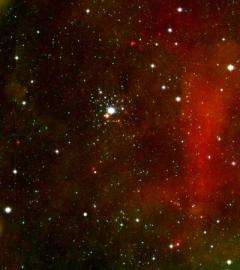
This photograph from NASA's Spitzer Space Telescope shows the young star cluster NGC 2362. By studying it, astronomers found that gas giant planet formation happens very rapidly and efficiently, within less than 5 million years, meaning that Jupiter-like worlds experience a growth spurt in their infancy. Image: NASA/JPL-Caltech/T. Currie (CfA)

The planet Jupiter gained weight in a hurry during its infancy. It had to, since the material from which it formed probably disappeared in just a few million years, according to a new study of planet formation around young stars.

Smithsonian astronomers examined the 5 million-year-old star cluster NGC 2362 with NASA's Spitzer Space Telescope, which can detect the signatures of actively forming planets in infrared light. They found that all stars with the mass of the Sun or greater have lost their protoplanetary (planet-forming) disks. Only a few stars less massive than the Sun retain their protoplanetary disks. These disks provide the raw material for forming gas giants like Jupiter. Therefore, gas giants have to form in less than 5 million years or they probably won't form at all.

"Even though astronomers have detected hundreds of Jupiter-mass planets around other stars, our results suggest that such planets must form extremely fast. Whatever process is responsible for forming Jupiters has to be incredibly efficient," said lead researcher Thayne Currie of the Harvard-Smithsonian Center for Astrophysics. Currie presented the team's findings at a meeting of the American Astronomical Society in Long Beach, Calif.

Even though nearly all gas giant-forming disks in NGC 2362 have disappeared, several stars in the cluster have "debris disks," which indicates that smaller rocky or icy bodies such as Earth, Mars, or Pluto may still be forming.

"The Earth got going sooner, but Jupiter finished first, thanks to a big growth spurt," explained co-author Scott Kenyon.

Kenyon added that while Earth took about 20 to 30 million years to reach its final mass, Jupiter was fully grown in only 2 to 3 million years.

Previous studies indicated that protoplanetary disks disappear within 10 million years. The new findings put even tighter constraints on the time available to create gas giant planets around stars of various masses.

Source: Harvard-Smithsonian Center for Astrophysics


print this article email this article download pdf blog this article bookmark this article     Stumble it Digg this share on Facebook retweet share on Reddit add to delicious
Rate this story - 4.3 /5 (3 votes)


January 5, 2009 all stories

Comments: 0

4.3 /5 (3 votes)
  • Stumble this up

  • Digg this

  • share this

  • hide
  • Related Stories


  • hide
  • Relevant PhysicsForums posts

  • Help with Images and Optical Instrument Question..
    created 3 hours ago
  • Redshift as a distance indicator
    created 10 hours ago
  • Question about 2-body gravity
    created Nov 24, 2009
  • life on Mars
    created Nov 24, 2009
  • More from Physics Forums - General Astronomy

Other News

Past regional cold and warm periods linked to natural climate drivers

Space & Earth / Earth Sciences

created 7 hours ago | popularity 3.7 / 5 (7) | comments 6

Intervals of regional warmth and cold in the past are linked to the El Niño phenomenon and the so-called "North Atlantic Oscillation" in the Northern hemisphere's jet stream, according to a team of climate scientists. These ...


Russia: no space for space tourists (AP)

Russia: no space for space tourists

Space & Earth / Space Exploration

created 15 hours ago | popularity 2.7 / 5 (3) | comments 2

(AP) -- A top Russian space official says there is no space for tourists wishing to fly to the International Space Station.


Astronauts surprised by holiday turkey dinners (AP)

Astronauts surprised by holiday turkey dinners

Space & Earth / Space Exploration

created 10 hours ago | popularity 5 / 5 (1) | comments 0

(AP) -- Space shuttle Atlantis' astronauts thought they were going to give thanks with pantry leftovers Thursday as their mission drew to a close, but found turkey dinners awaiting them.


Gullies and Flow Features on Crater Wall

Gullies and Flow Features on Crater Wall

Space & Earth / Space Exploration

created 11 hours ago | popularity 5 / 5 (1) | comments 0

(PhysOrg.com) -- This image from the High Resolution Imaging Science Experiment (HiRISE) camera on NASA's Mars Reconnaissance Orbiter shows a sample of the variety and complexity of processes that may occur ...


Thanksgiving last full day in space for shuttle (AP)

Thanksgiving last full day in space for shuttle

Space & Earth / Space Exploration

created 14 hours ago | popularity not rated yet | comments 0

(AP) -- Space shuttle Atlantis' astronauts will spend Thanksgiving checking their ship for the ride home.