Stars Forming Just Beyond Black Hole’s Grasp at Galactic Center
January 5, 2009 Stars forming just beyond black hole's grasp at galactic center

Enlarge

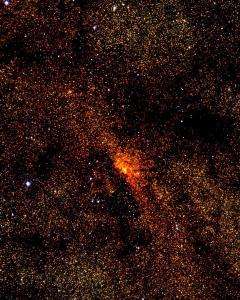
This 0.6 by 0.7-degree infrared photograph of the galactic center shows a large population of old, red stars. However, the discovery of two young protostars within a few light-years of the center of the Milky Way shows that stars can form there despite powerful gravitational tides due to the supermassive black hole. Credit: 2MASS/E. Kopan (IPAC/Caltech)

(PhysOrg.com) -- The center of the Milky Way presents astronomers with a paradox: it holds young stars, but no one is sure how those stars got there. The galactic center is wracked with powerful gravitational tides stirred by a 4 million solar-mass black hole. Those tides should rip apart molecular clouds that act as stellar nurseries, preventing stars from forming in place. Yet the alternative - stars falling inward after forming elsewhere - should be a rare occurrence.

Using the Very Large Array of radio telescopes, astronomers from the Harvard-Smithsonian Center for Astrophysics and the Max Planck Institute for Radio Astronomy have identified two protostars located only a few light-years from the galactic center. Their discovery shows that stars can, in fact, form very close to the Milky Way's central black hole.

"We literally caught these stars in the act of forming," said Smithsonian astronomer Elizabeth Humphreys. She presented the finding today at a meeting of the American Astronomical Society in Long Beach, Calif.

The center of the Milky Way is a mysterious region hidden behind intervening dust and gas, making it hard to study. Visible light doesn't make it out, leaving astronomers no choice but to use other wavelengths like infrared and radio, which can penetrate dust more easily.

Humphreys and her colleagues searched for water masers—radio signals that serve as signposts for protostars still embedded in their birth cocoons. They found two protostars located seven and 10 light-years from the galactic center. Combined with one previously identified protostar, the three examples show that star formation is taking place near the Milky Way's core.

Their finding suggests that molecular gas at the center of our galaxy must be denser than previously believed. A higher density would make it easier for a molecular cloud's self-gravity to overcome tides from the black hole, allowing it to not only hold together but also collapse and form new stars.

The discovery of these protostars corroborates recent theoretical work, in which a supercomputer simulation produced star formation within a few light-years of the Milky Way's central black hole.

"We don't understand the environment at the galactic center very well yet," Humphreys said. "By combining observational studies like ours with theoretical work, we hope to get a better handle on what's happening at our galaxy's core. Then, we can extrapolate to more distant galaxies."

Provided by Harvard-Smithsonian Center for Astrophysics


print this article email this article download pdf blog this article bookmark this article     Stumble it Digg this share on Facebook retweet share on Reddit add to delicious
Rate this story - 3.9 /5 (8 votes)


January 5, 2009 all stories

Comments: 0

3.9 /5 (8 votes)
  • Stumble this up

  • Digg this

  • share this

  • hide
  • Related Stories

  • The Edge of a Black Hole
    created Aug 18, 2009 | popularity not rated yet | comments 0
  • Chandra Shows Shocking Impact of Galaxy Jet
    created Apr 22, 2009 | popularity not rated yet | comments 0
  • Radio Telescopes' Sharp Vision Yields Rich Payoffs
    created Jan 11, 2008 | popularity not rated yet | comments 0
  • 'Death Star' Galaxy Black Hole Fires at Neighboring Galaxy
    created Dec 17, 2007 | popularity not rated yet | comments 0
  • Astronomers unveil new type of active galaxy
    created Jul 30, 2007 | popularity not rated yet | comments 0


  • hide
  • Relevant PhysicsForums posts

  • Sideral question
    created 17 hours ago
  • Doppler shifted blackbody spectrum
    created 20 hours ago
  • Earth v. Moon
    created 22 hours ago
  • help me with coordinates and orbits
    created 22 hours ago
  • More from Physics Forums - General Astronomy

Other News

Astronauts finish another spacewalk, still no baby (AP)

Astronauts finish another spacewalk, still no baby

Space & Earth / Space Exploration

created 9 hours ago | popularity 3 / 5 (2) | comments 0

(AP) -- A spacewalking astronaut put aside the impending birth of his daughter and blazed through his first-ever venture outside the International Space Station on Saturday.


Unseasonably hot and dry weather combined with strong winds to fan scores of blazes in the country's southeastern states

Australia issues 'catastrophic' alerts as fires rage

Space & Earth / Environment

created 15 hours ago | popularity 4.5 / 5 (2) | comments 0

Australia has issued "catastrophic" alerts after record-breaking temperatures and wild lightning storms sparked more than 100 fires across the country, officials said Saturday.


Commuters wait on the platform shrouded by fog in London

Climate change not man-made, say majority of Britons: poll

Space & Earth / Environment

created Nov 15, 2009 | popularity 3.3 / 5 (15) | comments 46

Less than half of Britons believes that human activity is to blame for global warming, according to a poll carried out for The Times newspaper and published on Saturday.


Mysteriously warm times in Antarctica

Mysteriously warm times in Antarctica

Space & Earth / Earth Sciences

created Nov 18, 2009 | popularity 4.2 / 5 (21) | comments 28

(PhysOrg.com) -- A new study of Antarctica's past climate reveals that temperatures during the warm periods between ice ages (interglacials) may have been higher than previously thought. The latest analysis ...


UN: Fight climate change with free condoms (AP)

UN: Fight climate change with free condoms

Space & Earth / Environment

created Nov 18, 2009 | popularity 3.1 / 5 (11) | comments 24

(AP) -- The battle against global warming could be helped if the world slowed population growth by making free condoms and family planning advice more widely available, the U.N. Population Fund said Wednesday.