Zeroing in on Hubble's constant
(PhysOrg.com) -- In the early part of the 20th Century, Carnegie astronomer Edwin Hubble discovered that the universe is expanding. The rate of expansion is known as the Hubble constant. Its precise value has been hotly debated for all of the 80 intervening years. The value of the Hubble constant is a key ingredient in determining the age and size of the universe.
In 2001, as part of the Hubble Space Telescope Key Project, a team of astronomers led by Carnegie's Wendy Freedman determined precision distances to individual far-off galaxies and used them to determine that the universe is expanding at the rate of 72 kilometers per second per megaparsec. While the debate had previously raged over a factor-of-two uncertainty in the Hubble constant, Freedman and her team cut that uncertainty down to just 10%. And now that number is about to be decreased to 3% with the new Carnegie Hubble Program (CHP) using NASA's space-based Spitzer telescope. Freedman, who is director of the Observatories of the Carnegie Institution, will lead the effort, which includes Carnegie staff members Barry Madore and Eric Persson, and Carnegie Spitzer Fellow, Jane Rigby.
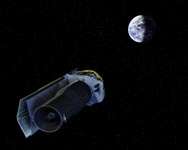
The Carnegie Hubble proposal was just selected by the Spitzer Science Center on behalf of NASA as a Cycle-6 Exploration Science Program using Spitzer. This space telescope currently takes images and spectra—chemical fingerprints—of objects by detecting their heat, or infrared (IR) energy, between wavelengths of 3 and 180 microns (a micron equals one-millionth of a meter). Most infrared radiation is blocked by the Earth's atmosphere and thus it has to be detected from space.
The Hubble Key Project observed distant objects primarily at optical wavelengths. In its post-cryogenic phase beginning in April 2009 Spitzer will have exhausted its liquid helium coolant but it will still be able to operate two of its imaging detectors that are sensitive to the near-infrared. This portion of the electromagnetic spectrum has numerous advantages, especially when observing Cepheid variable stars, the so-called "standard candles" that are used to determine distances to distant galaxies.
"The power of Spitzer," explained Freedman, "is that it will allow us to virtually eliminate the dimming and obscuring effects of dust. It offers us the ability to make the most precise measurements of Cepheid distances that have ever been made, and to bring the uncertainty in the Hubble constant down to the few percent level."
Cepheids are extremely bright, pulsating stars. Their pulsation periods are directly related to their intrinsic luminosities. So, by measuring their periods and apparent brightnesses their individual distances and therefore the distance to their parent galaxies can be determined. By considering the rate at which more distant galaxies are measured to be moving faster away from us in the universe we can calculate the Hubble constant and from that determine the size and the age of the universe.
One of the largest uncertainties plaguing past measurements of the Hubble constant involved the distance to the Large Magellanic Cloud (LMC), a relatively nearby galaxy, orbiting the Milky Way. Freedman and colleagues will begin their 700 hours of observations refining the distance to the LMC using Cepheids newly calibrated based on new Spitzer observations of similar stars in our own Milky Way. They will then measure Cepheid distances to all of the nearest galaxies previously observed from the ground over the past century and by the Key Project, acquiring distances to galaxies in our Local Group and beyond. The Local Group, our galactic neighborhood, is comprised of some 40 galaxies. The team will be able to correct for lingering uncertainties again by observing in the near-IR. Systematic errors such as whether chemical composition differences among Cepheids might affect the period-luminosity relation, will be examined using the infrared data. Spitzer will begin to execute the Carnegie Hubble Program in June 2009 and continue for at least the next two years.
"In the age of precision cosmology one of the key factors in securing the fundamental numbers that describe the time evolution and make-up of our universe is the Hubble constant. Ten percent is simply not good enough. Cosmologists need to know the expansion rate of the universe to as high a precision and as great an accuracy as we can deliver," remarked Carnegie co-investigator, Barry Madore.
Provided by Carnegie Institution


