Milky Way a Swifter Spinner, More Massive, New Measurements Show
January 5, 2009
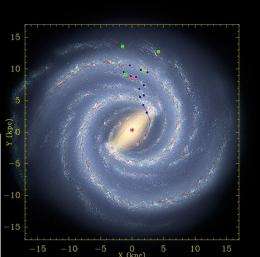
This artist's conception of the Milky Way shows the four-arm spiral structure confirmed by recent VLBA distance measurements (shown by green and blue dots). The data show that the Milky Way is spinning faster than previously believed. Our galaxy therefore is more massive than astronomers thought, matching Andromeda's heft. Red dots mark the galactic center and the location of our solar system. Image: Robert Hurt, IPAC; Mark Reid, CfA, NRAO/AUI/NSF
(PhysOrg.com) -- Fasten your seat belts -- we're faster, heavier, and more likely to collide than we thought. Astronomers making high-precision measurements of the Milky Way say our home Galaxy is rotating about 100,000 miles per hour faster than previously understood.
That increase in speed, said Mark Reid, of the Harvard-Smithsonian Center for Astrophysics, increases the Milky Way's mass by 50 percent, bringing it even with the Andromeda Galaxy. "No longer will we think of the Milky Way as the little sister of the Andromeda Galaxy in our Local Group family."
The larger mass, in turn, means a greater gravitational pull that increases the likelihood of collisions with the Andromeda galaxy or smaller nearby galaxies.
Our Solar System is about 28,000 light-years from the Milky Way's center. At that distance, the new observations indicate, we're moving at about 600,000 miles per hour in our Galactic orbit, up from the previous estimate of 500,000 miles per hour.
The scientists are using the National Science Foundation's Very Long Baseline Array (VLBA) radio telescope to remake the map of the Milky Way. Taking advantage of the VLBA's unparalleled ability to make extremely detailed images, the team is conducting a long-term program to measure distances and motions in our Galaxy. They reported their results at the American Astronomical Society's meeting in Long Beach, California.
The scientists observed regions of prolific star formation across the Galaxy. In areas within these regions, gas molecules are strengthening naturally-occuring radio emission in the same way that lasers strengthen light beams. These areas, called cosmic masers, serve as bright landmarks for the sharp radio vision of the VLBA. By observing these regions repeatedly at times when the Earth is at opposite sides of its orbit around the Sun, the astronomers can measure the slight apparent shift of the object's position against the background of more-distant objects.
"The new VLBA observations of the Milky Way are producing highly-accurate direct measurements of distances and motions," said Karl Menten of the Max Planck Institute for Radio Astronomy in Germany, a member of the team. "These measurements use the traditional surveyor's method of triangulation and do not depend on any assumptions based on other properties, such as brightness, unlike earlier studies."
The astronomers found that their direct distance measurements differed from earlier, indirect measurements, sometimes by as much as a factor of two. The star-forming regions harboring the cosmic masers "define the spiral arms of the Galaxy," Reid explained. Measuring the distances to these regions thus provides a yardstick for mapping the Galaxy's spiral structure.
"These direct measurements are revising our understanding of the structure and motions of our Galaxy," Menten said. "Because we're inside it, it's difficult for us to determine the Milky Way's structure. For other galaxies, we can simply look at them and see their structure, but we can't do this to get an overall image of the Milky Way. We have to deduce its structure by measuring and mapping," he added.
The VLBA can fix positions in the sky so accurately that the actual motion of the objects can be detected as they orbit the Milky Way's center. Adding in measurements of motion along the line of sight, determined from shifts in the frequency of the masers' radio emission, the astronomers are able to determine the full 3-dimensional motions of the star-forming regions. Using this information, Reid reported that "most star-forming regions do not follow a circular path as they orbit the Galaxy; instead we find them moving more slowly than other regions and on elliptical, not circular, orbits."
The researchers attribute this to what they call spiral density wave shocks, which can take gas in a circular orbit, compress it to form stars, and cause it to go into a new, elliptical orbit. This, they explained, helps to reinforce the spiral structure.
Reid and his colleagues found other surprises, too. Measuring the distances to multiple regions in a single spiral arm allowed them to calculate the angle of the arm. "These measurements," Reid said, "indicate that our Galaxy probably has four, not two, spiral arms of gas and dust that are forming stars." Recent surveys by NASA's Spitzer Space Telescope suggest that older stars reside mostly in two spiral arms, raising a question of why the older stars don't appear in all the arms. Answering that question, the astronomers say, will require more measurements and a deeper understanding of how the Galaxy works.
Provided by Harvard-Smithsonian Center for Astrophysics
-
Astronomers determine color of the Milky Way Galaxy
Jan 11, 2012 |
4.2 / 5 (14) |
5
-
Black hole, star collisions may illuminate universe's dark side
Sep 19, 2011 |
4.9 / 5 (12) |
13
-
Astrophysicists use X-ray fingerprints to study eating habits of giant black holes
Jun 06, 2011 |
4.9 / 5 (8) |
10
-
Hubble rules out one alternative to dark energy
Mar 14, 2011 |
4.6 / 5 (25) |
92
-
BigBOSS receives favorable review from the National Optical Astronomy Observatory
Feb 01, 2011 |
5 / 5 (2) |
0
-
Engineers build first sub-10-nm carbon nanotube transistor
Feb 01, 2012 |
4.9 / 5 (31) |
30
-
Something old, something new: Evolution and the structural divergence of duplicate genes
Jan 31, 2012 |
4.6 / 5 (7) |
1
-
The hidden nanoworld of ice crystals: Revealing the dynamic behavior of quasi-liquid layers
Jan 30, 2012 |
5 / 5 (3) |
1
-
Stock market network reveals investor clustering
Jan 27, 2012 |
3.9 / 5 (23) |
8
-
Of microchemistry and molecules: Electronic microfluidic device synthesizes biocompatible probes
Jan 26, 2012 |
5 / 5 (1) |
0
-
Scale of the Universe
5 hours ago
-
Titan's lack of impact craters
Feb 09, 2012
-
Real pictures of black hole eating a star?
Feb 08, 2012
-
Hypothetical way to travel faster than light, but not technically exceed lightspeed
Feb 06, 2012
-
How do scientists monitor the Sun's activity?
Feb 05, 2012
-
Search patterns in observational studies
Feb 05, 2012
- More from Physics Forums - General Astronomy
More news stories
Humans may have helped the decline of African rainforests 3000 years ago
(PhysOrg.com) -- Large areas of rainforests in Central Africa mysteriously disappeared over three thousand years ago, to be replaced by savannas. The prevailing theory has been that the cause was a change ...
Could Venus be shifting gear?
(PhysOrg.com) -- ESAs Venus Express spacecraft has discovered that our cloud-covered neighbour spins a little slower than previously measured. Peering through the dense atmosphere in the infrared, the ...
Space & Earth / Space Exploration
13 hours ago |
5 / 5 (7) |
7
|
NASA sees wide-eyed cyclone Jasmine
Cyclone Jasmine's eye has opened wider on NASA satellite imagery, as it moves through the Southern Pacific Ocean.
Space & Earth / Earth Sciences
5 hours ago |
3.5 / 5 (2) |
1
NASA budget will axe Mars deal with Europe: scientists
US President Barack Obama's budget proposal to be submitted next week for 2013 will cut NASA's budget by 20 percent and eliminate a major partnership with Europe on Mars exploration, scientists said Thursday.
Space & Earth / Space Exploration
16 hours ago |
5 / 5 (2) |
18
Mars Science Laboratory computer issue resolved
(PhysOrg.com) -- Engineers have found the root cause of a computer reset that occurred two months ago on NASA's Mars Science Laboratory and have determined how to correct it.
Space & Earth / Space Exploration
14 hours ago |
4.7 / 5 (6) |
3
|
Google users warned of threat to smartphone wallets
Users of Google smartphone wallets were being warned on Friday that there is a way to crack pass codes intended to thwart thieves from going on illicit shopping sprees.
Anonymous knocks CIA website offline (Update)
The website of the Central Intelligence Agency was inaccessible on Friday after the hacker group Anonymous claimed to have knocked it offline.
Complex wiring of the nervous system may rely on a just a handful of genes and proteins
Researchers at the Salk Institute have discovered a startling feature of early brain development that helps to explain how complex neuron wiring patterns are programmed using just a handful of critical genes. ...
New error-correcting codes guarantee the fastest possible rate of data transmission
Error-correcting codes are one of the triumphs of the digital age. Theyre a way of encoding information so that it can be transmitted across a communication channel such as an optical fiber o ...
The power of estrogen -- male snakes attract other males
A new study has shown that boosting the estrogen levels of male garter snakes causes them to secrete the same pheromones that females use to attract suitors, and turned the males into just about the sexiest ...
New power source discovered
(PhysOrg.com) -- Researchers at the Massachusetts Institute of Technology (MIT) and RMIT University have made a breakthrough in energy storage and power generation.
Jan 05, 2009
Rank: 1 / 5 (1)
Jan 06, 2009
Rank: not rated yet
Jan 06, 2009
Rank: not rated yet
Jan 14, 2009
Rank: not rated yet
Jan 24, 2009
Rank: not rated yet