Researchers create all seeing 'eye'
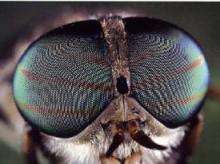
The remarkable ability of insects to look in all directions at once has been emulated by a team of international scientists who have built an artificial 'eye' with an unobstructed all-round view.
Designed primarily as a scientific tool to investigate how insects see, navigate and learn, the elegant Perspex globe also has potential uses for guiding robot vehicles and aircraft, providing low-cost panoramic security surveillance and novel lighting systems, its developers say.
The ‘eye’ was designed by a team from The Vision Centre, in Australia, as a tool to emulate as closely as possible what insects see as they zip around the landscape, as part of a larger project to understand how they navigate, find food, escape predators and especially, how insects like bees find their way home.
“Panoramic vision means you have far more information with which to monitor and control your own movement in the world. Insects, in some ways, do this better than we do because they can see all round them at once,” explains Dr Jochen Zeil of The Vision Centre and the Australian National University.
“Many sorts of wide-angle and panoramic devices have been designed before, but this one gives a wider field of view without obstruction, while being rugged and light-weight.”
The ‘eye’ is a beautifully-machined Perspex globe with an embedded silvered cone, which allows a 360-degree all-round view, uninterrupted by the brackets used to support mirrors in similar devices. It sits on a standard video camera.
Most panoramic devices also have a blind spot where the scene is occluded by the mirror but the ACEVS team solved this by inserting a tiny wide-angle lens at the apex of the mirror, giving a 260-degree vertical field of view.
The Vision Centre design team consists of Dr Wolfgang Stürzl and Dr Norbert Boeddeker of Bielefeld University, Germany, Dr Jochen Zeil of the ANU and Dean Soccol and Professor Mandyam Srinivasan of the University of Queensland. “We wanted an imager that would work outdoors, but with the usual optical devices you get a lot of problems caused by sun and shadows, strange refractions and reflections. We wanted a way to see clearly in all directions at once, reliably and without obstruction,” Dr Zeil says.
Starting with a basic mirror shape defined in Professor Srinivasan’s and Dr. Javaan Chahl’s earlier research, Dr Stürzl ran a series of experiments in ray tracing - following the paths of light taken through the camera lens, the Perspex globe and the reflective surface - and modelling to predict the optimal shape of the ‘eye’. Dean Soccol found the ideal material and machined it to perfection.
“What we ended up with is actually a bit better than normal insect vision, although we can’t mimic their ability to see colour or polarised light,” Dr Zeil says. “However we can now map the spatial arrangement of the views they have in great detail.
“This means we are now in a better position to understand how insects navigate and learn. We can see the information they are receiving - and how they are using it.
“We know they don’t simply take a snapshot of the place they wish to return to. Instead, they go through an active learning routine and then use what they remember to find their way back. The zig-zag flight they make as they leave the nest is a way of learning what to look for when they return.”
The Vision Centre insect imager is due to be put through its paces shortly mounted on a radio-controlled helicopter - a pure research application which also hints at possible future uses in helping robot aircraft to navigate in three dimensions with the use of sight.
On the web: www.vision.edu.au/
Source: ARC Centre of Excellence in Vision Science


