Brown Dwarfs Don't Hang Out With Stars
January 5, 2009 Brown Dwarfs Don't Hang Out With Stars

Enlarge

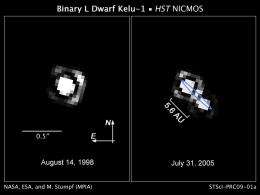
This pair of NASA Hubble Space Telescope images of the binary brown dwarf Kelu-1 trace the orbital motion of the two stars over a seven-year span as photographed by the Near Infrared Camera and Multi-Object Spectrometer (NICMOS) on Hubble. In 1998, the stars were too close together to be resolved by Hubble. By 2005, they had moved apart to a separation of 520 million miles. The projected maximum separation is 550 million miles. Binary systems allow astronomers to estimate the mass of companion objects. The brown dwarfs are 61 and 50 times the mass of Jupiter. They are therefore too small to burn as stars, but too large to have formed as planets. Based on the total estimated mass of the system, astronomers suspect there is a third brown dwarf member that has not yet been resolved. Credit: NASA, ESA, and M. Stumpf (Max-Planck-Institute for Astronomy)

(PhysOrg.com) -- Brown dwarfs, objects that are less massive than stars but larger than planets, just got more elusive, based on a study of 233 nearby multiple-star systems by NASA's Hubble Space Telescope. Hubble found only two brown dwarfs as companions to normal stars. This means the so-called "brown dwarf desert" (the absence of brown dwarfs around solar-type stars) extends to the smallest stars in the universe.

Sergio Dieterich of Georgia State University in Atlanta and team leader of the study is reporting the results today at the 213th meeting of the American Astronomical Society (AAS) in Long Beach, Calif.

"We still did not find brown dwarfs around small red stars whose mass is only slightly above the hydrogen burning limit. Especially when we consider the fact that brown dwarfs binaries do exist, the fact that there are very few binaries whose components lie on different sides of the hydrogen burning limit is significant," says Dieterich.

The 233 stars surveyed are part of the RECONS (Research Consortium on Nearby Stars) survey meant to understand the nature of the sun's nearest stellar neighbors, both individually and as a population. The current primary goals are to discover and characterize "missing" members of the sample of stars within 32.6 light-years (10 parsecs) of Earth.

RECONS searches for nearby stars through analyzing existing all-sky surveys, combined with observations by a variety of telescopes in both hemispheres. A total of 12 brown dwarfs are currently known within 32.6 light-years of Earth, as compared to 239 red dwarf stars (stars that are largely 20 percent the mass of our sun and are roughly half its diameter and temperature).

In fact, the number of known brown dwarfs is close to that of known extrasolar planets. However, the number of exoplanets known in this region so far is very likely only a lower limit as smaller-mass exoplanets are not within our capability of detection at present.

The Hubble survey, taken with Hubble's Near Infrared Camera and Multi-Object Spectrometer (NICMOS), provides strong statistics pointing to the fact that brown dwarfs do not exist around even the least massive stars. "If mass ratio was the driving factor we would expect to find more brown dwarfs around small red stars than around solar type stars," says Dieterich.

These results are complementary to another study also being reported at the AAS meeting by Micaela Stumpf of the Max-Planck-Institute for Astronomy in Heidelberg, Germany. The results imply that brown dwarfs tend to hang out with their own kind.

Nearly ten years' worth of NICMOS observations, combined with recent ground-based adaptive optics results, have provided a first estimate of the orbit of the double brown dwarf system Kelu-1 AB. The eccentric orbit is tilted nearly edge-on to Earth and the dwarfs complete an orbit every 38 years.

Based on the orbital dynamics, the total mass of the system is estimated to be 184 Jupiter masses. But, based on spectroscopic and photometric measurements, the two brown dwarfs are no larger than 61 and 50 Jupiter masses, respectively (a star is no smaller than 75 Jupiter masses). Stumpf is reporting that there may in fact be a third member of the system to account for the "missing mass." This would make it potentially the first-ever confirmed triple brown dwarf system.

All-sky surveys planned for the next decade, with advanced telescopes like the Large Synoptic Survey Telescope, promise to ultimately solve the puzzle of the "brown dwarf desert" by doing deep infrared searches for the underlying brown dwarf population.

Provided by Hubble Centre


print this article email this article download pdf blog this article bookmark this article     Stumble it Digg this share on Facebook retweet share on Reddit add to delicious
Rate this story - 4.4 /5 (5 votes)


January 5, 2009 all stories

Comments: 0

4.4 /5 (5 votes)
  • Stumble this up

  • Digg this

  • share this

  • hide
  • Related Stories

  • In Search of Dark Asteroids (and Other Sneaky Things)
    created Sep 16, 2009 | popularity not rated yet | comments 0
  • NASA's WISE Mission Arrives at Launch Site
    created Aug 17, 2009 | popularity not rated yet | comments 0
  • Ultracool stars take 'wild rides' around, outside the Milky Way
    created Jun 09, 2009 | popularity not rated yet | comments 0
  • Cool Stars Have Different Mix of Life-Forming Chemicals
    created Apr 07, 2009 | popularity not rated yet | comments 0
  • Adventures in the 'Goldilocks zone'
    created Mar 12, 2009 | popularity not rated yet | comments 0


  • hide
  • Relevant PhysicsForums posts

  • The shape of our solar system's orbits.
    created Nov 07, 2009
  • Above or Below the Line of Nodes
    created Nov 07, 2009
  • Supernova vs. Nova?
    created Nov 07, 2009
  • Supernova's Gamma Rays and Comets
    created Nov 06, 2009
  • More from Physics Forums - General Astronomy

Other News

The GOES-12 satellite sees Large Hurricane Ida nearing landfall

The GOES-12 satellite sees Large Hurricane Ida nearing landfall

Space & Earth / Earth Sciences

created 44 minutes ago | popularity not rated yet | comments 0

Residents of the U.S. Gulf coast thought they were getting a break this hurricane season until Ida showed up. Today, November 9, Ida is a hurricane and is headed for a landfall in the western Florida Panhandle ...


NASA's TRMM Satellite sees most of Ida's heaviest rain stayed off coasts

NASA's TRMM Satellite sees most of Ida's heaviest rain stayed off coasts

Space & Earth / Earth Sciences

created 35 minutes ago | popularity not rated yet | comments 0

NASA and the Japanese Space Agency's Tropical Rainfall Measuring Mission (TRMM) satellite flew over Ida and captured her rainfall when she passed by Nicaragua, Honduras and Belize this weekend. TRMM data revealed ...


Scientists seek safe carbon dioxide storage for 'greener' power generation (w/ Video)

Space & Earth / Environment

created 1hour ago | popularity not rated yet | comments 1

The U.S. Department of Energy (DOE) has announced plans to fund research at the University of Alabama at Birmingham (UAB) School of Engineering on technologies that would help reduce greenhouse gas emissions through the capture ...


Antarctica glacier retreat creates new carbon dioxide store

Antarctica glacier retreat creates new carbon dioxide store

Space & Earth / Earth Sciences

created 4 hours ago | popularity 5 / 5 (1) | comments 1

Large blooms of tiny marine plants called phytoplankton are flourishing in areas of open water left exposed by the recent and rapid melting of ice shelves and glaciers around the Antarctic Peninsula. This ...


Success in 'space elevator' competition (AP)

Success in 'space elevator' competition (Update 3)

Space & Earth / Space Exploration

created Nov 05, 2009 | popularity 4.3 / 5 (33) | comments 53

(AP) -- A robot powered by a ground-based laser beam climbed a long cable dangling from a helicopter on Wednesday to qualify for prize money in a $2 million competition to test the potential reality of the ...