Electronics from the printer
January 5, 2009

Enlarge

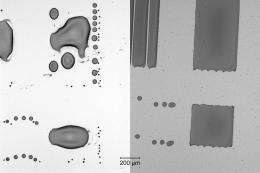
In order for printed electron devices to work, the researchers need to match the properties of the ink and the substrate surface to one another. The untreated insulator (left) is difficult to wet, unlike the surface-treated insulator (right). © Fraunhofer IISB

(PhysOrg.com) -- Electronic systems designed to perform simple functions, such as monitor the temperature on a yogurt pot, mustn’t cost much: This is where printed electronics are at an advantage. Researchers are now significantly improving the properties of printed circuits.

Televisions have changed dramatically: While bulky TV sets dominated our living rooms until just a few years ago, the screens are now so flat that they can easily be hung on the wall. A close look at the inside of these devices will reveal fine conductor paths and transistors that supply the electricity needed to switch the pixels on the screen on and off. These circuits are manufactured layer by layer, usually by photolithography. The materials are deposited onto the entire surface of a substrate and covered with photoresist, which is exposed to light at specific points using a mask.

The exposed photoresist alters its chemical properties: It becomes soluble and can be easily removed. The layer to be structured returns to the surface and can be etched away. However, the parts of the layer still covered with photoresist remain intact. One major disadvantage of this process is that a large fraction of the deposited material is not used. A more cost-efficient and resource-saving method is to deposit the material by printing only in places where it will actually be needed later.

Printed electronics already exist in the form of conductor paths and devices made from polymers. However, their electrical properties cannot compete with those of inorganic materials. The charge carriers in the polymers travel more slowly, with the result that a printed RFID tag, for example, will have a shorter transmission range than a conventional one. Moreover, polymers tend to react more sensitively to moisture and UV light. Researchers at the Fraunhofer Institute of Integrated Systems and Device Technology IISB in Erlangen have now commissioned a process line in which electron devices can be printed from inorganic materials using an ink jet similar to those in any office printer. “We use ink made of nanoparticles and add a stabilizer so that the particles can be easily processed and do not clump together,” says IISB group manager Dr. Michael Jank.

The nano ink has passed the first printing tests and Jank hopes that the researchers will be able to print circuits performing simple functions in about a year’s time. “We expect printed products to cost around 50 percent less than silicon-based ones in the case of simple circuits,” he says. “Printed RFID tags should then be cheap enough to be attached to the packaging of low-cost products such as yogurts, where they can then monitor the temperature, and store and transmit data.”

Provided by Fraunhofer-Gesellschaft


print this article email this article download pdf blog this article bookmark this article     Stumble it Digg this share on Facebook retweet share on Reddit add to delicious
Rate this story - 4.7 /5 (3 votes)

Rank Filter

Move the slider to adjust rank threshold, so that you can hide some of the comments.


Display comments: newest first


January 5, 2009 all stories

Comments: 1

4.7 /5 (3 votes)
  • Stumble this up

  • Digg this

  • share this

  • hide
  • Related Stories

  • Camera flash turns an insulating material into a conductor
    created Aug 12, 2009 | popularity not rated yet | comments 0
  • Strength through diversity
    created Feb 11, 2009 | popularity not rated yet | comments 0
  • A first in integrated nanowire sensor circuitry
    created Aug 04, 2008 | popularity not rated yet | comments 0
  • Move over, silicon: Advances pave way for powerful carbon-based electronics
    created Dec 18, 2007 | popularity not rated yet | comments 0
  • Flat, Flexible, Wireless Power Source Can Go Anywhere
    created May 23, 2007 | popularity not rated yet | comments 0


  • hide
  • Relevant PhysicsForums posts

Other News

A system of space solar power system (SSPS)

Japan eyes solar station in space as new energy source

Technology / Energy

created 22 hours ago | popularity 4.7 / 5 (14) | comments 20

It may sound like a sci-fi vision, but Japan's space agency is dead serious: by 2030 it wants to collect solar power in space and zap it down to Earth, using laser beams or microwaves.


Framed for child porn -- by a PC virus

Framed for child porn -- by a PC virus

Technology / Internet

created 15 hours ago | popularity 5 / 5 (5) | comments 2

(AP) -- Of all the sinister things that Internet viruses do, this might be the worst: They can make you an unsuspecting collector of child pornography.


Software cos. eye key patent case in Supreme Court (AP)

Software cos. eye key patent case in Supreme Court

Technology / Business

created 23 hours ago | popularity 5 / 5 (4) | comments 2

(AP) -- With the technology industry looking on, the Supreme Court on Monday will explore what types of inventions should be eligible for a patent in a pivotal case that could undermine such legal protections ...


Campaigners are stepping up efforts to curb online tracking

Advertisers face resistance to on-line tracking

Technology / Internet

created 22 hours ago | popularity 5 / 5 (4) | comments 0

Campaigners are stepping up efforts to curb online tracking of Internet use by firms that deliver adverts tailored to the specific interests of consumers, as polls reveal widespread unease with the practice.


Sony offers 'Cloudy' early to people with its TVs

Technology / Business

created 15 hours ago | popularity not rated yet | comments 0

(AP) -- In a bid to sell living room electronics and spur buzz for "Cloudy with A Chance of Meatballs," Sony Corp. is offering the movie for free to U.S. buyers of its Internet-connected TVs and Blu-ray players starting ...