Dead Stars Tell Story of Planet Birth
January 5, 2009
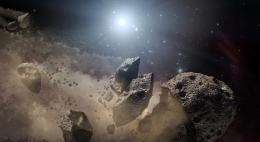
This artist's concept illustrates a dead star, or "white dwarf," surrounded by the bits and pieces of a disintegrating asteroid. Image: NASA/JPL-Caltech
(PhysOrg.com) -- Astronomers have turned to an unexpected place to study the evolution of planets -- dead stars. Observations made with NASA's Spitzer Space Telescope reveal six dead "white dwarf" stars littered with the remains of shredded asteroids. This might sound pretty bleak, but it turns out the chewed-up asteroids are teaching astronomers about the building materials of planets around other stars.
So far, the results suggest that the same materials that make up Earth and our solar system's other rocky bodies could be common in the universe. If the materials are common, then rocky planets could be, too.
"If you ground up our asteroids and rocky planets, you would get the same type of dust we are seeing in these star systems," said Michael Jura of the University of California, Los Angeles, who presented the results today at the American Astronomical Society meeting in Long Beach, Calif. "This tells us that the stars have asteroids like ours -- and therefore could also have rocky planets." Jura is the lead author of a paper on the findings accepted for publication in the Astronomical Journal.
Asteroids and planets form out of dusty material that swirls around young stars. The dust sticks together, forming clumps and eventually full-grown planets. Asteroids are the leftover debris. When a star like our sun nears the end of its life, it puffs up into a red giant that consumes its innermost planets, while jostling the orbits of remaining asteroids and outer planets. As the star continues to die, it blows off its outer layers and shrinks down into a skeleton of its former self -- a white dwarf.
Sometimes, a jostled asteroid wanders too close to a white dwarf and meets its demise -- the gravity of the white dwarf shreds the asteroid to pieces. A similar thing happened to Comet Shoemaker Levy 9 when Jupiter's gravity tore it up, before the comet ultimately smashed into the planet in 1994.
Spitzer observed shredded asteroid pieces around white dwarfs with its infrared spectrograph, an instrument that breaks light apart into a rainbow of wavelengths, revealing imprints of chemicals. Previously, Spitzer analyzed the asteroid dust around two so-called polluted white dwarfs; the new observations bring the total to eight.
"Now, we've got a bigger sample of these polluted white dwarfs, so we know these types of events are not extremely rare," said Jura.
In all eight systems observed, Spitzer found that the dust contains a glassy silicate mineral similar to olivine and commonly found on Earth. "This is one clue that the rocky material around these stars has evolved very much like our own," said Jura.
The Spitzer data also suggest there is no carbon in the rocky debris -- again like the asteroids and rocky planets in our solar system, which have relatively little carbon.
A single asteroid is thought to have broken apart within the last million years or so in each of the eight white-dwarf systems. The biggest of the bunch was once about 200 kilometers (124 miles) in diameter, a bit larger than Los Angeles County.
Jura says the real power of observing these white dwarf systems is still to come. When an asteroid "bites the dust" around a dead star, it breaks into very tiny pieces. Asteroid dust around living stars, by contrast, is made of larger particles. By continuing to use spectrographs to analyze the visible light from this fine dust, astronomers will be able to see exquisite details -- including information about what elements are present and in what abundance. This will reveal much more about how other star systems sort and process their planetary materials.
"It's as if the white dwarfs separate the dust apart for us," said Jura.
Other authors are Ben Zuckerman at the University of California, Los Angeles, and Jay Farihi at Leicester University, England.
Provided by JPL/NASA
-
White Dwarf Stars Consume Rocky Bodies
Aug 16, 2011 |
5 / 5 (4) |
0
-
The methane habitable zone
Nov 11, 2011 |
4.9 / 5 (16) |
3
-
Living in the galactic danger zone
Sep 23, 2011 |
4.9 / 5 (8) |
12
-
Watery, rocky planets may be common in the Milky Way
Apr 13, 2010 |
4.8 / 5 (25) |
8
-
Solar systems around dead Suns?
Apr 20, 2009 |
4.5 / 5 (15) |
3
-
Engineers build first sub-10-nm carbon nanotube transistor
Feb 01, 2012 |
4.9 / 5 (33) |
30
-
Something old, something new: Evolution and the structural divergence of duplicate genes
Jan 31, 2012 |
4.6 / 5 (7) |
1
-
The hidden nanoworld of ice crystals: Revealing the dynamic behavior of quasi-liquid layers
Jan 30, 2012 |
5 / 5 (4) |
1
-
Stock market network reveals investor clustering
Jan 27, 2012 |
3.9 / 5 (23) |
8
-
Of microchemistry and molecules: Electronic microfluidic device synthesizes biocompatible probes
Jan 26, 2012 |
5 / 5 (2) |
0
-
Never ending outer space.....
19 hours ago
-
Neutron Star fragments?
21 hours ago
-
stationary or not?
Feb 11, 2012
-
Scale of the Universe
Feb 10, 2012
-
Titan's lack of impact craters
Feb 09, 2012
-
Real pictures of black hole eating a star?
Feb 08, 2012
- More from Physics Forums - General Astronomy
More news stories
Latin America mining boom clashes with conservation
Latin America is experiencing a mining boom as prices rise fuelled by a hike in global demand, but the region is also being hit by a wave of violent protests, strikes and rallies by environmentalists.
12 hours ago |
5 / 5 (1) |
1
Salvage workers begin pumping fuel from Italian shipwreck
Salvage workers Sunday began pumping fuel from the shipwrecked Italian cruise liner Costa Concordia, a day ahead of schedule, officials said.
4 hours ago |
not rated yet |
0
Political leaders play key role in how worried Americans are by climate change: study
More than extreme weather events and the work of scientists, it is national political leaders who influence how much Americans worry about the threat of climate change, new research finds.
Feb 06, 2012 |
5 / 5 (6) |
73
NASA budget will axe Mars deal with Europe: scientists
US President Barack Obama's budget proposal to be submitted next week for 2013 will cut NASA's budget by 20 percent and eliminate a major partnership with Europe on Mars exploration, scientists said Thursday.
Space & Earth / Space Exploration
Feb 10, 2012 |
5 / 5 (3) |
58
Humans may have helped the decline of African rainforests 3000 years ago
(PhysOrg.com) -- Large areas of rainforests in Central Africa mysteriously disappeared over three thousand years ago, to be replaced by savannas. The prevailing theory has been that the cause was a change ...
Overeating may double risk of memory loss
New research suggests that consuming between 2,100 and 6,000 calories per day may double the risk of memory loss, or mild cognitive impairment (MCI), among people age 70 and older. The study was released today and will be ...
Google might launch Drive for cloud storage soon
(PhysOrg.com) -- Google's next big move, according to the Wall Street Journal, is a cloud storage service called Drive. Hardly first to the plate, Google is simply catching up to introducing its cloud reposi ...
Scientists discover molecular secrets of 2,000-year-old Chinese herbal remedy
For roughly two thousand years, Chinese herbalists have treated Malaria using a root extract, commonly known as Chang Shan, from a type of hydrangea that grows in Tibet and Nepal. More recent studies suggest that halofuginone, ...
New method to examine batteries -- MRI from the inside
There is an ever-increasing need for advanced batteries for portable electronics, such as phones, cameras, and music players, but also to power electric vehicles and to facilitate the distribution and storage of energy derived ...
Injured boomers beware: Know when to see doctor
(AP) -- It happened to nurse Jane Byron years after an in-line skating fall, business owner Haralee Weintraub while doing "men's" push-ups, and avid cyclist Gene Wilberg while lifting a heavy box.
Lab study raises questions over nano-particle impact
Tests involving chickens have raised questions about the impact on health from engineered nano-particles, the ultra-fine grains commonly used in drugs and processed foods, scientists said on Sunday.
Jan 06, 2009
Rank: not rated yet
So why wouldn't it work with solar systems. In my opinion it is a great way to look at how other systems are build up.