Lunar rock-like material may someday house moon colonies
January 5, 2009 By Steven Mackay
Lunar rock-like material may someday house moon colonies

Enlarge

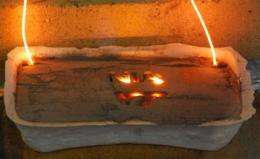
A composite of simulated lunar regolith and powdered aluminum heats up via wires as part of the fusion process that forms a brick. A team of Virginia Tech students, under the advisement of Kathryn Logan, a professor in the materials science and engineering department, designed the brick as a potential building tool for future colonies on the moon. The NIA carved into the stands for National Institute of Aerospace, which includes Virginia Tech.

(PhysOrg.com) -- Dwellings in colonies on the moon one day may be built with new, highly durable bricks developed by students from the College of Engineering at Virginia Tech.

Initially designed to construct a dome, the building material is composed of a lunar rock-like material mixed with powdered aluminum that can be molded into any shape. The invention recently won the In-Situ Lunar Resource Utilization materials and construction category award from the Pacific International Space Center for Exploration Systems (PISCES). The award was one of two prizes given out this year by the research center, which is dedicated to supporting life on the moon and beyond.

Design work on the early-development lunar bricks was based on previous work by the College of Engineering student team’s adviser Kathryn Logan, a professor of materials science and engineering and the Virginia Tech Langley Professor at the National Institute of Aerospace (NIA) in Hampton, Va. The seven-member student team works with Logan at the NIA.

Logan’s prior research entailed mixing powdered aluminum and ceramic materials to form armor plating for tanks funded through a Department of Defense contract. “I theorized that if I could do this kind of reaction to make armor, then I could use a similar type of reaction to make construction materials for the moon,” Logan said.

Since actual lunar rock, known as regolith, is scarce, the students used volcanic ash from a deposit on Earth along with various minerals and basaltic glass, similar to rock on the lunar surface, according to Eric Faierson, a doctoral student who led the Virginia Tech team.

During initial experiments, the simulated regolith and aluminum powder were mixed and placed inside a shallow aluminum foil crucible. A wire was inserted into the mixture, which was then heated to 2,700 degrees Fahrenheit triggering a reaction called self-propagating high-temperature synthesis (SHS), Logan said. The reaction caused the material to form a solid brick. A ceramic crucible was used in later experiments to form complex curved surfaces.

Once the student team had created a brick, they found that it was almost as strong as concrete under various pressure tests. Faierson said one-square inch of the brick could withstand the gradual application of 2,450 pounds, nearly the weight of a Ford Focus. This strength would enable it to withstand an environment where gravity is a fraction of the pull on Earth. The more than yearlong ongoing research has included studying the bricks reaction to solar radiation and their effectiveness as a construction material for lunar applications.

The research team chose small bricks -- about one-third the size of a regular mason’s brick, or roughly 5 inches by 2.5 inches by 1 inch, and weighing about an eighth of a pound -- for quality control and to conserve materials. “Theoretically the material can be made in any size and shape, however performing the reaction on a larger scale increases the potential for” flaws in the end product, Faierson said. “Large scale implementation might be more appropriate in applications such as landing pads, roadways, and blast berms, where flaws are less of a concern.”

The group formed several brick shapes to demonstrate the concept of forming an igloo-like dome component, but did not build the full structure. Creation of larger bricks, about cinder block size, including those closer to perfectly formed shape, are forthcoming, Logan said. Also to be studied is the harnessing of large quantities of heat derived from the SHS reaction to produce electricity, and extract volatiles for the lunar colony.

One of the team members, Michael Hunt, a graduate student, studied the chemical composition of the aluminum powder and the regolith before the fusion process, and then the resulting brick compound. “It’s definitely exciting to have worked on the lunar brick project,” he said. “I never would have thought that I’d be a part of something like this,” Hunt said.

Judging by members of the Japan-United States Science, Technology and Space Applications Program, which included scientists from NASA and industry, was based on the novelty and thoughtfulness evidenced by the teams, their commitment to PISCES goals and objectives, and their compliance with the rules of the competition. PISCES is located in Hawaii, where volcanic geology gives scientists a landscape similar to the moon that can be used to test technology prior to possible lunar use.

Provided by Virginia Tech

4.6 /5 (9 votes)  

Filter


Move the slider to adjust rank threshold, so that you can hide some of the comments.


Display comments: newest first

googleplex
Jan 05, 2009

Rank: 3 / 5 (2)
Without an atmosphere the moon surface is continually bombarded by meteorites. Whatever is built would need to be robust. Building underground caverns or tunneling into a hill would afford the best protection.
physpuppy
Jan 05, 2009

Rank: 3 / 5 (2)
Underground is probably best for living quarters, but there will be need for storage huts and temporary living quarters in place where digging would take too much time. In addition, I'm sure that folks that will be living there, even underground, would like to be able to renovate their quarters, and drywall might be a bit difficult to come by...

(don't forget material needed for tables, etc.- while it wouldn't replace the panache of "imported from Earth" designer labels, this is a great start)

NOM
Jan 05, 2009

Rank: 3 / 5 (2)
You don't want to be just digging a hole either. The underground bases will need to be strengthened and making air tight.
This is a high temperature method for making bricks - good because most methods of extracting volatiles (such as oxygen) from regolith will involve getting it pretty hot.
nkalanaga
Jan 05, 2009

Rank: 2.5 / 5 (2)
They used electricity, which isn't a problem on the Moon, but I wonder if the bricks could be baked directly by solar heat, using mirrors?
la7dfa
Jan 06, 2009

Rank: 3.3 / 5 (3)
A proposal is using microwaves to make regolith into roads etc directly on the surface. Else the fine grained sand will become a major problem.
morpheus2012
Jan 06, 2009

Rank: 1.8 / 5 (5)
there moon and mars bases sinc the 6oths

run by the secret space program not the mental

retard liers at nasa
NOM
Jan 06, 2009

Rank: 3 / 5 (2)
there moon and mars bases sinc the 6oths

run by the secret space program not the mental

retard liers at nasa

This morpharse idiot is nearly as bad as a moon-hoax theorist.
nkalanaga
Jan 06, 2009

Rank: 1 / 5 (1)
I've seen the microwave proposal, and it's been tested with actual moon samples. It's better for baking large areas, and doesn't produce air-tight products, but is certainly good enough for roads and dust control. A combination would be excellent for structures. Use the bricks for the inner surface, and then cover it with microwaved dirt for protection.
morpheus2012
Jan 06, 2009

Rank: 1 / 5 (4)
ur just a comon idiot NOM

who thinks reality is what u learn ins school and ur daddy bush tells u on fox news evrynite

fell nothing but sorry for dumb sheep like u
who has no kwowledge yet i i bet u think u know somthing lol

take a hike retard maybe next life u will learn somthing
Rank 4.6 /5 (9 votes)
Related Stories
Relevant PhysicsForums posts
  • How to tilt a object
    created7 hours ago
  • How to calculate total compressibility in liquid porous solid system
    created13 hours ago
  • Need help reading 3-D
    createdFeb 11, 2012
  • A way to send and receive wireless data
    createdFeb 11, 2012
  • Calling function with no input argument
    createdFeb 10, 2012
  • Force free body diagram problem on gym equipment
    createdFeb 10, 2012
  • More from Physics Forums - General Engineering

More news stories

Japan's Fukushima reactor may be reheating: operator

Temperature readings at one of the crippled Fukushima nuclear reactors have risen above Japan's stringent new safety standard but there was no immediate danger, its operator said Sunday.

Technology / Energy & Green Tech

created 24 minutes ago | popularity 1 / 5 (1) | comments 0

Google might launch Drive for cloud storage soon

(PhysOrg.com) -- Google's next big move, according to the Wall Street Journal, is a cloud storage service called Drive. Hardly first to the plate, Google is simply catching up to introducing its cloud reposi ...

Technology / Internet

created 21 hours ago | popularity 4.2 / 5 (6) | comments 5 | with audio podcast report

Iran blocks email, restricts net access: reports

Iran has further restricted access to the Internet and blocked popular email services for the past few days, in a move a top lawmaker said could "cost the regime dearly," media reports said on Sunday.

Technology / Internet

created 14 hours ago | popularity 5 / 5 (2) | comments 5

Walney offshore wind farm is world's biggest (for now)

(PhysOrg.com) -- The Walney wind farm on the Irish Sea--characterized by high tides, waves and windy weather--officially opened this week. The farm is treated in the press as a very big deal as the Walney ...

Technology / Energy & Green Tech

created Feb 11, 2012 | popularity 4.1 / 5 (14) | comments 59 | with audio podcast weblog

Navy to begin tests on electromagnetic railgun prototype launcher

The Office of Naval Research (ONR)'s Electromagnetic (EM) Railgun program will take an important step forward in the coming weeks when the first industry railgun prototype launcher is tested at a facility ...

Technology / Engineering

created Feb 06, 2012 | popularity 4.6 / 5 (21) | comments 95 | with audio podcast


Botox developer rues missing out on billions

Botox developer Alan Scott says he rues the day he handed over rights to the best-selling wrinkle-smoothing drug to a US company for just $4.5 million, saying he might have become a billionaire.

Australian women reject 'I love u' texts

Australian women may have embraced the digital era, but they prefer a face-to-face declaration of affection to an "I love u" text and find men addicted to their mobile phones a major turnoff.

Scientists discover molecular secrets of 2,000-year-old Chinese herbal remedy

For roughly two thousand years, Chinese herbalists have treated Malaria using a root extract, commonly known as Chang Shan, from a type of hydrangea that grows in Tibet and Nepal. More recent studies suggest that halofuginone, ...

New method to examine batteries -- MRI from the inside

There is an ever-increasing need for advanced batteries for portable electronics, such as phones, cameras, and music players, but also to power electric vehicles and to facilitate the distribution and storage of energy derived ...

A mitosis mystery solved: How chromosomes align perfectly in a dividing cell

Although the process of mitotic cell division has been studied intensely for more than 50 years, Whitehead Institute researchers have only now solved the mystery of how cells correctly align their chromosomes during symmetric ...

Lab study raises questions over nano-particle impact

Tests involving chickens have raised questions about the impact on health from engineered nano-particles, the ultra-fine grains commonly used in drugs and processed foods, scientists said on Sunday.