Protein's essential role in repairing damaged cells revealed
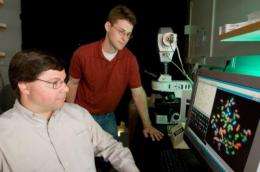
University of Michigan researchers have discovered that a key protein in cells plays a critical role in not one, but two processes affecting the development of cancer.
"Most proteins involved in responding to DNA damage that can cause cancer either help detect the damage and warn the rest of the cell, or help repair the damage," says David O. Ferguson, M.D., Ph.D., the study's lead author. Ferguson is an assistant professor of pathology at the U-M Medical School and a member of U-M's Comprehensive Cancer Center.
Prior research has shown that the protein, Mre11, functioned as a "gatekeeper" to signal injury to the cell and prevent damaged cells from proliferating. Now, Ferguson and colleagues have discovered that in mammals, a function of the Mre11 protein also serves as a "caretaker," by repairing DNA.
Their findings, published in the journal Cell, could have important implications for cancer treatment by someday allowing oncologists to predict a tumor's sensitivity to radiation and other therapies, making it more vulnerable to treatment.
Under normal circumstances, the body's cells grow, divide and eventually die. When something damages a healthy cell's DNA -- such as radiation or exposure to a toxin -- a multiprotein complex steps in to repair the breakage and activate other fundamental cellular processes.
The MRN complex, comprised of the Mre11, Rad50 and NBS1 proteins, senses DNA damage, known as double-strand breaks, within the cell. The complex then transmits that information to an enzyme called the ATM (ataxia-telangiectasia mutated) checkpoint kinase.
The ATM kinase controls the cell's response to double-strand breaks, and slows cell growth to give the cell opportunities to repair them, says Ferguson.
When the MRN complex doesn't work properly, inherited human neurological diseases, such as ataxia-telangiectasia-like syndrome and Nijmegen breakage syndrome, result. Both feature MRN mutations and significantly predispose a person to immunodeficiency and cancer.
What Ferguson and colleagues discovered is that Mre11 not only senses and communicates damage, it also repairs DNA double-strand breaks by acting as a nuclease, an enzyme that modifies and processes the broken DNA ends.
Research details
The researchers generated mouse models to examine the exact role of Mre11 in the MRN complex. They engineered two mouse strains, one in which Mre11 was disabled completely, and one in which only a single amino acid change was made.
What surprised researchers the most was that making that change to a single amino acid in Mre11 caused consequences as severe as when they eliminated the entire MRN complex.
Taking out the amino acid in Mre11 responsible for nuclease activity caused the mice to develop growth defects, chromosomal abnormalities and sensitivity to DNA-damaging agents. Therefore, researchers could say that the nuclease, or repair, activity of Mre11 proves critical for both MRN function and stability of the genetic material of the organism.
"First, Mre11 signals to the cell by activating the kinase, but it also acts in the repair of double-strand breaks via the nuclease functions. Therefore, it prevents the two individual steps that lead to cancer," Ferguson says.
Implications
The work, called "virtuoso cell engineering" in a Cell preview article, holds particular promise for identifying mutations associated with many cancers.
"What's emerging in the literature from large-scale screening studies of human tumors is that Mre11 may be frequently mutated in certain cancers," Ferguson says.
"This may have implications for diagnoses because tumors associated with different mutations may have different prognoses and respond to different therapies," he says. In particular, mutations in Mre11 may predict how sensitive or resistant a particular tumor will be to treatments with DNA-damaging agents.
"The fact that we have now separated the functions of DNA repair from the checkpoint functions means we may have identified a target that can sensitize tumors to radiation and chemotherapeutic agents used in treating cancer."
Reference: Cell, Vol. 135, Issue 1, pp. 85-96
Source: University of Michigan


