Astronomers use gamma-ray burst to probe star formation in the early universe
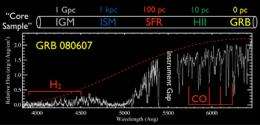
(PhysOrg.com) -- The brilliant afterglow of a powerful gamma-ray burst (GRB) has enabled astronomers to probe the star-forming environment of a distant galaxy, resulting in the first detection of molecular gas in a GRB host galaxy. By analyzing the spectrum of light emitted in the GRB afterglow, the researchers are gleaning insights into an active stellar nursery in a galaxy so far away it appears as it was 10 billion years ago.
"This observation required a rare and exceptionally bright event to allow us to probe the fragile environment where stars were forming just 3 billion years after the Big Bang. After correcting for the extreme dust extinction, this is intrinsically the second brightest GRB afterglow to date; it would have been easily observed with amateur telescopes, if not for the dust in the way," said Jason X. Prochaska, professor of astronomy and astrophysics at the University of California, Santa Cruz.
Prochaska's team presented its findings at the American Astronomical Society meeting this week in Long Beach, Calif. A paper describing the results has been accepted for publication in Astrophysical Journal Letters.
Stars form in vast clouds of molecular gas and dust, and astronomers have expected to find evidence of these molecular clouds in GRB host galaxies. Until now, however, efforts to detect molecular gas in GRB afterglow spectra had been unsuccessful. The new observations by Prochaska and his coauthors indicate that star formation in the early universe occurred in environments similar to star-forming regions in the Milky Way.
The study focused on a "long duration" gamma-ray burst known as GRB 080607. This type of burst is thought to occur when a massive star collapses to form a black hole. The initial burst of high-energy gamma rays was followed by a slowly fading afterglow of radiation over the entire spectrum of wavelengths.
"We suspect that previous events like 080607 were too faint to be observed on Earth," said coauthor Yaron Sheffer of the University of Toledo. "Many so-called dark bursts, with no observable afterglow, probably mark the dusty, highly extinguished environments of young star-forming regions."
NASA's Swift satellite detected the gamma-ray burst and began x-ray observations, while alerting astronomers and triggering automatic observations by ground-based telescopes such as the Katzman Automatic Imaging Telescope at Lick Observatory. Team members Joshua Bloom, Daniel Perley, and Adam Miller of UC Berkeley happened to be using the Keck I Telescope at the W. M. Keck Observatory in Hawaii and began spectroscopic observations within 15 minutes using the Low Resolution Imaging Spectrograph (LRIS).
The resulting spectrum of the optical afterglow yielded information about the dust, gas, and metals in the interstellar medium through which the light passed on its way out of the host galaxy. In addition to the first clear detection of molecular gases (both carbon monoxide and hydrogen), the spectrum indicated a metal composition comparable to that of the Sun (to astronomers, "metals" are elements heavier than hydrogen and helium).
The spectrum also has many features researchers have never seen before, Prochaska said. In addition to hundreds of standard absorption lines corresponding to known transitions of various elements, the spectrum shows many absorption lines that researchers have yet to identify.
"This is easily the most fascinating spectrum that I've ever worked on," Prochaska said. "Nearly half of the features remain a mystery, and it is possible that no one has ever detected them previously, either in controlled laboratory experiments or in spectra from our galaxy or other galaxies."
There is also more hydrogen in this spectrum than along any path through the Milky Way, he added. "This remains a bit of a puzzle," Prochaska said. "For now, we don't know much about the galaxy that hosted the explosion, but the evidence suggests it has been prodigious in terms of star formation."
The burst and its afterglow were observed in June, and the team did not manage to get images of the host galaxy before it moved to a position in the sky where it could not be observed. In January, the researchers will image the galaxy to connect their findings on the star-forming region with its global properties.
Provided by University of California, Santa Cruz


