Black Holes Lead Galaxy Growth
January 6, 2009
Black Holes Lead Galaxy Growth

Enlarge

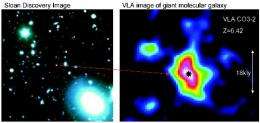
VLA image (right) of gas in young galaxy seen as it was when the Universe was only 870 million years old. Image: NRAO/AUI/NSF, SDSS

(PhysOrg.com) -- Astronomers may have solved a cosmic chicken-and-egg problem -- the question of which formed first in the early Universe -- galaxies or the supermassive black holes seen at their cores.

"It looks like the black holes came first. The evidence is piling up," said Chris Carilli, of the National Radio Astronomy Observatory (NRAO). Carilli outlined the conclusions from recent research done by an international team studying conditions in the first billion years of the Universe's history in a lecture presented to the American Astronomical Society's meeting in Long Beach, California.

Earlier studies of galaxies and their central black holes in the nearby Universe revealed an intriguing linkage between the masses of the black holes and of the central "bulges" of stars and gas in the galaxies. The ratio of the black hole and the bulge mass is nearly the same for a wide range of galactic sizes and ages. For central black holes from a few million to many billions of times the mass of our Sun, the black hole's mass is about one one-thousandth of the mass of the surrounding galactic bulge.

"This constant ratio indicates that the black hole and the bulge affect each others' growth in some sort of interactive relationship," said Dominik Riechers, of Caltech. "The big question has been whether one grows before the other or if they grow together, maintaining their mass ratio throughout the entire process."

In the past few years, scientists have used the National Science Foundation's Very Large Array radio telescope and the Plateau de Bure Interferometer in France to peer far back in the 13.7 billion-year history of the Universe, to the dawn of the first galaxies.

"We finally have been able to measure black-hole and bulge masses in several galaxies seen as they were in the first billion years after the Big Bang, and the evidence suggests that the constant ratio seen nearby may not hold in the early Universe. The black holes in these young galaxies are much more massive compared to the bulges than those seen in the nearby Universe," said Fabian Walter of the Max-Planck Institute for Radioastronomy (MPIfR) in Germany.

"The implication is that the black holes started growing first."

The next challenge is to figure out how the black hole and the bulge affect each others' growth. "We don't know what mechanism is at work here, and why, at some point in the process, the 'standard' ratio between the masses is established," Riechers said.

New telescopes now under construction will be key tools for unraveling this mystery, Carilli explained. "The Expanded Very Large Array (EVLA) and the Atacama Large Millimeter/submillimeter Array (ALMA) will give us dramatic improvements in sensitivity and the resolving power to image the gas in these galaxies on the small scales required to make detailed studies of their dynamics," he said.

"To understand how the Universe got to be the way it is today, we must understand how the first stars and galaxies were formed when the Universe was young. With the new observatories we'll have in the next few years, we'll have the opportunity to learn important details from the era when the Universe was only a toddler compared to today's adult," Carilli said.

Provided by National Radio Astronomy Observatory

4.5 /5 (13 votes)  

Filter


Move the slider to adjust rank threshold, so that you can hide some of the comments.


Display comments: newest first

brant
Jan 06, 2009

Rank: 1 / 5 (1)
"Here we report that a `sample of galaxies that were first detected through their neutral hydrogen radio-frequency emission, and are thus free of optical selection effects, shows five independent correlations among six independent observables, despite having a wide range of properties. This implies that the structure of these galaxies must be controlled by a single parameter, although we cannot identify this parameter from our dataset. Such a degree of organization appears to be at odds with hierarchical galaxy formation, a central tenet of the cold dark matter paradigm in cosmology."
http://www.cosmol...8.12.pdf
NeilFarbstein
Jan 07, 2009

Rank: 1 / 5 (1)
Cold dark matter seems to be a logical explanantion as opposed to dark energy type theories. Black holes could be holding a lot of the missing mass also.
Thecis
Jan 07, 2009

Rank: 5 / 5 (1)
Black holes could hold them but not the supermassive black holes that have already formed galaxies. Those can be seen and were used within the calculations to show that we have some missing mass
TimESimmons
Jan 07, 2009

Rank: 1 / 5 (1)
A mechanism that could stabilise the ratio of masses of bulge and central black hole is suggested near the bottom here:-

http://www.presto...ndex.htm
theophys
Jan 08, 2009

Rank: not rated yet
Cold dark matter seems to be a logical explanantion as opposed to dark energy type theories. Black holes could be holding a lot of the missing mass also.

That was considered, but their just isn't enough cold dark matter to explain all of the missing mass. Personally, I think it's a combination of cold dark matter and all the fun little particles like neutrinos and such.
Razy
Jan 31, 2009

Rank: not rated yet
How do you know that we are not inside a black hole?

Are they not simply a critical mass of energy that has broken down the inter-atomic forces that hold atomic structures in form?
That hold the very atom itself in volume...
That holds the electrons apart from the protons, and that holds true the electron existence as one would describe it in magnetic theory...
Basically crunching mass to the point where it approaches a finite volume. Well, as far close to finite as we can observe. Perhaps even forming time itself.

You may be focusing on the appearances that black holes have mass %u2013 yet we are only viewing the extent to which light is drawn closely enough to be accelerated by force.

I think that answers would be attained faster if we were to calculate the rate of change (from earth point of reference) that the universe volume is accelerating at. At least to what we can surmise. Obviously if light is actually a constant then the volume would be accelerating due to a vector radius changing the size of the sphere. But is that rate of change constant? Or is the formula actually observed to be integration and/or a derivative? If you can accurately theories this for me, then I may be able to adorn you some answers. I think that the question in of itself may beg of the answer. If you can devise the formula to the rate of change, then I can tell you the critical mass that results in a black holes formation.

So much mass held together with so much more force that the universe (light) can not hold it apart within the relative argument of existence and functioning laws of our universe...

I gave Hawkins his paradox years ago%u2026 the dude knows one - I still have seven more%u2026.
Rank 4.5 /5 (13 votes)
Related Stories
Relevant PhysicsForums posts
  • Never ending outer space.....
    created20 hours ago
  • Neutron Star fragments?
    created22 hours ago
  • stationary or not?
    createdFeb 11, 2012
  • Scale of the Universe
    createdFeb 10, 2012
  • Titan's lack of impact craters
    createdFeb 09, 2012
  • Real pictures of black hole eating a star?
    createdFeb 08, 2012
  • More from Physics Forums - General Astronomy

More news stories

Salvage workers begin pumping fuel from Italian shipwreck

Salvage workers Sunday began pumping fuel from the shipwrecked Italian cruise liner Costa Concordia, a day ahead of schedule, officials said.

Space & Earth / Environment

created 5 hours ago | popularity not rated yet | comments 0

Latin America mining boom clashes with conservation

Latin America is experiencing a mining boom as prices rise fuelled by a hike in global demand, but the region is also being hit by a wave of violent protests, strikes and rallies by environmentalists.

Space & Earth / Environment

created 13 hours ago | popularity 5 / 5 (1) | comments 1

Political leaders play key role in how worried Americans are by climate change: study

More than extreme weather events and the work of scientists, it is national political leaders who influence how much Americans worry about the threat of climate change, new research finds.

Space & Earth / Environment

created Feb 06, 2012 | popularity 5 / 5 (7) | comments 73

NASA budget will axe Mars deal with Europe: scientists

US President Barack Obama's budget proposal to be submitted next week for 2013 will cut NASA's budget by 20 percent and eliminate a major partnership with Europe on Mars exploration, scientists said Thursday.

Space & Earth / Space Exploration

created Feb 10, 2012 | popularity 5 / 5 (3) | comments 58

Humans may have helped the decline of African rainforests 3000 years ago

(PhysOrg.com) -- Large areas of rainforests in Central Africa mysteriously disappeared over three thousand years ago, to be replaced by savannas. The prevailing theory has been that the cause was a change ...

Space & Earth / Environment

created Feb 10, 2012 | popularity 4.1 / 5 (14) | comments 21 | with audio podcast report


Declining health-care productivity in England: Who says so?

Reports that the National Health Service in England has been declining in productivity in the last decade appear to have been accepted as fact. However, a Viewpoint published Online First by The Lancet disputes this. The Vi ...

Scientists discover molecular secrets of 2,000-year-old Chinese herbal remedy

For roughly two thousand years, Chinese herbalists have treated Malaria using a root extract, commonly known as Chang Shan, from a type of hydrangea that grows in Tibet and Nepal. More recent studies suggest that halofuginone, ...

New method to examine batteries -- MRI from the inside

There is an ever-increasing need for advanced batteries for portable electronics, such as phones, cameras, and music players, but also to power electric vehicles and to facilitate the distribution and storage of energy derived ...

Overeating may double risk of memory loss

New research suggests that consuming between 2,100 and 6,000 calories per day may double the risk of memory loss, or mild cognitive impairment (MCI), among people age 70 and older. The study was released today and will be ...

A mitosis mystery solved: How chromosomes align perfectly in a dividing cell

Although the process of mitotic cell division has been studied intensely for more than 50 years, Whitehead Institute researchers have only now solved the mystery of how cells correctly align their chromosomes during symmetric ...

Lab study raises questions over nano-particle impact

Tests involving chickens have raised questions about the impact on health from engineered nano-particles, the ultra-fine grains commonly used in drugs and processed foods, scientists said on Sunday.