Polarized light pollution leads animals astray
January 7th, 2009 Polarized light pollution leads animals astray

Enlarge

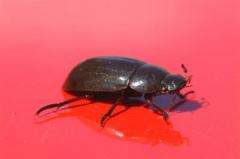
Hydrochara caraboides, a species of diving beetle that is attracted to lay its egg on cars, especially red ones. Vehicles are very strong polarizers of light. The coating of the eggs is acidic and eats away the surface of the car's paint. This occurs worldwide. Credit: Gyorgy Kriska

Human-made light sources can alter natural light cycles, causing animals that rely on light cues to make mistakes when moving through their environment. In the journal Frontiers in Ecology and the Environment, a collaboration of ecologists, biologists and biophysicists has now shown that in addition to direct light, cues from polarized light can trigger animal behaviors leading to injury and often death.

Artificial light that occurs at unnatural times or places - often called light pollution - can attract or repulse animals, resulting in increased predation, migrating in the wrong direction, choosing bad nest sites or mates, collisions with artificial structures and reduced time available to spend looking for food, just to name a few. In a classic example, baby sea turtles use the direction of star- and moonlight reflected off the water surface to help them find the ocean when they emerge from their beach nests; in urbanized areas, many turtles turn the wrong way and migrate toward the brighter lights of buildings or streetlamps.

"Environmental cues, such as the intensity of light, that animals use to make decisions occur at different levels of severity in the natural world," explains Bruce Robertson, an ecologist at Michigan State University. "When cues become unnaturally intense, animals can respond unnaturally strongly to them." That heightened response, he says, happens because of the way humans have changed the environment.

In their study, lead author Gabor Horvath, Robertson and their colleagues explain that many animals are also thrown off course by light reflecting from man-made structures. The darker and smoother a surface is, the more highly polarized its reflected light. In most cases, artificial polarized light symbolizes one thing to animals.

"For example, the primary source of horizontally polarized light in nature is water," says Robertson. "Biologists discovered in the 1980s that such polarized light is an amazingly reliable cue for finding bodies of water."

Especially in the case of dragonflies and other insects, which often lay their eggs and spend their first phase of life in ponds, streams and lakes, mistaking human-made objects for water can be deadly. Horizontal, shiny, dark surfaces - such as dark glass surfaces of buildings, asphalt, dark-colored cars and black plastic sheeting - reflect horizontally polarized light that is more strongly polarized than that reflected by water, which augments the animals' attraction to it. Polarized light pollution can disrupt the entire food web in an ecosystem: When insects mistake the sheen of an oil slick for water, their predators often follow the insects to the source and risk becoming trapped and drowning, as in the La Brea tar pits of Los Angeles and other oil-slicked lakes around the world.

Even in the absence of a physical trap, if the attraction is great enough, animals can't remove themselves from a polarized light source, ultimately causing death from dehydration and exhaustion. For example, a dragonfly laying its eggs on a shiny black highway may become paralyzed by attraction to the pavement after laying its eggs, effectively dooming its fate and that of its offspring. These so-called ecological traps occur when environmental change happens more quickly than animals can evolve to react to it. If large numbers of animals fall victim to these false cues, says Robertson, it could cause populations to decline, perhaps to extinction.

There are several ways humans can ameliorate the effects of their overlarge dark, shiny structures. Preliminary studies show that white hatch marks on roads can prevent insects from mistaking them for bodies of water. The addition of white curtains to shiny black buildings, suggests Robertson, also deters insects, bats and birds.

"It's yet another case where we're faced with a choice between what's more expensive or what's better for biodiversity," Robertson says. "Aquatic insects are the foundation of the food web, and what's harmful to them is harmful to entire ecosystems and the services they provide."

Source: Ecological Society of America


print this article email this article download pdf blog this article bookmark this article     Digg this Stumble it share on Facebook share on Reddit add to delicious save to Yahoo! bookmarks
3.7/5 after 3 votes


January 7th, 2009 all stories
Space & Earth / Environment

Comments: 0
Rank: 3.7/5 after 3 votes

  • Stumble this up

  • Digg this

  • Share it:
  • share on Facebook
  • share on MySpace
  • share on Slashdot
  • rss-newsfeed
  • share on Google
  • share on Reddit
  • add to delicious
  • save to Yahoo! bookmarks
  • share on Windows Live
  • Add to Mixx!
Rating: 3.7/5 after 3 votes

  • Related Stories

  • Shrimps see beyond the rainbow
    created May 14, 2008 | popularity not rated yet | comments 0
  • Mantis shrimp vision reveals new way that animals can see
    created Mar 20, 2008 | popularity not rated yet | comments 0
  • Oosight microscope enables embryonic stem cell breakthrough
    created Nov 29, 2007 | popularity not rated yet | comments 0
  • No sunglasses required for fish supper
    created Oct 16, 2007 | popularity not rated yet | comments 0
  • Mother-of-pearl -- Classic beauty and remarkable strength
    created Jul 02, 2007 | popularity not rated yet | comments 0


  • Physicists Demonstrate Quantum Memory with Matter Qubits
    Physicists Demonstrate Quantum Memory with Matter Qubits
    Physics / General Physics
    created Jul 03, 2009 | popularity 4.4 / 5 (17) | comments 1
  • 'Holey' Nanosheets for Wastewater Dye Removal
    Nanotechnology / Nanomaterials
    created Jul 01, 2009 | popularity 5 / 5 (5) | comments 1
  • Jellyfish Robot Swims Like its Biological Counterpart
    Jellyfish Robot Swims Like its Biological Counterpart
    Electronics / Robotics
    created Jun 26, 2009 | popularity 4.4 / 5 (8) | comments 1
  • Could Maxwell's Demon Exist in Nanoscale Systems?
    Could Maxwell's Demon Exist in Nanoscale Systems?
    Physics / General Physics
    created Jun 24, 2009 | popularity 4.4 / 5 (18) | comments 29
  • Living Safely with Robots, Beyond Asimov's Laws
    Living Safely with Robots, Beyond Asimov's Laws
    Electronics / Robotics
    created Jun 22, 2009 | popularity 4.6 / 5 (52) | comments 40
  • Other News

    US ambitions to send astronauts back to the moon as a prelude to missions to Mars have been put in doubt

    Forty years ago man first walked on the moon

    Space & Earth / Space Exploration

    created 20 hours ago | popularity 4.3 / 5 (4) | comments 2

    Forty years ago on July 20, 1969, American astronaut Neil Armstrong realized the oldest dream of human civilizations when he became the first man to walk on the moon.


    The least sea ice in 800 years

    The least sea ice in 800 years

    Space & Earth / Earth Sciences

    created Jul 01, 2009 | popularity 4.1 / 5 (63) | comments 59

    New research, which reconstructs the extent of ice in the sea between Greenland and Svalbard from the 13th century to the present indicates that there has never been so little sea ice as there is now. The ...


    Gas around young galaxy

    Intense heat killed the Universe's would-be galaxies, researchers say

    Space & Earth / Astronomy

    created Jul 01, 2009 | popularity 3.4 / 5 (21) | comments 27

    (PhysOrg.com) -- Our Milky Way galaxy only survived because it was already immersed in a large clump of dark matter which trapped gases inside it, scientists led by Durham University's Institute for Computational ...


    Scientists' Drill Hits Magma: Only Third Time on Record

    Scientists' Drill Hits Magma: Only Third Time on Record

    Space & Earth / Earth Sciences

    created Jun 29, 2009 | popularity 4.7 / 5 (22) | comments 20

    (PhysOrg.com) -- Scientists drilling a borehole deep into Iceland’s rocky crust to explore new methods of using geothermal energy hit a major roadblock on Thursday: Their drill ran into molten rock at a depth ...


    NASA manager pitches a cheaper return-to-moon plan

    Space & Earth / Space Exploration

    created Jun 30, 2009 | popularity 4.1 / 5 (8) | comments 18

    (AP) -- Like a car salesman pushing a luxury vehicle that the customer no longer can afford, NASA has pulled out of its back pocket a deal for a cheaper ride to the moon.