Scientists unravel structure of key breast cancer target enzyme
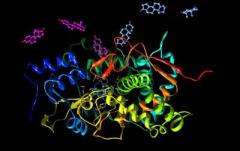
The molecular details of Aromatase, the key enzyme required for the body to make estrogen, are no longer a mystery thanks to the structural biology work done by the Ghosh lab at the Hauptman-Woodward Medical Research Institute (HWI) in Buffalo, New York. Dr. Debashis Ghosh's solution of the three-dimensional structure of aromatase is the first time that scientists have been able to visualize the mechanism of synthesizing estrogen.
In fact, the Ghosh lab has determined the structures of all three of the enzymes involved in controlling estrogen levels that can serve as drug targets for estrogen-dependent tumors in breast cancer. This work is so significant, the world-renowned journal Nature will be publishing the structure of aromatase at 2.90 angstrom resolution in an upcoming issue. The other two enzyme structures determined by the Ghosh lab as part of this project were estrone sulfatase (2003) and 17beta-hydroxysteroid dehydrogenase type 1 (1996). All three enzymes control the levels of estradiol in different tissues.
"This is a dream come true," Dr. Debashis Ghosh, an HWI senior research scientist and a principal investigator who also holds a joint faculty appointment at the Roswell Park Cancer Institute (RPCI), said. "Scientists worldwide have been trying for 35 years to crystallize this membrane-bound enzyme and we are the first to succeed. Now that we know the structures of all three key enzymes implicated in estrogen-dependant breast cancers, our goal is to have a personalized cocktail of inhibitors customized to the specific treatment needs of each patient. Our knowledge about these three enzymes will enable us to develop three mutually exclusive inhibitors customized to each patient's needs which will work in harmony together with minimal side effects."
Why Is This Important?
Most people know that breast cancer is the most common cancer among women in the United States and the second leading cause of cancer death in women, after lung cancer. Many people also may be aware that the chance of a woman having invasive breast cancer some time during her life is about 1 in 8 and the chance of dying from breast cancer is about 1 in 35. But many may not be aware that 75-80 percent of all breast cancer tumors are estrogen-fed. Estrogen is a female sex hormone and androgens are the male sex hormones. Regardless of gender, everyone has some percentage of both estrogens and androgens in their bodies. Each of the enzymes discussed above can individually promote the growth of estrogen-dependent breast cancers, but knowing all three structures opens the door to customized, comprehensive medical treatment.
Aromatase is the only enzyme in the vertebrate world that makes estrogens from androgens. All estrogens in the human body are made by aromatase. Drugs, such as Tamoxifen, that prevent aromatase from making estrogens constitute one of the foremost therapies for estrogen-dependent breast cancer. These drugs do not discriminate in what they target in the body, which results in significant side effects. Aromatase inhibitor drugs (AIs) have only been on the market a few years and are targeted to inhibit aromatase specifically. But because the structure was not known, nor the mechanism of androgen to estrogen conversion, the AIs currently in use have been developed using trial and error methods resulting in greater vulnerability to contraindications and side effects.
"Now that the Ghosh Lab has unraveled the molecular details of aromatase, drugs can be designed to specifically target aromoatase," Dr. Walter A. Pangborn, Executive Vice President at HWI, said. "This means that results from this research will form the basis for novel breast cancer drugs that are highly specific for aromatase but cause minimal side effects."
What Happens Next?
Ghosh now will work to test his hypothesis of the chemical mechanism involved in the conversion of androgens to estrogens. He also will be working with collaborators to develop medicinal complexes for testing. In collaboration with organic synthetic chemist Dr. Huw Davies of Emory University and RPCI colleagues, they will conduct cellular and animal studies of those complexes.
What Was The Project History?
The aromatase and sulfatase projects were started at HWI by Dr. Yoshio Osawa more than 30 years ago. His preliminary work laid the foundation for the eventual solution of the structure of estrone sulfatase. A number of collaborators played a role in the 17beta-hydroxysteroid dehydrogenase project's early work including scientists in Canada, Finland and HWI Hauptman Distinguished Scientist Dr. William Duax. Ghosh and Osawa started to collaborate in 1995. When Osawa retired in 1998, Ghosh took the project over and developed a revolutionary method of purifying and crystallizing these enzymes. "Everyone had given up on crystallizing the enzyme," Ghosh said. "Using a 'secret recipe,' we have been able to crystallize it and identify the structure - knowledge which will be used to make much better drugs."
The 9th International Aromatase Meeting held in Shanghai China in October 2008 was the venue for the first formal presentation of ground-breaking breast cancer research conducted by HWI's Dr. Debashis Ghosh. A biennial meeting, the conference draws scientists from all over the world who are interested in the role aromatase plays in various cancers and other diseases.
Source: Hauptman-Woodward Medical Research Institute


