'Scrawny' gene keeps stem cells healthy
January 7th, 2009 'Scrawny' gene keeps stem cells healthy

Enlarge

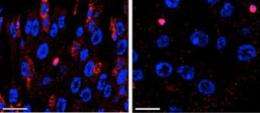
Red-stained intestinal stem cells are visible in the tissue of a 7-day old adult fruit fly with a normal copy of the scrawny gene (left), but have been prematurely lost in a mutant fly without a functioning copy of scrawny (right). Scale bar is 10 microns.

(PhysOrg.com) -- Stem cells are the body's primal cells, retaining the youthful ability to develop into more specialized types of cells over many cycles of cell division. How do they do it? Scientists at the Carnegie Institution have identified a gene, named scrawny, that appears to be a key factor in keeping a variety of stem cells in their undifferentiated state. Understanding how stem cells maintain their potency has implications both for our knowledge of basic biology and also for medical applications. The results will be published in the January 9, 2009 print edition of Science.

"Our tissues and indeed our very lives depend on the continuous functioning of stem cells," says Allan C. Spradling, director of the Carnegie Institution's Department of Embryology. "Yet we know little about the genes and molecular pathways that keep stem cells from turning into regular tissue cells—a process known as differentiation."

In the study, Spradling, with colleagues Michael Buszczak and Shelley Paterno, determined that the fruit fly gene scrawny (so named because of the appearance of mutant adult flies) modifies a specific chromosomal protein, histone H2B, used by cells to package DNA into chromosomes. By controlling the proteins that wrap the genes, scrawny can silence genes that would otherwise cause a generalized cell to differentiate into a specific type of cell, such as a skin or intestinal cell.

The researchers observed the effects of scrawny on every major type of stem cell found in fruit flies. In the experiments, mutant flies without functioning copies of the scrawny prematurely lost their stem cells in reproductive tissue, skin, and intestinal tissue.

Stem cells function as a repair system for the body. They maintain healthy tissues and organs by producing new cells to replenish dying cells and rebuild damaged tissues. "Losing stem cells represents the cellular equivalent of eating the seed corn," says Spradling.

While the scrawny gene has so far only been identified in fruit flies, very similar genes that may carry out the same function are known to be present in all multicellular organisms, including humans. The results of this study are an important step forward in stem cell research. "This new understanding of the role played by scrawny may make it easier to expand stem cell populations in culture, and to direct stem cell differentiation in desired directions," says Spradling.

Provided by Carnegie Institution


print this article email this article download pdf blog this article bookmark this article     Digg this Stumble it share on Facebook share on Reddit add to delicious save to Yahoo! bookmarks
4/5 after 1 votes


January 7th, 2009 all stories
Biology /

Comments: 0
Rank: 4/5 after 1 votes

  • Stumble this up

  • Digg this

  • Share it:
  • share on Facebook
  • share on MySpace
  • share on Slashdot
  • rss-newsfeed
  • share on Google
  • share on Reddit
  • add to delicious
  • save to Yahoo! bookmarks
  • share on Windows Live
  • Add to Mixx!
Rating: 4/5 after 1 votes

  • Related Stories

  • New Role Discovered for Molecule Important in Development of Endocrine System
    created 3 hours ago | popularity not rated yet | comments 0
  • Research may hold key to maintaining embryonic stem cells in lab
    created 5 hours ago | popularity not rated yet | comments 0
  • Stem cells' 'suspended' state preserved by key step, scientists report
    created Jul 08, 2009 | popularity not rated yet | comments 0
  • Human sperm created from embryonic stem cells (Update)
    created Jul 08, 2009 | popularity not rated yet | comments 0
  • Playing it safe
    created Jul 07, 2009 | popularity not rated yet | comments 0


  • Transform a ball into a rock -- or make it invisible -- using transformation optics
    Transform a ball into a rock -- or make it invisible -- using transformation optics
    Physics / General Physics
    created 9 hours ago | popularity 3 / 5 (2) | comments 0
  • Could a quantum motor do work?
    Physics / General Physics
    created Jul 07, 2009 | popularity 4 / 5 (12) | comments 0
  • Physicists Demonstrate Quantum Memory with Matter Qubits
    Physicists Demonstrate Quantum Memory with Matter Qubits
    Physics / General Physics
    created Jul 03, 2009 | popularity 4.5 / 5 (20) | comments 1
  • 'Holey' Nanosheets for Wastewater Dye Removal
    Nanotechnology / Nanomaterials
    created Jul 01, 2009 | popularity 5 / 5 (5) | comments 1
  • Jellyfish Robot Swims Like its Biological Counterpart
    Jellyfish Robot Swims Like its Biological Counterpart
    Electronics / Robotics
    created Jun 26, 2009 | popularity 4.4 / 5 (9) | comments 1
  • Other News

    Theory provides more precise estimates of large-area biodiversity

    Biology / Ecology

    created 2 hours ago | popularity not rated yet | comments 0

    Ask biologists how many species live in a pond, a grassland, a mountain range or on the entire planet, and the answers get increasingly vague. Hence the wide range of estimates for the planet's biodiversity, predicted to ...


    Getting mosquitoes to kill their own

    Biology / Other

    created 2 hours ago | popularity 5 / 5 (1) | comments 2

    (PhysOrg.com) -- It's about mosquitoes killing mosquitoes.


    Beetle, fungus deliver one-two punch to black walnut trees

    Beetle, fungus deliver one-two punch to black walnut trees

    Biology / Ecology

    created 2 hours ago | popularity not rated yet | comments 0

    (PhysOrg.com) -- A newly discovered disease, caused by a previously undescribed fungus hitchhiking on a tiny native bark beetle, is infecting and killing hundreds of black walnut trees in California and seven ...


    Thousands of plant species likely to go extinct in Amazon

    Biology / Ecology

    created 2 hours ago | popularity not rated yet | comments 0

    As many as 4,550 of the more than 50,000 plant species in the Amazon will likely disappear because of land-use changes and habitat loss within the next 40 years, according to a new study by two Wake Forest University researchers.


    Research may hold key to maintaining embryonic stem cells in lab

    Research may hold key to maintaining embryonic stem cells in lab

    Biology / Biotechnology

    created 5 hours ago | popularity not rated yet | comments 1

    In a new study that could transform embryonic stem cell (ES cell) research, scientists at UT Southwestern Medical Center have discovered why mouse ES cells can be easily grown in a laboratory while other mammalian ...