Half-baked asteroids have Earth-like crust
January 7, 2009 Half-baked asteroids have Earth-like crust

Enlarge

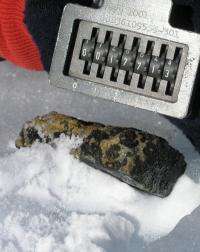
Field image of the achondrite meteorite GRA 06129, found in blue ice of the Graves Nunatak region of the Antarctica during the ANSMET 2006/2007 field-season. GRA 06129 and its pair, GRA 06128, are achondrite meteorites with compositions unlike any previously discovered Solar System materials. Image courtesy of the Antarctic Search for Meteorites (PI - Ralph Harvey, Case Western Reserve University)

Asteroids are hunks of rock that orbit in the outer reaches of space, and scientists have generally assumed that their small size limited the types of rock that could form in their crusts. But two newly discovered meteorites may rewrite the book on how some asteroids form and evolve. Researchers from the Carnegie Institution, the University of Maryland, and the University of Tennessee report in the January 8th edition of Nature that these meteorites are ancient asteroid fragments consisting of feldspar-rich rock called andesite. Similar rocks were previously known only from Earth, making these samples the first of their kind from elsewhere in the Solar System.

The two meteorites were discovered during the Antarctic Search for Meteorites (ANSMET) 2006/2007 field season in a region of the Antarctic ice known as the Graves Nunatak icefield. The light-colored meteorites, designated GRA 06128 and GRA 06129, were immediately recognized as being different from previously known meteorites.

"What is most unusual about these rocks is that they have compositions similar to Earth's andesite continental crust - what makes up the ground beneath our feet," says University of Maryland's James Day, lead author of the study. "No meteorites like this have ever been seen before."

Andesite is an igneous rock common on Earth in areas where colliding tectonic plates generate volcanoes, such as those of the Andes mountain range. The meteorites contain minerals thought to require large-scale processes such as plate tectonics to concentrate the right chemical ingredients. In view of this, some researchers had suggested that the meteorites were fragments of a planet or the Moon, not an asteroid. But analysis of the meteorites' oxygen isotopes at the Carnegie Institution's Geophysical Laboratory by Douglas Rumble ruled out that possibility.

"A number of solar system objects including parent bodies of meteorites, planets, moons, and asteroids have their own oxygen isotope signatures," says Rumble. "Just by analyzing 16O-17O-18O ratios we can tell if a meteorite came from Mars, from the Moon, or from a particular asteroid. One extensively studied parent is the asteroid 4 Vesta. In the majority of cases the actual location of the parent body is unknown, but a particular group of meteorites may be assigned to the same parent body based on the isotope ratios even if the specific location of the body isn't known. When the ratios in meteorites are plotted against one another the result is mutually parallel lines offset from one another. The GRA 06128 and GRA 06129 meteorites, and some similar ones called brachinites, plot below Earth-Moon rocks and are nearly coincident with meteorites from 4 Vesta."

The meteorites' age, more than 4.5 billion years, suggests that they formed very soon after the birth of the solar system. This makes it unlikely that they came from the crust of a differentiated planet. The chemical signature of some rare precious metals, notably osmium, in the meteorites also points to their origin on an asteroid that was not fully differentiated.

The researchers hypothesize that that the asteroid had a diameter somewhat larger than 100 kilometers, which would be sufficient to hold enough heat for the asteroid's rocks to partially, but not completely, melt. The asteroid would remain undifferentiated, but the melted portions could erupt on the asteroid's surface to form the andesitic crust.

"Our work illustrates that the formation of planet-like andesite crust has occurred by processes other than plate tectonics on solar system bodies," says Day. "Ultimately this may shed light on how evolved crust forms on planets, including Earth, during the earliest stages of their birth."

Source: Carnegie Institution


print this article email this article download pdf blog this article bookmark this article     Stumble it Digg this share on Facebook retweet share on Reddit add to delicious
Rate this story - 4.7 /5 (3 votes)

Rank Filter

Move the slider to adjust rank threshold, so that you can hide some of the comments.


Display comments: newest first

  • Grendel - Jan 08, 2009
    • Rank: not rated yet
    I wonder if it might be a piece of the Mars-sized object whose collision with Earth resulted in the Moon's creation?
  • smiffy - Jan 08, 2009
    • Rank: not rated yet
    Fair point - but the researchers seem to have ruled this possibility out due to the oxygen isotope analysis -
    some researchers had suggested that the meteorites were fragments of a planet or the Moon, not an asteroid. But analysis of the meteorites' oxygen isotopes at the Carnegie Institution's Geophysical Laboratory by Douglas Rumble ruled out that possibility.

January 7, 2009 all stories

Comments: 2

4.7 /5 (3 votes)
  • Stumble this up

  • Digg this

  • share this

  • hide
  • Related Stories


  • hide
  • Relevant PhysicsForums posts

  • Which countries around the world cause the most destruction to the rain forest
    created 13 hours ago
  • HadleyCru data hacked
    created Nov 20, 2009
  • Younger Dryas Caused by Ice Dam Collapse?
    created Nov 17, 2009
  • Modeling rainfall and flooding
    created Nov 15, 2009
  • More from Physics Forums - Earth

Other News

Baby can wait as expectant dad finishes spacewalk (AP)

Baby can wait as expectant dad finishes spacewalk

Space & Earth / Space Exploration

created 13 hours ago | popularity 3 / 5 (2) | comments 0

(AP) -- A spacewalking astronaut put aside the impending birth of his daughter and blazed through his first-ever venture outside the International Space Station on Saturday.


Unseasonably hot and dry weather combined with strong winds to fan scores of blazes in the country's southeastern states

Australia issues 'catastrophic' alerts as fires rage

Space & Earth / Environment

created 19 hours ago | popularity 4 / 5 (3) | comments 0

Australia has issued "catastrophic" alerts after record-breaking temperatures and wild lightning storms sparked more than 100 fires across the country, officials said Saturday.


Commuters wait on the platform shrouded by fog in London

Climate change not man-made, say majority of Britons: poll

Space & Earth / Environment

created Nov 15, 2009 | popularity 3.3 / 5 (15) | comments 46

Less than half of Britons believes that human activity is to blame for global warming, according to a poll carried out for The Times newspaper and published on Saturday.


Mysteriously warm times in Antarctica

Mysteriously warm times in Antarctica

Space & Earth / Earth Sciences

created Nov 18, 2009 | popularity 4.2 / 5 (21) | comments 28

(PhysOrg.com) -- A new study of Antarctica's past climate reveals that temperatures during the warm periods between ice ages (interglacials) may have been higher than previously thought. The latest analysis ...


UN: Fight climate change with free condoms (AP)

UN: Fight climate change with free condoms

Space & Earth / Environment

created Nov 18, 2009 | popularity 3.1 / 5 (11) | comments 24

(AP) -- The battle against global warming could be helped if the world slowed population growth by making free condoms and family planning advice more widely available, the U.N. Population Fund said Wednesday.