Spookfish uses mirrors for eyes
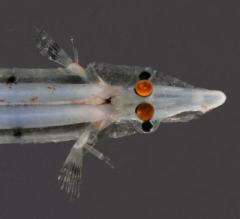
January 7, 2009 View of a Spookfish from Above

Enlarge

The red eyes are the spookfish's tubular eyes that point upwards, the black bumps on the side of its head are the diverticular eyes that point downwards so do not reflect the flashlight. Credit: Dr. Tammy Frank, Habor Branch Oceanographic Institution

A remarkable new discovery shows the four-eyed spookfish to be the first vertebrate ever found to use mirrors, rather than lenses, to focus light in its eyes.

Professor Julian Partridge from the University of Bristol, said: "In nearly 500 million years of vertebrate evolution, and many thousands of vertebrate species living and dead, this is the only one known to have solved the fundamental optical problem faced by all eyes - how to make an image - using a mirror."

While the spook fish looks like it has four eyes, in fact it only has two, each of which is split into two connected parts. One half points upwards, giving the spookfish a view of the ocean - and potential food - above. The other half, which looks like a bump on the side of the fish's head, points downwards into the abyss below. These 'diverticular' eyes are unique among all vertebrates in that they use a mirror to make the image.

Very little light penetrates beneath about 1000m of water and like many other deep-sea fish the spookfish is adapted to make the most of what little light there is. At these depths it is flashes of bioluminescent light from other animals that the spookfish are largely looking for. The diverticular eyes image these flashes, warning the spookfish of other animals that are active, and otherwise unseen, below its vulnerable belly.

Although the spookfish was first discovered 120 years ago, no one had discovered its reflective eyes until now because a live animal had never been caught. When Professor Hans-Joachim Wagner from Tuebingen University caught a live specimen off the Pacific island of Tonga, members of his research team used flash photography to confirm the fish's upward and downward gazes.

Photographs taken by Dr Tammy Frank looking down on the live fish produced eye-shine in the main tubular eyes that point upwards, but not in the diverticular eyes that point downward. Instead, these reflect light when seen from below.

It was when looking at sections of the eye that had been prepared for microscopy that Professor Partridge realised that the diverticular mirrors where something exciting. The mirror uses tiny plates, probably of guanine crystals, arranged into a multi-layer stack. This is not unique in the animal kingdom (it's why silvery fish are silvery) but the arrangement and orientation of the guanine crystals is precisely controlled such that they direct the light to a focus. Partridge's computer simulation showed that the precise orientation of the plates within the mirror's curved surface is perfect for focusing reflected light onto the fish's retina.

The use of a single mirror has a distinct advantage over a lens in its potential to produce bright, high-contrast images. That must give the fish a great advantage in the deep sea, where the ability to spot even the dimmest and briefest of lights can mean the difference between eating and being eaten.

The paper: A Novel Vertebrate Eye Using Both Refractive and Reflective Optics, by Hans-Joachim Wagner, Ron H. Douglas, Tamara M. Frank, Nicholas W. Roberts and Julian C. Partridge. Current Biology 19, 1-7, January 27, 2009. DOI 10.1016/j.cub.2008.11.061

Source: University of Bristol


print this article email this article download pdf blog this article bookmark this article     Stumble it Digg this share on Facebook retweet share on Reddit add to delicious
Rate this story - 4.9 /5 (10 votes)

Rank Filter

Move the slider to adjust rank threshold, so that you can hide some of the comments.


Display comments: newest first

  • gopher65 - Jan 07, 2009
    • Rank: not rated yet
    That is made of awesome.
  • el_gramador - Jan 08, 2009
    • Rank: not rated yet
    It is also made of grammar error.

    "It was when looking at sections of the eye that had been prepared for microscopy that Professor Partridge realised that the diverticular mirrors where something exciting."

    where should have been were.

    I know these guys aren't scientists but at the very least they should be able to spell and make coherent sentences.
  • gopher65 - Jan 13, 2009
    • Rank: not rated yet
    I meant the fish of course, not the article;).

January 7, 2009 all stories

Comments: 3

4.9 /5 (10 votes)
  • Stumble this up

  • Digg this

  • share this

  • hide
  • Related Stories

  • New device finds early signs of eye disease in preemies
    created Sep 21, 2009 | popularity not rated yet | comments 0
  • Mathematical keys to a sixth sense -- the lateral-line system
    created Aug 28, 2009 | popularity not rated yet | comments 0
  • Flying frog among 353 new Himalayan species: WWF
    created Aug 10, 2009 | popularity not rated yet | comments 0
  • Scientists explain why birds get sex on the brain in the Spring
    created Aug 07, 2009 | popularity not rated yet | comments 0
  • Lucky survivors rescued by Fla. turtle hospital
    created Aug 06, 2009 | popularity not rated yet | comments 0


Other News

The Monarchs' annual migration ritual has yet to be scientifically explained

Tree-eating bugs threaten Monarch butterfly in Mexico

Biology / Ecology

created 8 hours ago | popularity 4 / 5 (1) | comments 0

The mysterious Monarch butterfly, which migrates en masse annually between Canada and Mexico, is now facing a new peril: another insect thriving in Western Mexican forests.


Bigger not necessarily better, when it comes to brains

Bigger not necessarily better, when it comes to brains

Biology / Plants & Animals

created Nov 17, 2009 | popularity 4.5 / 5 (17) | comments 11

(PhysOrg.com) -- Tiny insects could be as intelligent as much bigger animals, despite only having a brain the size of a pinhead, say scientists at Queen Mary, University of London.


Extinct goat Myotragus balearicus

Extinct goat was cold-blooded

Biology / Plants & Animals

created Nov 18, 2009 | popularity 4.9 / 5 (33) | comments 10

(PhysOrg.com) -- An extinct goat that lived on a barren Mediterranean island survived for millions of years by reducing in size and by becoming cold-blooded, which has never before been discovered in mammals.


Right-handed chimpanzees provide clues to the origin of human language

Biology / Plants & Animals

created Nov 16, 2009 | popularity 3 / 5 (1) | comments 7

Most of the linguistic functions in humans are controlled by the left cerebral hemisphere. A study of captive chimpanzees at the Yerkes National Primate Research Center (Atlanta, Georgia), reported in the January 2010 issue ...


The creature was found at a depth of 161 metres

Japanese researchers film rare baby fish 'fossil'

Biology / Plants & Animals

created Nov 17, 2009 | popularity 4.7 / 5 (7) | comments 4

Japanese marine researchers said Tuesday they had found and successfully filmed a young coelacanth -- a rare type of fish known as "a living fossil" -- in deep water off Indonesia.