Lost in translation: Perfectionist protein-maker trashes errors
January 7, 2009 ribosome

Enlarge

ribosome

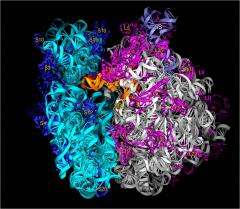
The enzyme machine that translates a cell's DNA code into the proteins of life is nothing if not an editorial perfectionist.

Johns Hopkins researchers, reporting this week in Nature, have discovered a new "proofreading step" during which the suite of translational tools called the ribosome recognizes errors, just after making them, and definitively responds by hitting its version of a "delete" button.

It turns out, the Johns Hopkins researchers say, that the ribosome exerts far tighter quality control than anyone ever suspected over its precious protein products which, as workhorses of the cell, carry out the very business of life.

"What we now know is that in the event of miscoding, the ribosome cuts the bond and aborts the protein-in-progress, end of story," says Rachel Green, a Howard Hughes Medical Institute investigator and professor of molecular biology and genetics in the Johns Hopkins University School of Medicine. "There's no second chance."

Previously, Green says, molecular biologists thought the ribosome tightly managed its actions only prior to the actual incorporation of the next building block by being super-selective about which chemical ingredients it allows to enter the process.

Because a protein's chemical "shape" dictates its function, mistakes in translating assembly codes can be toxic to cells, resulting in the misfolding of proteins often associated with neurodegenerative conditions. Working with bacterial ribosomes, Green and her team watched them react to lab-induced chemical errors and were surprised to see that the protein-manufacturing process didn't proceed as usual, getting past the error and continuing its "walk" along the DNA's protein-encoding genetic messages.

"We thought that once the mistake was made, it would have just gone on to make the next bond and the next," Green says. "But instead, we noticed that one mistake on the ribosomal assembly line begets another, and it's this compounding of errors that leads to the partially finished protein being tossed into the cellular trash," she adds.

To their further surprise, the ribosome lets go of error-laden proteins 10,000 times faster than it would normally release error-free proteins, a rate of destruction that Green says is "shocking" and reveals just how much of a stickler the ribosome is about high-fidelity protein synthesis.

"These are not subtle numbers," she says, noting that there's a clear biological cost for this ribosomal editing and jettisoning of errors, but a necessary expense.

"The cell is a wasteful system in that it makes something and then says, forget it, throw it out," Green concedes. "But it's evidently worth the waste to increase fidelity. There are places in life where fidelity matters."

Source: Johns Hopkins Medical Institutions


print this article email this article download pdf blog this article bookmark this article     Stumble it Digg this share on Facebook retweet share on Reddit add to delicious
Rate this story - 5 /5 (3 votes)


January 7, 2009 all stories

Comments: 0

5 /5 (3 votes)
  • Stumble this up

  • Digg this

  • share this

  • hide
  • Related Stories

  • New invention could revolutionize how diseases are diagnosed
    created Jul 24, 2009 | popularity not rated yet | comments 0
  • Study links dietary folate intake to genetic abnormalities in sperm
    created Mar 20, 2008 | popularity not rated yet | comments 0
  • 'Safety valve' protects photosynthesis from too much light
    created Nov 25, 2009 | popularity not rated yet | comments 0
  • Probing life's extremes in Yellowstone (w/ Podcast)
    created Nov 24, 2009 | popularity not rated yet | comments 0
  • An atomic-level look at an HIV accomplice
    created Nov 19, 2009 | popularity not rated yet | comments 0


Other News

Hammerhead shark

Wide heads give hammerheads exceptional stereo view

Biology / Plants & Animals

created 6 hours ago | popularity 4.3 / 5 (4) | comments 2

Hammerhead sharks are some of the Ocean's most distinctive residents. 'Everyone wants to understand why they have this strange head shape,' says Michelle McComb from Florida Atlantic University. One possible ...


Tough yet stiff deer antler is materials scientist's dream

Biology / Plants & Animals

created 6 hours ago | popularity not rated yet | comments 1

Prized for their impressive antlers, red deer have been caught in the hunters' sights for generations. But a deer's antlers are much more than decorative. They are lethal weapons that stags crash together when duelling. John ...


Indonesia rejects Bali plan for turtle sacrifices (AP)

Indonesia rejects Bali plan for turtle sacrifices

Biology / Ecology

created 3 hours ago | popularity not rated yet | comments 0

(AP) -- Indonesia has rejected a push by the resort island of Bali for rare turtles to be legally slain in Hindu ceremonies, siding with conservationists of the protected reptiles against religious advocates, ...


Ecologists sound out new solution for monitoring cryptic species

Biology / Ecology

created 6 hours ago | popularity not rated yet | comments 0

Ecologists have at last worked out a way of using recordings of birdsong to accurately measure the size of bird populations. This is the first time sound recordings from a microphone array have been translated into accurate ...


First-ever blueprint of a minimal cell is more complex than expected

First-ever blueprint of a minimal cell is more complex than expected

Biology / Cell & Microbiology

created 22 hours ago | popularity 5 / 5 (17) | comments 4

What are the bare essentials of life, the indispensable ingredients required to produce a cell that can survive on its own? Can we describe the molecular anatomy of a cell, and understand how an entire organism ...