Preterm births rise 36 percent since early 1980s
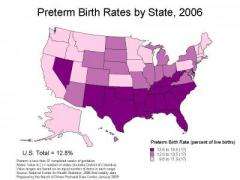
New government statistics confirm that the decades-long rise in the United States preterm birth rate continues, putting more infants than ever at increased risk of death and disability.
Nearly 543,000 babies were born too soon in 2006, according to the National Center for Health Statistics, which today released "Births: Final data for 2006," National Vital Statistics Reports; Vol. 57, No. 7. The nation's preterm birth rate (birth before 37 completed weeks gestation) rose to 12.8 percent in 2006 -- that's a 36 percent increase since the early 1980s.
The report attributed much of the increase to the growing number of late preterm infants (those born at 34 to 36 weeks gestation), which increased 25 percent since 1990. The report also noted an increase in preterm births to Hispanic women, while rates were unchanged for non-Hispanic whites and blacks. However, black women continue to have the highest preterm birth rate, at 18.5 percent.
The preterm birth rate continued to rise despite the fact that multiple births, a known risk factor for preterm birth, have begun to stabilize. The rate of twin births was unchanged in 2005 and 2006, and triplets and higher order multiples declined 5 percent in 2006.
"The health consequences for babies who survive an early birth can be devastating and we know that preterm birth exacts a toll on the entire family - emotionally and financially," said Dr. Jennifer L. Howse, president of the March of Dimes.
"We are committed to raising public awareness about premature birth, and we believe there are concrete steps we can take to solve this problem, including ensuring that all women of childbearing age have access to health insurance and expanding our nation's investment in research into the causes and strategies to prevent preterm birth," Dr. Howse continued.
Preterm birth is the leading cause of death in the first month of life and a contributing cause in more than a third of all infant deaths. Babies who survive an early birth face the risk of serious lifelong health problems and even late preterm infants have a greater risk of breathing problems, feeding difficulties, temperature instability (hypothermia), jaundice, delayed brain development and an increased risk of cerebral palsy and mental retardation.
Last month, the March of Dimes issued its first-ever Premature Birth Report Card, which gave the United States a "D" -- and not a single "A" to any state -- by comparing 2005 preterm birth rates to the national Healthy People 2010 objective of 7.6 percent. The report card is online at www.marchofdimes.com/petition .
Source: March of Dimes Foundation


