Recognise this image?
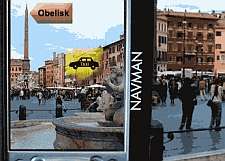
(PhysOrg.com) -- Image recognition is a long-standing challenge in science. But European researchers have achieved a breakthrough by developing a powerful image-recognition application with mass-market appeal. There is a bright future for the technology.
An image-recognition system developed by European researchers can hyperlink reality. It’s true. The MOBVIS system can recognise individual buildings in a photo you take with your camera-phone. Then it can apply icons that hyperlink to information about the building. Simply by looking at a picture, the system knows where you are and can tell what you are looking at.
The system worked very well in demonstrators, enabling free exploration in a dedicated city area, but now the project is winding up and the partners are looking at what they can do with the technology in the commercial world. Some of the applications are fairly obvious, but turning them into a commercial product is another story.
One of the EU-funded project’s partners, Tele Atlas, is very interested in MOBVIS’ innovations to interpret mobile mapping images. Tele Atlas provides digital mapping and navigation solutions. As part of that work, it has a fleet of over 50 vans, travelling the world to gather data.
These vans take pictures and videos of the roads they travel, each of them equipped with six cameras. At the same time, they track their exact location via high-precision GPS. They want to use MOBVIS technology to detect roads, people, cars, signs, text, and other details from video sequences acquired from the mobile mapping vans.
“This is not a mass-market application; it is an industrial application that could immeasurably improve the quality of mapping data, by including qualitative information, while at the same time making it more accurate and economic,” notes Lucas Paletta, coordinator of the MOBVIS project.
But with this information, Tele Atlas will be able to apply concrete, accurate, qualitative information to the mapping and navigation services they provide.
Image recognition to multi-sensor applications
Other partners are looking at concrete applications in advertising, image analysis, and other indoor and outdoor applications. “Co-operation is already established for running feasibility studies to test various concrete commercial services,” explains Paletta.
Mass-market applications may have to wait, but they are unlikely to wait too long because the technology is just too useful. Travel guidebook publishers could exploit the service to provide interactive information relevant to the user’s location at a specific point in time. Instead of hoping that a tourist buys their guide at the airport, publishers will be able to sell their service whenever and wherever a tourist decides they need it.
Image recognition as a stand-alone service is not the end of the MOBVIS story. Multi-sensor information, such as from GPS and inertial sensors, are available in current mobile phone technology and ready to be exploited for innovative services.
Imagine simply by wearing a wristband, you could recognise the wearer’s activities, such as sitting, standing, walking, cycling, or running in real-time. This technology, as developed by the Darmstadt University of Technology, led by Bernt Schiele's team, could update personal geo-diaries with contextual information,
MOBVIS has just opened a window to previously unimaginable innovations for everyday uses of mobile systems. The mobile phone will just become our personal multi-sensor magic wand to discover unknown stories in intuitive interaction with our environment.
It will be a major advance for the science of image recognition, a branch of computer vision. Computer vision has been around for a long time, becoming a defined field of research in the 1970s.
The most famous aspect of the discipline is robotic vision, the field that tries to teach robots to ‘see’. It is a huge challenge, but steadily researchers are making advances into areas that are more directly applicable.
For example, image recognition is already used to sort fruit - machines can divide produce according to degrees of quality. Face recognition, too, is a big area of research, particularly since the increased security since the 9/11 terrorist attacks in the USA.
But before MOBVIS, there were few prospects for mass-market applications. It may be a while before MOBVIS technology appears on a mobile phone near you, but it won’t be too long, mainly because MOBVIS was very successful telling the right people about what they have done.
Google, Microsoft, Nokia... big names
The project organised or attended more than six international conferences on computer vision and presented its work to hundreds of peers working in the same domain.
It also spread the word through its booth at the CHI 2008 trade show, which focuses on excellence in innovation. Over 100 attendees visited the MOBVIS team where they were introduced to the technology and given a demonstration. Visitors included representatives from leading industrial heavyweights like Google, Microsoft and Nokia.
The consortium published over 65 scientific papers, and generated enthusiastic interest from colleagues in the field. Industrial groups, too, showed enormous interest in MOBVIS work.
MOBVIS achieved some remarkable results, but the most remarkable impacts of their work are yet to come, when people, in the normal course of their day, take to hyperlinking reality.
MOBVIS project: www.mobvis.org/
Provided by ICT Results


