NASA Balloon Mission Tunes in to a Cosmic Radio Mystery
January 7th, 2009
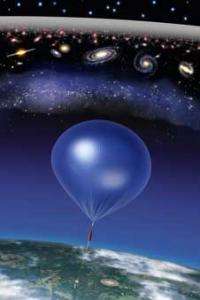
A mysterious screen of extra-loud radio noise permeates the cosmos, preventing astronomers from observing heat from the first stars. The balloon-borne ARCADE instrument discovered this cosmic static (white band, top) on its July 2006 flight. The noise is six times louder than expected. Astronomers have no idea why. Credit: NASA/ARCADE/Roen Kelly
(PhysOrg.com) -- Listening to the early universe just got harder. A team led by Alan Kogut of NASA's Goddard Space Flight Center in Greenbelt, Md., today announced the discovery of cosmic radio noise that booms six times louder than expected.
The finding comes from a balloon-borne instrument named ARCADE, which stands for the Absolute Radiometer for Cosmology, Astrophysics, and Diffuse Emission. In July 2006, the instrument launched from NASA's Columbia Scientific Balloon Facility in Palestine, Texas, and flew to an altitude of 120,000 feet, where the atmosphere thins into the vacuum of space.
ARCADE's mission was to search the sky for heat from the first generation of stars. Instead, it found a cosmic puzzle.
"The universe really threw us a curve," Kogut says. "Instead of the faint signal we hoped to find, here was this booming noise six times louder than anyone had predicted." Detailed analysis ruled out an origin from primordial stars or from known radio sources, including gas in the outermost halo of our own galaxy. The source of this cosmic radio background remains a mystery.
Many objects in the universe emit radio waves. In 1931, American physicist Karl Jansky first detected radio static from our own Milky Way galaxy. Similar emission from other galaxies creates a background hiss of radio noise.
The problem, notes team member Dale Fixsen of the University of Maryland at College Park, is that there don't appear to be enough radio galaxies to account for the signal ARCADE detected. "You'd have to pack them into the universe like sardines," he says. "There wouldn't be any space left between one galaxy and the next."
Enlarge
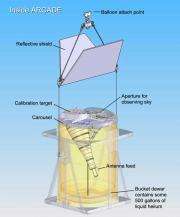
ARCADE's revolutionary design makes it super-sensitive to cosmic noise. Chilled to 2.7 degrees above absolute zero by immersion into more than 500 gallons of liquid helium, each of ARCADE's seven radiometers alternately views the sky and a calibration target. Credit: NASA/ARCADE
The sought-for signal from the earliest stars remains hidden behind the newly detected cosmic radio background. This noise complicates efforts to detect the very first stars, which are thought to have formed about 13 billion years ago -- not long, in cosmic terms, after the Big Bang. Nevertheless, this cosmic static may provide important clues to the development of galaxies when the universe was less than half its present age. Unlocking its origins should provide new insight into the development of radio sources in the early universe.
"This is what makes science so exciting," says Michael Seiffert, a team member at NASA's Jet Propulsion Laboratory in Pasadena, Calif. "You start out on a path to measure something -- in this case, the heat from the very first stars -- but run into something else entirely, something unexplained."
Seiffert and Kogut announced the findings today at the 213th meeting of the American Astronomical Society in Long Beach, Calif. Four papers describing ARCADE's results have been submitted to The Astrophysical Journal.
ARCADE is the first instrument to measure the radio sky with enough precision to detect this mysterious signal. To enhance the sensitivity of ARCADE's radio receivers, they were immersed in more than 500 gallons of ultra-cold liquid helium. The instrument's operating temperature was just 2.7 degrees above absolute zero.
This is the same temperature as the cosmic microwave background (CMB) radiation, the remnant heat of the Big Bang that was itself discovered as cosmic radio noise in 1965. "If ARCADE is the same temperature as the microwave background, then the instrument's heat cannot contaminate the cosmic signal," Kogut explains.
Goddard's Arcade Balloon Web site: http://arcade.gsfc.nasa.gov/
Provided by Goddard Space Flight Center


This will mean we can keep all our current theories and just keep adding dark stuff to make it all fit.
The cool thing is that science has to be honest with itself. Even if that means tearing down a majority of previous theories.
Science is about discoveries and showing possible ways it all fits together. This is how we begin to understand our universe.
Dude, black holes have actualy been observed. And the term 'dark' just means that it is hard to observe due to a lack of light emission and rarity of interaction. There really isn't anything exotic or mysterious out there, just things we don't know everything about.
Isn't it also possible that these other galaxies are not as far away as we have calculated? In that case they would each sound louder.
Well, we use light to calculate the relative distances of cosmic object. So if we decide that everything is a little closer based on this, then we would have to ask why everything appears dimmer than it should.
Dark matter could not have something to do with this?
Why would it? Dark matter is dark because it doesn't frequently interact with matter or give off light. It stands to reason that the same things could be applied to light, occasional interactions, but very rare indeed. The only way I can think that dark matter would effect the light would be through gravitational lensing, but that would just change the apparant position.
Sorry, but black holes have never been observed. the effects of a "blackhole" have, and using gravity as a model the "blackhole" must be there, but you are incorrect to say blackhole have been observed.
Blackholes are "exotic". until Einstein it was a principle of physics that singularities DO NOT EXIST IN NATURE. Here, we have a singularity, it doesn't exist except in mathematical equations, which don't relate to reality. Gravity cannot overcome electrostatic charge of an atom, its an impossibility.
So, in effect, black holes have been observed. WE know where they are, what they are doing, and can predict what they will do in the future.
Actualy, the singularity and the black hole were concepts derived from Einstein's equations. After that, then there was debate as to whether or not they actualy existed with no clear winner until the effects of black holes were observed throughout the universe. Infact, Stephan Hawking lost a bet on that to the theoretical physicist, Kip Thorne. The debate then was over whether or not 'naked' singularities could possibly exist in nature, a beet that Stephan Hawking again lost because of a mathematical technicality.
Says who? What wonderous principle in nature stops gravity from building up to a point where its force is greater than that of electromagnetism? There's nothing to top large amounts of mass from being in one area.
quite simple. electrostatic force is trillions of times stronger than gravity. no matter how much of a substance u pile into one area, electrostatic charges will always be stronger than gravity.
But if the matter were on the opposite side of the light source (behind it), then couldn't its gravity affect the amount of light being observed, or at least its wavelength (due to a slowing affect)?
there's nothing else that fits the observed data. Massive, unseen objects have very large gravitational effects and do lot's of fun things to surroundin matter. There's really not much wrong with the model, other than the ability to merge relativity with quantum mechanics, but that's irrelevent for the case in point.
On a particle to particle basis, yes, electromagnetism is far stronger. But, when you are dealing with large amounts of mass, the force of gravity continues to increase with the mass while the electromagnetic forces generally stay the same no matter what the scale. Go work out the equations. You'll find that there eventually comes a point where electrostatic forces can't stop gravity. Unless you can find actual proof that singularities can't exist, which i bet you can't because there isn't any, then there is no reason to belive black holes are fictional and every reason to continue studying them.
No, the gravitational lensing would move the light so that could see it and stretch out the wavelength a little. We would just see the star in a false position and slightly redshifted.
LOL, to use your logic, unless u can prove otherwise, then the moon IS hollow.