Scientists Discover An Ancient Odor-Detecting Mechanism in Insects
(PhysOrg.com) -- In 1913 Theodore Roosevelt added cartographer to his resume when he and his crew ventured up an unspeakably dangerous and uncharted tributary named the River of Doubt. Now, on a charting expedition of their own, Rockefeller University scientists have completed a journey that has also defied expectation. In work to be published in the January 9 issue of Cell, the team reports the discovery of a new family of receptors in the fly nose, a finding that not only fills in a missing piece in the organizational logic of the insect olfactory system but also unearths one of the most ancient mechanisms that organisms have evolved to smell.
The work, led by Leslie B. Vosshall, head of the Laboratory of Neurogenetics and Behavior, revamps traditional ideas regarding the roles of ionotropic glutamate receptors, proteins that reside deep in the brain at the synapses. There, they grab glutamate molecules and quickly relay messages from one nerve cell to the next, helping animals learn, move and remember. But Vosshall's group now shows that insects do not relegate these receptors to the depths of the brain. They also put them to use elsewhere: in the nose.
"On the surface it's a completely absurd idea," says Vosshall, who is also a Howard Hughes Medical Institute investigator. "We know what these proteins do; they sit at the synapse and mediate fast neuronal communication. So the idea that the fly has massively expanded the number of these receptors and positioned them to interact with small molecules in the air seems very strange. But if you think about it, it makes sense. The process is the same, but rather than grabbing small molecules at the synapse, they're grabbing small molecules from the air."
The project began two years ago, when Vosshall and Richard Benton, then a postdoc in her lab, noticed a group of six ionotropic glutamate receptor genes while sifting through the fly genome. Although this group was recognized 10 years ago, ever since the genome was sequenced, the genes did not have a known function, in part because it was assumed they must be similar to any other ionotropic glutamate receptor deep in the fly brain. But to Vosshall and Benton, who is now at the Center for Integrative Genomics in Lausanne, Switzerland, that didn't matter.
Vosshall and her team wondered whether these receptors could in fact represent the "missing" receptors thought to exist in the fly's "nose" — its two antennae. Each antenna is divided into three types of smell neurons. Scientists have characterized the receptors that detect odors in two of these types but those receptors were mysteriously absent in the third, a swath of territory known as the coeloconic sensilla. "It has been shown that cells in the coeloconic sensilla detect odors," Vosshall says. "It's just that we didn't know how they did it."
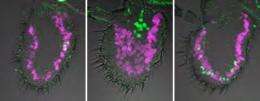
The team showed that these receptors, which the Vosshall lab named ionotropic receptors, do in fact explain how cells in coeloconic sensilla detect odors. First, they showed that they are expressed in complex combinatorial patterns at the sensory end of olfactory neurons where they have access to and can scan the outside world for odors. They then showed that when these receptors are expressed in the cells in the coeloconic sensilla, the cells respond to odors. Finally, the researchers showed that when they plucked a receptor — say one that detects an odor that resembles a mix of grass and honey — out of its native cell and genetically embedded it in a different cell, the new cell would now detect that odor.
Although it is still unclear why insects have developed two sets of chemosensory receptors — olfactory receptors and ionotropic receptors — the work raises questions regarding their evolutionary origin. Ten years ago, researchers at New York University revealed that plants, which detect soil nutrients and chemicals in the air, also express glutamate receptors, suggesting that the ancestral origin of glutamate receptors may have been to detect small molecules in the air, rather than small molecules in the brain.
"In a way, these receptors were very well hidden because everyone assumed that they were extra glutamate receptors that were unlikely to be of interest," explains Vosshall. "All we did to find them was searched for a gene family of unknown function — and left our preconceived notions aside."
Provided by Rockefeller University


